




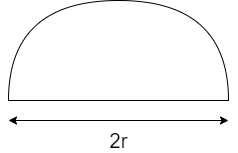
A magnetised wire of magnetic moment M and length l is bent in the form of a semicircle of radius r. The new magnetic moment is:
A) $M$
B) $\dfrac{{2M}}{\pi }$
C) $\dfrac{M}{\pi }$
D) None of the above
Answer
 Verified
257.1k+ views
Hint: Since a magnet has two poles- North pole and the South pole. So the magnetic moment of a magnet is defined as the tendency of a magnet to get attracted towards a magnetic field. It is a vector quantity. It is the maximum torque experienced by a magnet when placed in an external magnetic field.
Complete step by step solution:
Step I: Suppose a bar magnet of length ‘l’ and magnetic moment ‘M’. Suppose that the bar magnet has a pole strength ‘m’, such that the magnetic moment is
$M = m.l$---(i)
The pole strength of the bar magnet is
$m = \dfrac{M}{l}$---(ii)
Step II: Now given that the bar magnet is bent in the form of a semicircle. The circumference of the semi circle is the length of the bar magnet which is equal to $l$.
Therefore, $l = \pi r$---(iii)
Step III: Given the length between the two poles of the magnet when it is bent into a semi circle is $2r$. Now the magnetic moment of the bent magnet is
$M' = m.(2r)$---(iv)
Substitute the value of ‘m’ from equation (ii) in equation (iv),
$M' = \dfrac{M}{l}.2r$
$M' = \dfrac{{2Mr}}{l}$
Step IV: Substitute the value of ‘l’ from equation (iii),
$M' = \dfrac{{2Mr}}{{\pi r}}$
$M' = \dfrac{{2M}}{\pi }$
Step V: The new magnetic moment is $\dfrac{{2M}}{\pi }.$
Therefore option B is the right answer.
Note: It is to be noted that there is another term used for magnetic moment. Sometimes it is also called magnetic dipole moment. The direction of magnetic moment points from the South pole to the North pole of the magnet. Magnetic dipoles align themselves in the direction of the external magnetic field.
Complete step by step solution:
Step I: Suppose a bar magnet of length ‘l’ and magnetic moment ‘M’. Suppose that the bar magnet has a pole strength ‘m’, such that the magnetic moment is
$M = m.l$---(i)
The pole strength of the bar magnet is
$m = \dfrac{M}{l}$---(ii)
Step II: Now given that the bar magnet is bent in the form of a semicircle. The circumference of the semi circle is the length of the bar magnet which is equal to $l$.
Therefore, $l = \pi r$---(iii)
Step III: Given the length between the two poles of the magnet when it is bent into a semi circle is $2r$. Now the magnetic moment of the bent magnet is
$M' = m.(2r)$---(iv)
Substitute the value of ‘m’ from equation (ii) in equation (iv),
$M' = \dfrac{M}{l}.2r$
$M' = \dfrac{{2Mr}}{l}$
Step IV: Substitute the value of ‘l’ from equation (iii),
$M' = \dfrac{{2Mr}}{{\pi r}}$
$M' = \dfrac{{2M}}{\pi }$
Step V: The new magnetic moment is $\dfrac{{2M}}{\pi }.$
Therefore option B is the right answer.
Note: It is to be noted that there is another term used for magnetic moment. Sometimes it is also called magnetic dipole moment. The direction of magnetic moment points from the South pole to the North pole of the magnet. Magnetic dipoles align themselves in the direction of the external magnetic field.
Recently Updated Pages
JEE Main Mock Test 2025-26: Electromagnetic Induction & Alternating Currents

JEE Main Mock Test 2025-26: Optics Chapter Practice Online
JEE Main 2025-26 Mock Test: Properties of Solids and Liquids
JEE Main Mock Test 2025-26: Dual Nature of Matter & Radiation
JEE Main 2025-26 Electromagnetic Waves Mock Test with Solutions
JEE Main 2025-26 Mock Test: Electronic Devices Chapter Practice
Trending doubts
JEE Main 2026: Exam Dates, Session 2 Updates, City Slip, Admit Card & Latest News
JEE Main Participating Colleges 2026 - A Complete List of Top Colleges
JEE Main 2026 Application Login: Direct Link, Registration, Form Fill, and Steps
JEE Main Colleges 2026: Complete List of Participating Institutes
JEE Main Marking Scheme 2026- Paper-Wise Marks Distribution and Negative Marking Details
Hybridisation in Chemistry – Concept, Types & Applications
Other Pages
CBSE Class 12 Physics Question Paper 2026: Download SET-wise PDF with Answer Key & Analysis
JEE Advanced 2026 - Exam Date (Released), Syllabus, Registration, Eligibility, Preparation, and More
JEE Advanced Marks vs Ranks 2025: Understanding Category-wise Qualifying Marks and Previous Year Cut-offs
JEE Advanced Weightage 2025 Chapter-Wise for Physics, Maths and Chemistry
Understanding the Electric Field of a Uniformly Charged Ring
Derivation of Equation of Trajectory Explained for Students