




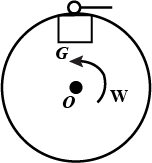
A horizontal turntable in the form of a disc of radius r carries a gun at G and rotates with angular velocity ${\omega _o}$ about a vertical axis passing through the centre O. The increase in angular velocity of the system if the gun fires a bullet of mass m with tangential velocity v with respect to the gun is: (moment of inertia of gun + table about O is ${I_o}$)
A) \[\dfrac{{mvr}}{{{I_o} + m{r^2}}}\]
B) \[\dfrac{{2mvr}}{{{I_o}}}\]
C) $\dfrac{v}{{2r}}$
D) $None$
Answer
 Verified
272.7k+ views
Hint: Here the net initial angular momentum will be the angular moment of the table ${I_o}{\omega _o}$ in addition to the angular momentum of the disc which is $m{r^2}{\omega _o}$. Similarly, we can write the net final angular momentum. Compare the two momentum by applying conservation of angular momentum (as net external force is zero).
Complete step by step solution:
Here on the system the net external force acting on the system is zero so we can apply conservation of momentum.
The initial moment would be:
${P_i} = \left( {{I_o} + m{r^2}} \right){\omega _o}\widehat k$;
Here:
${P_i}$= Initial Momentum;
${I_o}$= Moment of inertia.
m = Mass;
r = radius;
${\omega _o}$= Angular velocity.
Similarly, the final moment of inertia is given as:
${\overrightarrow P _f} = {I_o}\omega \widehat k + mv'r\left( { - \widehat k} \right)$
Now,
\[{v_{BP}} = {v_{BG}} - {v_{PG}}\] ;
\[ \Rightarrow v\left( {\widehat i} \right) = v'\left( {\widehat i} \right) - \left( { - \omega r} \right)\widehat i\] …(here: \[{v_{BP}} = v\left( {\widehat i} \right)\];\[{v_{BG}} = v'\left( {\widehat i} \right)\]; \[{v_{PG}} = \left( { - \omega r} \right)\widehat i\] )
Write the above equation in terms of v’:
\[ \Rightarrow v\left( {\widehat i} \right) - \left( {\omega r} \right)\widehat i = v'\left( {\widehat i} \right)\];
\[ \Rightarrow v' = v - \omega r\];
Put the above in the equation for final momentum:
\[{P_f} = {I_o}\omega \widehat k + mv'r\left( { - \widehat k} \right)\];
$ \Rightarrow {P_f} = {I_o}\omega \widehat k + m\left( {v - \omega r} \right)r\left( { - \widehat k} \right)$;
Now, apply conservation of angular momentum and equate final and initial momentum together.
$\left( {{I_o} + m{r^2}} \right){\omega _o}\widehat k = {I_o}\omega \widehat k + m\left( {v - \omega r} \right)r\left( { - \widehat k} \right)$;
Cancel out the common:
$ \Rightarrow \left( {{I_o} + m{r^2}} \right){\omega _o} = {I_o}\omega - m\left( {v - \omega r} \right)r$;
Write the above equation in terms of $\omega $,
\[ \Rightarrow \left( {{I_o} + m{r^2}} \right){\omega _o} = {I_o}\omega + m\omega {r^2} - mvr\];
Take the common out:
\[ \Rightarrow \left( {{I_o} + m{r^2}} \right){\omega _o} + mvr = \omega \left( {{I_o} + m{r^2}} \right)\];
\[ \Rightarrow \dfrac{{\left( {{I_o} + m{r^2}} \right){\omega _o} + mvr}}{{\left( {{I_o} + m{r^2}} \right)}} = \omega \];
Now, we calculate the change in angular velocity which is given as:
$\Delta \omega = \omega - {\omega _o}$;
Put in the given value in the above equation:
$\Delta \omega = \left( {\dfrac{{\left( {{I_o} + m{r^2}} \right){\omega _o} + mvr}}{{\left( {{I_o} + m{r^2}} \right)}}} \right) - {\omega _o}$;
Take LCM and solve:
$ \Rightarrow \Delta \omega = \left( {\dfrac{{\left( {{I_o} + m{r^2}} \right){\omega _o} + mvr - \left( {{I_o} + m{r^2}} \right){\omega _o}}}{{\left( {{I_o} + m{r^2}} \right)}}} \right)$;
$ \Rightarrow \Delta \omega = \left( {\dfrac{{mvr}}{{\left( {{I_o} + m{r^2}} \right)}}} \right)$;
Final Answer: Option “A” is correct. The increase in angular velocity of the system if the gun fires a bullet of mass m with tangential velocity v with respect to the gun is$\Delta \omega = \left( {\dfrac{{mvr}}{{\left( {{I_o} + m{r^2}} \right)}}} \right)$.
Note: Here, the change in the angular velocity would be the final angular velocity minus the initial angular velocity. In the final angular momentum, the velocity of bullet w.r.t to the disc would be equal to the velocity of bullet w.r.t ground minus the velocity of disc w.r.t ground.
Complete step by step solution:
Here on the system the net external force acting on the system is zero so we can apply conservation of momentum.
The initial moment would be:
${P_i} = \left( {{I_o} + m{r^2}} \right){\omega _o}\widehat k$;
Here:
${P_i}$= Initial Momentum;
${I_o}$= Moment of inertia.
m = Mass;
r = radius;
${\omega _o}$= Angular velocity.
Similarly, the final moment of inertia is given as:
${\overrightarrow P _f} = {I_o}\omega \widehat k + mv'r\left( { - \widehat k} \right)$
Now,
\[{v_{BP}} = {v_{BG}} - {v_{PG}}\] ;
\[ \Rightarrow v\left( {\widehat i} \right) = v'\left( {\widehat i} \right) - \left( { - \omega r} \right)\widehat i\] …(here: \[{v_{BP}} = v\left( {\widehat i} \right)\];\[{v_{BG}} = v'\left( {\widehat i} \right)\]; \[{v_{PG}} = \left( { - \omega r} \right)\widehat i\] )
Write the above equation in terms of v’:
\[ \Rightarrow v\left( {\widehat i} \right) - \left( {\omega r} \right)\widehat i = v'\left( {\widehat i} \right)\];
\[ \Rightarrow v' = v - \omega r\];
Put the above in the equation for final momentum:
\[{P_f} = {I_o}\omega \widehat k + mv'r\left( { - \widehat k} \right)\];
$ \Rightarrow {P_f} = {I_o}\omega \widehat k + m\left( {v - \omega r} \right)r\left( { - \widehat k} \right)$;
Now, apply conservation of angular momentum and equate final and initial momentum together.
$\left( {{I_o} + m{r^2}} \right){\omega _o}\widehat k = {I_o}\omega \widehat k + m\left( {v - \omega r} \right)r\left( { - \widehat k} \right)$;
Cancel out the common:
$ \Rightarrow \left( {{I_o} + m{r^2}} \right){\omega _o} = {I_o}\omega - m\left( {v - \omega r} \right)r$;
Write the above equation in terms of $\omega $,
\[ \Rightarrow \left( {{I_o} + m{r^2}} \right){\omega _o} = {I_o}\omega + m\omega {r^2} - mvr\];
Take the common out:
\[ \Rightarrow \left( {{I_o} + m{r^2}} \right){\omega _o} + mvr = \omega \left( {{I_o} + m{r^2}} \right)\];
\[ \Rightarrow \dfrac{{\left( {{I_o} + m{r^2}} \right){\omega _o} + mvr}}{{\left( {{I_o} + m{r^2}} \right)}} = \omega \];
Now, we calculate the change in angular velocity which is given as:
$\Delta \omega = \omega - {\omega _o}$;
Put in the given value in the above equation:
$\Delta \omega = \left( {\dfrac{{\left( {{I_o} + m{r^2}} \right){\omega _o} + mvr}}{{\left( {{I_o} + m{r^2}} \right)}}} \right) - {\omega _o}$;
Take LCM and solve:
$ \Rightarrow \Delta \omega = \left( {\dfrac{{\left( {{I_o} + m{r^2}} \right){\omega _o} + mvr - \left( {{I_o} + m{r^2}} \right){\omega _o}}}{{\left( {{I_o} + m{r^2}} \right)}}} \right)$;
$ \Rightarrow \Delta \omega = \left( {\dfrac{{mvr}}{{\left( {{I_o} + m{r^2}} \right)}}} \right)$;
Final Answer: Option “A” is correct. The increase in angular velocity of the system if the gun fires a bullet of mass m with tangential velocity v with respect to the gun is$\Delta \omega = \left( {\dfrac{{mvr}}{{\left( {{I_o} + m{r^2}} \right)}}} \right)$.
Note: Here, the change in the angular velocity would be the final angular velocity minus the initial angular velocity. In the final angular momentum, the velocity of bullet w.r.t to the disc would be equal to the velocity of bullet w.r.t ground minus the velocity of disc w.r.t ground.
Recently Updated Pages
WBJEE 2026 Result Live: Important Dates, Last Date Apply Online 2026

Circuit Switching vs Packet Switching: Key Differences Explained
Dimensions of Pressure in Physics: Formula, Derivation & SI Unit
JEE General Topics in Chemistry Important Concepts and Tips
JEE Extractive Metallurgy Important Concepts and Tips for Exam Preparation
JEE Atomic Structure and Chemical Bonding important Concepts and Tips
Trending doubts
JEE Main Participating Colleges 2026 - A Complete List of Top Colleges
Understanding Uniform Acceleration in Physics
Electron Gain Enthalpy and Electron Affinity Explained
Understanding Instantaneous Velocity
Degree of Dissociation: Meaning, Formula, Calculation & Uses
Understanding the Angle of Deviation in a Prism
Other Pages
A physical quantity which has a direction A Must be class 11 physics JEE_Main
Three elephants A B and C are moving along a straight class 11 physics JEE_Main
CBSE Notes Class 11 Physics Chapter 9 - Mechanical Properties of Fluids - 2026-27
NCERT Solutions For Class 11 Physics Chapter 8 Mechanical Properties Of Solids - 2025-26
CBSE Notes Class 11 Physics Chapter 11 - Thermodynamics - 2026-27
CBSE Notes Class 11 Physics Chapter 8 - Mechanical Properties Of Solids - 2026-27