




A group of $13$ elements if added in small amounts to $Ge$ , then the type of semiconductor formed is :
A . n-type semiconductor
B . p-type semiconductor
C . super semiconductor
D . both A and B
Answer
 Verified
266.7k+ views
Hint : We know that when a small amount of foreign impurity is added to a crystal then this process is called doping. Doping increases electrical conductivity of the crystal. We have learned about two types of semiconductor i.e. extrinsic semiconductors and intrinsic semiconductors. The pure semiconductor which does not go through the process of doping is called intrinsic semiconductor and an extrinsic semiconductor is one that has been doped.
Complete answer:
- We know about two types of doping agents which result in two types of semiconductor .
- When the donor is an electron donor atom then it is called n-type semiconductor while when the dopant is electron acceptor it is called p-type semiconductor. The majority charge carriers in p-type semiconductors and n-type semiconductors are holes and electrons respectively. Extrinsic semiconductors are used as the components of many semiconductor devices.
- Group $13$ elements in the periodic table are the boron family. The members of group $13$ are boron, aluminium, gallium ,indium, thallium. Elements of this group $13$ have three valence electrons. So these elements will give electrons when we add them in pure semiconductor. Germanium ($Ge$) has a similar nature like silicon and is used to make semiconductor devices. So a group of $13$ elements if added in small amounts to $Ge$ , then the type of semiconductor formed is p-type semiconductor. Hence option B is correct
.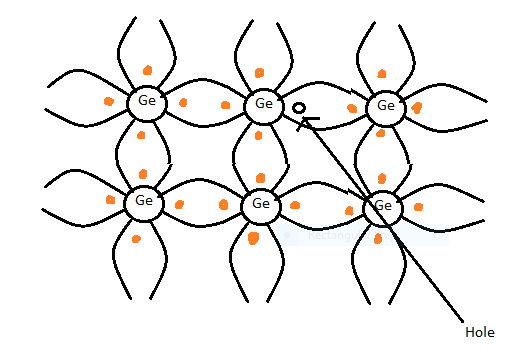
Note : Here we have approached this problem with the help of concept that when trivalent impurity atom is added to germanium it becomes p-type semiconductor so here option B is correct that is p-type semiconductor .In the above diagram we can see that there is bonding between germanium and trivalent impurity atoms.
Complete answer:
- We know about two types of doping agents which result in two types of semiconductor .
- When the donor is an electron donor atom then it is called n-type semiconductor while when the dopant is electron acceptor it is called p-type semiconductor. The majority charge carriers in p-type semiconductors and n-type semiconductors are holes and electrons respectively. Extrinsic semiconductors are used as the components of many semiconductor devices.
- Group $13$ elements in the periodic table are the boron family. The members of group $13$ are boron, aluminium, gallium ,indium, thallium. Elements of this group $13$ have three valence electrons. So these elements will give electrons when we add them in pure semiconductor. Germanium ($Ge$) has a similar nature like silicon and is used to make semiconductor devices. So a group of $13$ elements if added in small amounts to $Ge$ , then the type of semiconductor formed is p-type semiconductor. Hence option B is correct
.
Note : Here we have approached this problem with the help of concept that when trivalent impurity atom is added to germanium it becomes p-type semiconductor so here option B is correct that is p-type semiconductor .In the above diagram we can see that there is bonding between germanium and trivalent impurity atoms.
Recently Updated Pages
States of Matter Chapter For JEE Main Chemistry

Classification of Drugs in Chemistry: Types, Examples & Exam Guide
Difference Between Alcohol and Phenol: Structure, Tests & Uses
JEE Main Participating Colleges 2026 - A Complete List of Top Colleges
[Awaiting the three content sources: Ask AI Response, Competitor 1 Content, and Competitor 2 Content. Please provide those to continue with the analysis and optimization.]
Sign up for JEE Main 2026 Live Classes - Vedantu
Trending doubts
Hybridisation in Chemistry – Concept, Types & Applications
Understanding Atomic Structure for Beginners
Ideal and Non-Ideal Solutions Explained for Class 12 Chemistry
Understanding the Different Types of Solutions in Chemistry
Electron Gain Enthalpy and Electron Affinity Explained
Degree of Dissociation: Meaning, Formula, Calculation & Uses
Other Pages
JEE Main Marking Scheme 2026- Paper-Wise Marks Distribution and Negative Marking Details
Understanding Displacement and Velocity Time Graphs
Understanding the Angle of Deviation in a Prism
Test for Phenolic Group
CBSE Notes Class 12 Chemistry Chapter 10 - Biomolecules - 2025-26
CBSE Notes Class 12 Chemistry Chapter 7 - Alcohol Phenol and Ether - 2025-26