




(a)- Discuss cis-trans isomerization with suitable example (organic compounds).
(b)- Account for the reducing nature of formic acid
Answer
 Verified
232.8k+ views
Hint:To answer this question we should know about isomerization. Isomerization is the phenomena when two compounds differ in properties but can be represented by the same formula.
The formic acid is the first member of the homologous series of the carboxylic acids.
Complete step by step solution:Let’s discuss the answer of the first part:
Cis-trans isomerization is a type of geometric isomerization. It is that type of stereoisomerism in which the molecular formula remains same but the relative arrangement of the atoms differ. It is found in properly substituted double bonded compounds.
In the case of alkenes of the type abC=Cab, where a and b are substituents, the cis-trans isomerization is present.
If the identical substituents are on the same side then it is called as cis isomer of the compound. If the identical substituents are present on the opposite side then it is called a trans isomer of the compound.
Let’s take example of but-2-ene
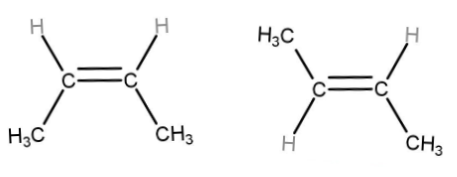
The first image is of cis-but-2-ene and the next image is of trans-but-2-ene.
Now, we will answer the part (b)
Formic acid is the only carboxylic acid which is a reducing agent. Formic acid is reducing in nature because of the aldehyde group attached to it. It is an atypical carboxylic acid and does not form anhydride. On heating in the presence of magnesium dioxide it further gets oxidized to carbon dioxide. This proves the reducing nature of formic acid.
Note: The cis and trans isomers are formed due to restricted rotation around a double bond. They differ in chemical and physical properties.
Formic acid is found in the ant sting and bee sting. The IUPAC name of formic acid is methanoic acid.
The formic acid is the first member of the homologous series of the carboxylic acids.
Complete step by step solution:Let’s discuss the answer of the first part:
Cis-trans isomerization is a type of geometric isomerization. It is that type of stereoisomerism in which the molecular formula remains same but the relative arrangement of the atoms differ. It is found in properly substituted double bonded compounds.
In the case of alkenes of the type abC=Cab, where a and b are substituents, the cis-trans isomerization is present.
If the identical substituents are on the same side then it is called as cis isomer of the compound. If the identical substituents are present on the opposite side then it is called a trans isomer of the compound.
Let’s take example of but-2-ene
The first image is of cis-but-2-ene and the next image is of trans-but-2-ene.
Now, we will answer the part (b)
Formic acid is the only carboxylic acid which is a reducing agent. Formic acid is reducing in nature because of the aldehyde group attached to it. It is an atypical carboxylic acid and does not form anhydride. On heating in the presence of magnesium dioxide it further gets oxidized to carbon dioxide. This proves the reducing nature of formic acid.
Note: The cis and trans isomers are formed due to restricted rotation around a double bond. They differ in chemical and physical properties.
Formic acid is found in the ant sting and bee sting. The IUPAC name of formic acid is methanoic acid.
Recently Updated Pages
JEE Main 2023 April 6 Shift 1 Question Paper with Answer Key

JEE Main 2023 April 6 Shift 2 Question Paper with Answer Key
JEE Main 2023 (January 31 Evening Shift) Question Paper with Solutions [PDF]
JEE Main 2023 January 30 Shift 2 Question Paper with Answer Key
JEE Main 2023 January 25 Shift 1 Question Paper with Answer Key
JEE Main 2023 January 24 Shift 2 Question Paper with Answer Key
Trending doubts
JEE Main 2026: Session 2 Registration Open, City Intimation Slip, Exam Dates, Syllabus & Eligibility
JEE Main 2026 Application Login: Direct Link, Registration, Form Fill, and Steps
Understanding the Angle of Deviation in a Prism
Hybridisation in Chemistry – Concept, Types & Applications
How to Convert a Galvanometer into an Ammeter or Voltmeter
Understanding the Electric Field of a Uniformly Charged Ring
Other Pages
JEE Advanced Marks vs Ranks 2025: Understanding Category-wise Qualifying Marks and Previous Year Cut-offs
Hydrocarbons Class 11 Chemistry Chapter 9 CBSE Notes - 2025-26
Thermodynamics Class 11 Chemistry Chapter 5 CBSE Notes - 2025-26
Equilibrium Class 11 Chemistry Chapter 6 CBSE Notes - 2025-26
Organic Chemistry Some Basic Principles And Techniques Class 11 Chemistry Chapter 8 CBSE Notes - 2025-26
NCERT Solutions For Class 11 Chemistry Chapter 7 Redox Reactions (2025-26)