




A cube of side $10cm$ is floating in water kept in a cylindrical beaker of base area $1500c{m^2}$. When a mass m is kept on a wooden block the level of water rises in the beaker by $2mm$. Find them mass m.
$\left( A \right)200g$
$\left( B \right)300g$
$\left( C \right)400g$
$\left( D \right)500g$
Answer
 Verified
284.1k+ views
Hint: Here to solve the above question we have to make use of Archimedes principle. The weight immersed in a fluid by a body is equal to the weight of the fluid displaced due to the body. Using the above statements find the displacement. Then by substituting the displacement determine the mass $m$ that is placed in the wooden block.
Formula used:
$mg = \delta Vg$
$\delta $ is the density, $V$ is the volume, $g$ is the acceleration of gravity.
Complete step by step answer:
When a body is immersed in a liquid, this fluid will exert a force due its weight on the body and it will experience an upward force due to the fluid. A balance will be reached when the body displaces fluid weight equal to its weight. This upward force is called the buoyancy force. If they have different density then the body may sink or float. The weight immersed in a fluid by a body is equal to the weight of the fluid displaced due to the body.
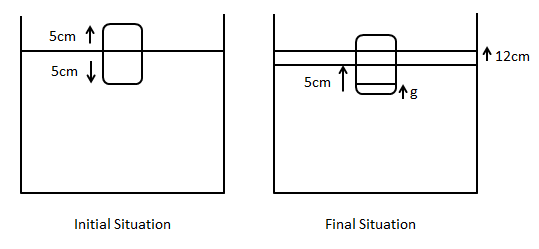
Area of the cube $A = 10 \times 10 = 100c{m^2}$
Water rises by $\dfrac{2}{{10}}cm\left( {2mm} \right)$
The weight immersed in a fluid by a body is equal to the weight of the fluid displaced due to the body.
$100y = \left( {1500 - 100} \right) \times \dfrac{2}{{10}}$
$\Rightarrow y = 2.8cm$
Then the mass kept on the wooden block
$mg = \delta Vg$
$\Rightarrow mg = {\delta _{water}} \times \left( {2.8 + 0.2} \right)100g$
$\Rightarrow mg = 1 \times \left( {2.8 + 0.2} \right)100g$
$\Rightarrow m = 300g$
Then option $\left( B \right)$ is the right option.
Note: The weight immersed in a fluid by a body is equal to the weight of the fluid displaced due to the body. A balance will be reached when the body displaces fluid weight equal to its weight. This upward force is called the buoyancy force. Buoyancy is not dependent on mass, density and size of the body.
Formula used:
$mg = \delta Vg$
$\delta $ is the density, $V$ is the volume, $g$ is the acceleration of gravity.
Complete step by step answer:
When a body is immersed in a liquid, this fluid will exert a force due its weight on the body and it will experience an upward force due to the fluid. A balance will be reached when the body displaces fluid weight equal to its weight. This upward force is called the buoyancy force. If they have different density then the body may sink or float. The weight immersed in a fluid by a body is equal to the weight of the fluid displaced due to the body.
Area of the cube $A = 10 \times 10 = 100c{m^2}$
Water rises by $\dfrac{2}{{10}}cm\left( {2mm} \right)$
The weight immersed in a fluid by a body is equal to the weight of the fluid displaced due to the body.
$100y = \left( {1500 - 100} \right) \times \dfrac{2}{{10}}$
$\Rightarrow y = 2.8cm$
Then the mass kept on the wooden block
$mg = \delta Vg$
$\Rightarrow mg = {\delta _{water}} \times \left( {2.8 + 0.2} \right)100g$
$\Rightarrow mg = 1 \times \left( {2.8 + 0.2} \right)100g$
$\Rightarrow m = 300g$
Then option $\left( B \right)$ is the right option.
Note: The weight immersed in a fluid by a body is equal to the weight of the fluid displaced due to the body. A balance will be reached when the body displaces fluid weight equal to its weight. This upward force is called the buoyancy force. Buoyancy is not dependent on mass, density and size of the body.
Recently Updated Pages
How to Calculate Moment of Inertia: Step-by-Step Guide & Formulas

Dimensions of Charge: Dimensional Formula, Derivation, SI Units & Examples
Mass vs Weight: Key Differences Explained for Students
Uniform Acceleration Explained: Formula, Examples & Graphs
JEE Main 2025-26 Mock Test: Binomial Theorem & Quick Practice
Properties of Solids and Liquids Mock Test 2025
Trending doubts
JEE Main 2026: Exam Dates, Session 2 Updates, City Slip, Admit Card & Latest News
Understanding the Electric Field of a Uniformly Charged Ring
Understanding Atomic Structure for Beginners
Derivation of Equation of Trajectory Explained for Students
Electron Gain Enthalpy and Electron Affinity Explained
How to Convert a Galvanometer into an Ammeter or Voltmeter
Other Pages
JEE Advanced Percentile vs Marks 2026: JEE Main Cutoff, AIR & IIT Admission Guide
CBSE Notes Class 11 Physics Chapter 1 - Units And Measurements - 2026-27
NCERT Solutions For Class 11 Physics Chapter 1 Units And Measurements - 2026-27 Free PDF Download (Login Required)
NCERT Solutions For Class 11 Physics Chapter 2 Motion In A Straight Line - 2026-27 Free PDF Download (Login Required)
Important Questions For Class 11 Physics Chapter 1 Units and Measurement - 2026-27
CBSE Notes Class 11 Physics Chapter 2 - Motion in a Straight Line - 2026-27