




A convex lens and convex mirror are placed co axially and separated by distance d. The focal length of both is \[20\,\,cm\] each. A point object is placed at a distance \[30\,\,cm\] from the lens as shown. Then the value of d so that image on the object itself is
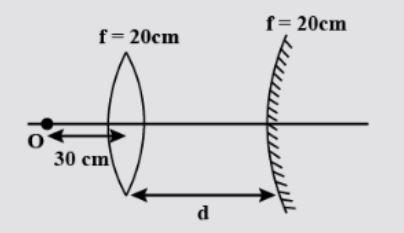
A) $10\,\,cm$
B) \[60\,\,cm\]
C) \[30\,\,cm\]
D) \[20\,\,cm\]
Answer
 Verified
257.4k+ views
Hint:- The above problem can be solved using the formula derived from the object image and focal distance relationship formulas of the convex lens and the convex mirror of the same focal length. The formula for the focal length of the lens and the mirror is used.
Useful formula:
The distance of the value $d$;
\[\dfrac{1}{d} = \dfrac{1}{f}\]
Where, the $d$ is the distance between the convex lens and convex mirror, $f$ is the focal length of the convex mirror.
Complete step by step solution:
The data given in the problem is;
Focal length of the convex lens is, ${f_1} = 20\,\,cm$.
Focal length of the convex mirror is, ${f_2} = 20\,\,cm$
Distance of the image placed from the image is, ${u_1} = 30\,\,cm$
At convex lens;
$\dfrac{1}{{{f_1}}} = \dfrac{1}{{{v_1}}} + \dfrac{1}{{{u_1}}}$
Substituting the value of focal length and the object distance from the lens
$
\dfrac{1}{{20}} = \dfrac{1}{{{d_i}}} + \dfrac{1}{{30}} \\
\dfrac{1}{{20}} - \dfrac{1}{{30}} = \dfrac{1}{{{d_i}}} \\
$
Where, ${d_i}$ denotes the distance of the image at convex lens.
\[\dfrac{1}{{{d_i}}} = \dfrac{1}{{60}}\]
At convex mirror:
$\dfrac{1}{{{f_2}}} = \dfrac{1}{{{d_i}}} + \dfrac{1}{{{u_o}}}$
Substitutes the values of the focal length and the image distance;
$
\dfrac{1}{{20}} = \dfrac{1}{{60}} + \dfrac{1}{{{d_o}}} \\
\dfrac{1}{{20}} - \dfrac{1}{{60}} = \dfrac{1}{{{d_o}}} \\
$
Where, ${d_o}$ denotes the distance of the object at convex mirror.
\[\dfrac{1}{{{d_o}}} = \dfrac{1}{{30}}\]
The distance of the value $d$;
\[\dfrac{1}{d} = \dfrac{1}{f}\]
That is
\[
\dfrac{1}{d} = \dfrac{1}{f} = \dfrac{1}{{{d_i}}} + \dfrac{1}{{{d_o}}} \\
\dfrac{1}{d} = \dfrac{1}{{60}} + \dfrac{1}{{30}} \\
\dfrac{1}{d} = \dfrac{{90}}{{1800}} \\
d = 20\,\,cm \\
\]
Therefore, the value of the $d$ is 20 cm.
Hence the option (D), \[d = 20\,\,cm\] is the correct answer.
Note: Image distance denotes that when the image is created then the distance between pole and image is known image distance. Focal length is the interval between pole and the principal focus of the mirror.
Useful formula:
The distance of the value $d$;
\[\dfrac{1}{d} = \dfrac{1}{f}\]
Where, the $d$ is the distance between the convex lens and convex mirror, $f$ is the focal length of the convex mirror.
Complete step by step solution:
The data given in the problem is;
Focal length of the convex lens is, ${f_1} = 20\,\,cm$.
Focal length of the convex mirror is, ${f_2} = 20\,\,cm$
Distance of the image placed from the image is, ${u_1} = 30\,\,cm$
At convex lens;
$\dfrac{1}{{{f_1}}} = \dfrac{1}{{{v_1}}} + \dfrac{1}{{{u_1}}}$
Substituting the value of focal length and the object distance from the lens
$
\dfrac{1}{{20}} = \dfrac{1}{{{d_i}}} + \dfrac{1}{{30}} \\
\dfrac{1}{{20}} - \dfrac{1}{{30}} = \dfrac{1}{{{d_i}}} \\
$
Where, ${d_i}$ denotes the distance of the image at convex lens.
\[\dfrac{1}{{{d_i}}} = \dfrac{1}{{60}}\]
At convex mirror:
$\dfrac{1}{{{f_2}}} = \dfrac{1}{{{d_i}}} + \dfrac{1}{{{u_o}}}$
Substitutes the values of the focal length and the image distance;
$
\dfrac{1}{{20}} = \dfrac{1}{{60}} + \dfrac{1}{{{d_o}}} \\
\dfrac{1}{{20}} - \dfrac{1}{{60}} = \dfrac{1}{{{d_o}}} \\
$
Where, ${d_o}$ denotes the distance of the object at convex mirror.
\[\dfrac{1}{{{d_o}}} = \dfrac{1}{{30}}\]
The distance of the value $d$;
\[\dfrac{1}{d} = \dfrac{1}{f}\]
That is
\[
\dfrac{1}{d} = \dfrac{1}{f} = \dfrac{1}{{{d_i}}} + \dfrac{1}{{{d_o}}} \\
\dfrac{1}{d} = \dfrac{1}{{60}} + \dfrac{1}{{30}} \\
\dfrac{1}{d} = \dfrac{{90}}{{1800}} \\
d = 20\,\,cm \\
\]
Therefore, the value of the $d$ is 20 cm.
Hence the option (D), \[d = 20\,\,cm\] is the correct answer.
Note: Image distance denotes that when the image is created then the distance between pole and image is known image distance. Focal length is the interval between pole and the principal focus of the mirror.
Recently Updated Pages
JEE Main Mock Test 2025-26: Electromagnetic Induction & Alternating Currents

JEE Main Mock Test 2025-26: Optics Chapter Practice Online
JEE Main 2025-26 Mock Test: Properties of Solids and Liquids
JEE Main Mock Test 2025-26: Dual Nature of Matter & Radiation
JEE Main 2025-26 Electromagnetic Waves Mock Test with Solutions
JEE Main 2025-26 Mock Test: Electronic Devices Chapter Practice
Trending doubts
JEE Main 2026: Exam Dates, Session 2 Updates, City Slip, Admit Card & Latest News
JEE Main Participating Colleges 2026 - A Complete List of Top Colleges
JEE Main 2026 Application Login: Direct Link, Registration, Form Fill, and Steps
JEE Main Colleges 2026: Complete List of Participating Institutes
JEE Main Marking Scheme 2026- Paper-Wise Marks Distribution and Negative Marking Details
Hybridisation in Chemistry – Concept, Types & Applications
Other Pages
CBSE Class 12 Physics Question Paper 2026: Download SET-wise PDF with Answer Key & Analysis
JEE Advanced 2026 - Exam Date (Released), Syllabus, Registration, Eligibility, Preparation, and More
JEE Advanced Marks vs Ranks 2025: Understanding Category-wise Qualifying Marks and Previous Year Cut-offs
JEE Advanced Weightage 2025 Chapter-Wise for Physics, Maths and Chemistry
Understanding the Electric Field of a Uniformly Charged Ring
Derivation of Equation of Trajectory Explained for Students