




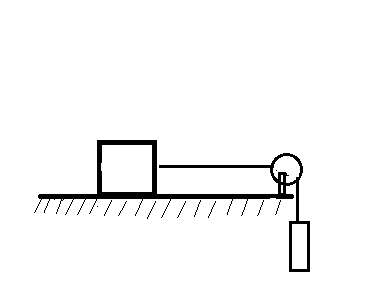
A constant force $F ={m_1}g/2$ is applied on the block of mass ${m_2}$ as shown in the figure. The string and pulley are light and the surface of the table is smooth. Find the acceleration of ${m_2}$.
Answer
 Verified
233.1k+ views
Hint: Newton’s second law will be applied in this problem.
F = ma, force is equal to mass and acceleration; net force applied on an object because there are other forces also acting on an object such as frictional force, tension and gravitational force.
If net force is greater than other acting forces on the body acceleration in the body will take place.
Using the above mentioned concept we will calculate the acceleration of mass ${m_2}$.
Complete step by step solution:
Newton’s Second Law: It states that force is equal to the change in momentum and change in time.
$F = \dfrac{{dP}}{{dt}}$ (P is the momentum of the body)
Where P = m v (m is the mass of the body and v is the velocity of the body)
When change in velocity takes place acceleration is developed, therefore our equation becomes:
$F = \dfrac{{mdv}}{{dt}}$
$F = ma$
Let’s conclude the calculation part of the question now.
Force given to us, F = ${m_1}$g/2
Our equation becomes;
$ \Rightarrow T - F = {m_2}a$ (T is the tension of the string; F is the force we have applied)
$
\Rightarrow {m_2}a = T - F \\
\Rightarrow {m_2}a = T - \dfrac{{{m_1}g}}{2} \\
$ (We have substituted the given value)....................(1)
Forces acting on mass ${m_1}$ are;
${m_1}a = {m_{1g}} - T$ ...........................(2)
On adding equation (1) and (2)
$
\Rightarrow {m_1}a + {m_2}a = T - \dfrac{{{m_1}g}}{2} + {m_1}g - T \\
\Rightarrow a({m_1} + {m_2}) = - \dfrac{{{m_1}g}}{2} + {m_1}g \\
$
(Cancelling the T on RHS and taking a common from LHS)
$\Rightarrow a({m_1} + {m_2}) = \dfrac{{ - {m_1}g + 2{m_1}g}}{2} \\
\Rightarrow a = \dfrac{{{m_1}g}}{{2\left( {{m_1} + {m_2}} \right)}} \\
$ (Acceleration of mass ${m_2}$)
Note: We have a number of daily life examples where we are observing Newton’s second law of motion such as, hitting the golf ball, cricket ball, football with a force the more we exert force the more we will observe the reaction. As in our question above force having higher magnitude was existing in the system.
F = ma, force is equal to mass and acceleration; net force applied on an object because there are other forces also acting on an object such as frictional force, tension and gravitational force.
If net force is greater than other acting forces on the body acceleration in the body will take place.
Using the above mentioned concept we will calculate the acceleration of mass ${m_2}$.
Complete step by step solution:
Newton’s Second Law: It states that force is equal to the change in momentum and change in time.
$F = \dfrac{{dP}}{{dt}}$ (P is the momentum of the body)
Where P = m v (m is the mass of the body and v is the velocity of the body)
When change in velocity takes place acceleration is developed, therefore our equation becomes:
$F = \dfrac{{mdv}}{{dt}}$
$F = ma$
Let’s conclude the calculation part of the question now.
Force given to us, F = ${m_1}$g/2
Our equation becomes;
$ \Rightarrow T - F = {m_2}a$ (T is the tension of the string; F is the force we have applied)
$
\Rightarrow {m_2}a = T - F \\
\Rightarrow {m_2}a = T - \dfrac{{{m_1}g}}{2} \\
$ (We have substituted the given value)....................(1)
Forces acting on mass ${m_1}$ are;
${m_1}a = {m_{1g}} - T$ ...........................(2)
On adding equation (1) and (2)
$
\Rightarrow {m_1}a + {m_2}a = T - \dfrac{{{m_1}g}}{2} + {m_1}g - T \\
\Rightarrow a({m_1} + {m_2}) = - \dfrac{{{m_1}g}}{2} + {m_1}g \\
$
(Cancelling the T on RHS and taking a common from LHS)
$\Rightarrow a({m_1} + {m_2}) = \dfrac{{ - {m_1}g + 2{m_1}g}}{2} \\
\Rightarrow a = \dfrac{{{m_1}g}}{{2\left( {{m_1} + {m_2}} \right)}} \\
$ (Acceleration of mass ${m_2}$)
Note: We have a number of daily life examples where we are observing Newton’s second law of motion such as, hitting the golf ball, cricket ball, football with a force the more we exert force the more we will observe the reaction. As in our question above force having higher magnitude was existing in the system.
Recently Updated Pages
JEE Main 2023 April 6 Shift 1 Question Paper with Answer Key

JEE Main 2023 April 6 Shift 2 Question Paper with Answer Key
JEE Main 2023 (January 31 Evening Shift) Question Paper with Solutions [PDF]
JEE Main 2023 January 30 Shift 2 Question Paper with Answer Key
JEE Main 2023 January 25 Shift 1 Question Paper with Answer Key
JEE Main 2023 January 24 Shift 2 Question Paper with Answer Key
Trending doubts
JEE Main 2026: Session 2 Registration Open, City Intimation Slip, Exam Dates, Syllabus & Eligibility
JEE Main 2026 Application Login: Direct Link, Registration, Form Fill, and Steps
JEE Main Marking Scheme 2026- Paper-Wise Marks Distribution and Negative Marking Details
Understanding the Angle of Deviation in a Prism
Hybridisation in Chemistry – Concept, Types & Applications
How to Convert a Galvanometer into an Ammeter or Voltmeter
Other Pages
JEE Advanced Marks vs Ranks 2025: Understanding Category-wise Qualifying Marks and Previous Year Cut-offs
Laws of Motion Class 11 Physics Chapter 4 CBSE Notes - 2025-26
Waves Class 11 Physics Chapter 14 CBSE Notes - 2025-26
Mechanical Properties of Fluids Class 11 Physics Chapter 9 CBSE Notes - 2025-26
Thermodynamics Class 11 Physics Chapter 11 CBSE Notes - 2025-26
Units And Measurements Class 11 Physics Chapter 1 CBSE Notes - 2025-26