




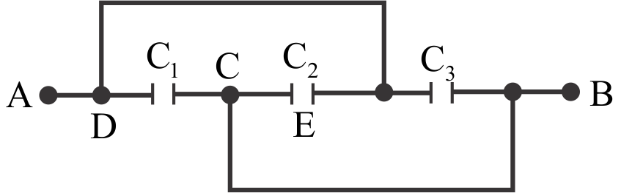
A combination of parallel plate capacitors is maintained at a certain potential difference. When a $3mm$ thick slab is introduced between all the plates, in order to maintain the same potential difference, the distance between the plates is increased by $2.4mm$. Find the dielectric constant of the slab.
A. $4$
B. $5$
C. $3$
D. $6$
Answer
 Verified
269.1k+ views
Hint Find the equivalent capacitance both with and without the slab between the plates and equate them. Use suitable formula to establish the expression for capacitance.
Formulas used:
$C = \dfrac{{{\varepsilon _0}A}}{d}$ where $d$ is the distance between the capacitance plates, $A$ is the area of the plates and ${\varepsilon _0}$ is the permittivity of free space.
$C' = \dfrac{{{\varepsilon _0}A}}{{d' - t\left( {1 - \dfrac{1}{K}} \right)}}$ where $K$ is the relative permittivity of the material of the slab and $d'$is the distance between the capacitor plates, $t$ is the thickness of the slab introduced.
Complete step by step answer
A capacitor is a system of conductors and dielectric that can store electric charge. It consists of two conductors containing equal and opposite charges and has a potential difference $V$ between them.
The potential difference between the conductors is proportional to the charge on the capacitor and is given by the relation $Q = CV$where $Q$ is the charge on the positive conductor and $C$ is called the capacitance.
Now, we know that the potential difference between the two plates is given by, $V = E \times d$ where $d$ is the distance between the two plates.
Thus, substituting the value of $V$ in the equation$Q = CV$, we get,
$Q = CEd$
Putting $E = \dfrac{\sigma }{{{\varepsilon _0}}}$ and $\sigma = \dfrac{Q}{A}$ where $A$ is the area of the capacitor plate, we get
$Q = C \times \dfrac{Q}{{A{\varepsilon _0}}} \times d$
$ \Rightarrow C = \dfrac{{A{\varepsilon _0}}}{d}$ where $C$ be the equivalent capacitance between terminals A and B.
Now, introducing a slab of thickness $t$, the resultant capacitance $C'$ becomes
$C' = \dfrac{{{\varepsilon _0}A}}{{d' - t\left( {1 - \dfrac{1}{K}} \right)}}$ where $K$ is the relative permittivity of the material of the slab and $d'$is the new distance between the capacitor plates.
Now, since the potential difference remains same, the capacitance must also not vary
So, $C = C'$
$ \Rightarrow \dfrac{{A{\varepsilon _0}}}{d} = \dfrac{{A{\varepsilon _0}}}{{d' - t\left( {1 - \dfrac{1}{K}} \right)}}$
$
\Rightarrow d = d' - t\left( {1 - \dfrac{1}{K}} \right) \\
\Rightarrow d = d + 2.4 - 3\left( {1 - \dfrac{1}{K}} \right) \\
\Rightarrow 2.4 - 3 + \dfrac{3}{K} = 0 \\
\Rightarrow \dfrac{3}{K} = 0.6 \\
\Rightarrow K = 5 \\
$
Therefore, the correct option is B.
Note:To establish the capacitance of an isolated single conductor, we assume the conductor to be a part of a capacitor whose other conductor is at infinity.
Formulas used:
$C = \dfrac{{{\varepsilon _0}A}}{d}$ where $d$ is the distance between the capacitance plates, $A$ is the area of the plates and ${\varepsilon _0}$ is the permittivity of free space.
$C' = \dfrac{{{\varepsilon _0}A}}{{d' - t\left( {1 - \dfrac{1}{K}} \right)}}$ where $K$ is the relative permittivity of the material of the slab and $d'$is the distance between the capacitor plates, $t$ is the thickness of the slab introduced.
Complete step by step answer
A capacitor is a system of conductors and dielectric that can store electric charge. It consists of two conductors containing equal and opposite charges and has a potential difference $V$ between them.
The potential difference between the conductors is proportional to the charge on the capacitor and is given by the relation $Q = CV$where $Q$ is the charge on the positive conductor and $C$ is called the capacitance.
Now, we know that the potential difference between the two plates is given by, $V = E \times d$ where $d$ is the distance between the two plates.
Thus, substituting the value of $V$ in the equation$Q = CV$, we get,
$Q = CEd$
Putting $E = \dfrac{\sigma }{{{\varepsilon _0}}}$ and $\sigma = \dfrac{Q}{A}$ where $A$ is the area of the capacitor plate, we get
$Q = C \times \dfrac{Q}{{A{\varepsilon _0}}} \times d$
$ \Rightarrow C = \dfrac{{A{\varepsilon _0}}}{d}$ where $C$ be the equivalent capacitance between terminals A and B.
Now, introducing a slab of thickness $t$, the resultant capacitance $C'$ becomes
$C' = \dfrac{{{\varepsilon _0}A}}{{d' - t\left( {1 - \dfrac{1}{K}} \right)}}$ where $K$ is the relative permittivity of the material of the slab and $d'$is the new distance between the capacitor plates.
Now, since the potential difference remains same, the capacitance must also not vary
So, $C = C'$
$ \Rightarrow \dfrac{{A{\varepsilon _0}}}{d} = \dfrac{{A{\varepsilon _0}}}{{d' - t\left( {1 - \dfrac{1}{K}} \right)}}$
$
\Rightarrow d = d' - t\left( {1 - \dfrac{1}{K}} \right) \\
\Rightarrow d = d + 2.4 - 3\left( {1 - \dfrac{1}{K}} \right) \\
\Rightarrow 2.4 - 3 + \dfrac{3}{K} = 0 \\
\Rightarrow \dfrac{3}{K} = 0.6 \\
\Rightarrow K = 5 \\
$
Therefore, the correct option is B.
Note:To establish the capacitance of an isolated single conductor, we assume the conductor to be a part of a capacitor whose other conductor is at infinity.
Recently Updated Pages
Circuit Switching vs Packet Switching: Key Differences Explained

JEE General Topics in Chemistry Important Concepts and Tips
JEE Extractive Metallurgy Important Concepts and Tips for Exam Preparation
JEE Atomic Structure and Chemical Bonding important Concepts and Tips
JEE Amino Acids and Peptides Important Concepts and Tips for Exam Preparation
Electricity and Magnetism Explained: Key Concepts & Applications
Trending doubts
JEE Main 2026: Exam Dates, Session 2 Updates, City Slip, Admit Card & Latest News
JEE Main Participating Colleges 2026 - A Complete List of Top Colleges
Kinematics Mock Test for JEE Main 2025-26: Comprehensive Practice
Understanding the Electric Field of a Uniformly Charged Ring
Derivation of Equation of Trajectory Explained for Students
Understanding Atomic Structure for Beginners
Other Pages
CBSE Class 12 Physics Question Paper 2026: Download SET-wise PDF with Answer Key & Analysis
JEE Advanced 2026 Notification Out with Exam Date, Registration (Extended), Syllabus and More
JEE Advanced Percentile vs Marks 2026: JEE Main Cutoff, AIR & IIT Admission Guide
JEE Advanced 2026 Marks vs Rank: Estimate IIT Rank from Your Score
JEE Advanced Weightage Chapter Wise 2026 for Physics, Chemistry, and Mathematics
JEE Main Marking Scheme 2026- Paper-Wise Marks Distribution and Negative Marking Details