




A cavity of radius $\dfrac{R}{2}$ is made inside a solid sphere of radius $R$. Find the gravitational force on a particle of mass $m$ at a distance $\dfrac{R}{2}$ from the center of sphere on the line joining both the centers of sphere and cavity (opposite to the center of cavity) if cavity is located at a distance $\dfrac{R}{2}$ from the center of sphere. Here, $g = \dfrac{{GM}}{{{R^2}}}$ , where $M$ is the mass of the sphere.
A) $\dfrac{{mg}}{2}$
B) $\dfrac{{3mg}}{8}$
C) $\dfrac{{mg}}{{16}}$
D) None of these
Answer
 Verified
272.4k+ views
Hint: Find the gravitational field at mass $m$ due to full solid sphere and gravitational field at mass $m$ due to cavity. Then, by using the superposition principle for gravitational fields, find the net gravitational field.
Formula used:
Use the formula for gravitational field at the mass due to cavity $p$ –
$E = \dfrac{{p{a^3}}}{{3{\varepsilon _0}{r^2}}}$
Complete step by step solution:
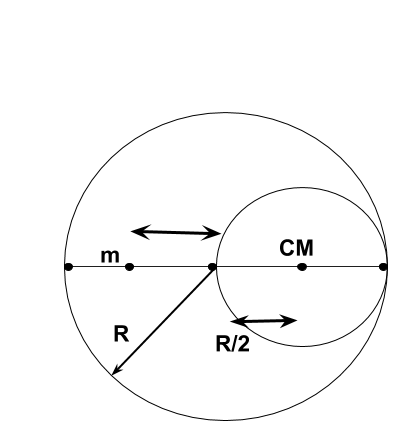
Let the cavity inside the solid sphere be $ - p$.
So, first of all, finding the gravitational field at mass $m$ due to full solid sphere –
${E_1} = \dfrac{{p\bar r}}{{3{\varepsilon _0}}}$
As given in the question that radius is equal to $\dfrac{R}{2}$
Therefore, putting the value of radius in the expression of gravitational field at mass $m$ due to full solid sphere –
$\therefore {E_1} = \dfrac{{pR}}{{6{\varepsilon _0}}} \cdots \left( 1 \right)$
So, now using the formula for gravitational field at the mass $m$ due to cavity $p$ -
$E = \dfrac{{p{a^3}}}{{3{\varepsilon _0}{r^2}}}$
So, putting the values in above formula –
$
\Rightarrow {E_2} = \dfrac{{\left( { - p} \right){{\left( {\dfrac{R}{2}} \right)}^3}}}{{3{\varepsilon _0}{R^2}}} \\
\Rightarrow {E_2} = \dfrac{{\left( { - p} \right){R^3}}}{{24{\varepsilon _0}{R^2}}} \\
\therefore {E_2} = \dfrac{{\left( { - p} \right)R}}{{24{\varepsilon _0}}} \\
$
Now, using the superposition principle of gravitational field for finding the net gravitational field.
According to the superposition principle in the gravitational field, the net gravitational field at a point is the vector sum of the gravitational field at that point due to different sources.
Therefore, the net gravitational field:
$E = {E_1} + {E_2}$
Putting the values of ${E_1}$ and ${E_2}$ from the equation $\left( 1 \right)$ and $\left( 2 \right)$ respectively –
$
\Rightarrow E = \dfrac{{pR}}{{6{\varepsilon _0}}} - \dfrac{{pR}}{{24{\varepsilon _0}}} \\
\Rightarrow E = \dfrac{{pR}}{{8{\varepsilon _0}}} \\
$
Now, finding the net force on the mass $m$ -
$\therefore F = mE$
Putting the value of $E$ -
$ \Rightarrow F = m \times \dfrac{{pR}}{{8{\varepsilon _0}}}$
Here, $p = \dfrac{M}{{\left( {\dfrac{4}{3}} \right)\pi {R^3}}}$ and ${\varepsilon _0} = \dfrac{1}{{4\pi G}}$
Then, $F = \dfrac{{3mg}}{8}$
Hence, the correct option is (B).
Note: Negative mass concept is a technique used to find the gravitational field at a point. The body of the same mass is assumed when the part of mass is missing from the. That assumed part is made to be present on the opposite side of the point and the distance is the same with that of the original vacancy. Then, the net field is calculated by calculating the field due to the full body without vacancy and newly assumed mass.
Formula used:
Use the formula for gravitational field at the mass due to cavity $p$ –
$E = \dfrac{{p{a^3}}}{{3{\varepsilon _0}{r^2}}}$
Complete step by step solution:
Let the cavity inside the solid sphere be $ - p$.
So, first of all, finding the gravitational field at mass $m$ due to full solid sphere –
${E_1} = \dfrac{{p\bar r}}{{3{\varepsilon _0}}}$
As given in the question that radius is equal to $\dfrac{R}{2}$
Therefore, putting the value of radius in the expression of gravitational field at mass $m$ due to full solid sphere –
$\therefore {E_1} = \dfrac{{pR}}{{6{\varepsilon _0}}} \cdots \left( 1 \right)$
So, now using the formula for gravitational field at the mass $m$ due to cavity $p$ -
$E = \dfrac{{p{a^3}}}{{3{\varepsilon _0}{r^2}}}$
So, putting the values in above formula –
$
\Rightarrow {E_2} = \dfrac{{\left( { - p} \right){{\left( {\dfrac{R}{2}} \right)}^3}}}{{3{\varepsilon _0}{R^2}}} \\
\Rightarrow {E_2} = \dfrac{{\left( { - p} \right){R^3}}}{{24{\varepsilon _0}{R^2}}} \\
\therefore {E_2} = \dfrac{{\left( { - p} \right)R}}{{24{\varepsilon _0}}} \\
$
Now, using the superposition principle of gravitational field for finding the net gravitational field.
According to the superposition principle in the gravitational field, the net gravitational field at a point is the vector sum of the gravitational field at that point due to different sources.
Therefore, the net gravitational field:
$E = {E_1} + {E_2}$
Putting the values of ${E_1}$ and ${E_2}$ from the equation $\left( 1 \right)$ and $\left( 2 \right)$ respectively –
$
\Rightarrow E = \dfrac{{pR}}{{6{\varepsilon _0}}} - \dfrac{{pR}}{{24{\varepsilon _0}}} \\
\Rightarrow E = \dfrac{{pR}}{{8{\varepsilon _0}}} \\
$
Now, finding the net force on the mass $m$ -
$\therefore F = mE$
Putting the value of $E$ -
$ \Rightarrow F = m \times \dfrac{{pR}}{{8{\varepsilon _0}}}$
Here, $p = \dfrac{M}{{\left( {\dfrac{4}{3}} \right)\pi {R^3}}}$ and ${\varepsilon _0} = \dfrac{1}{{4\pi G}}$
Then, $F = \dfrac{{3mg}}{8}$
Hence, the correct option is (B).
Note: Negative mass concept is a technique used to find the gravitational field at a point. The body of the same mass is assumed when the part of mass is missing from the. That assumed part is made to be present on the opposite side of the point and the distance is the same with that of the original vacancy. Then, the net field is calculated by calculating the field due to the full body without vacancy and newly assumed mass.
Recently Updated Pages
JoSAA Counselling 2026: JoSAA 2026 Mock Seat Allotment LIVE: Round 2 Result Released, Registration, Choice Filling and Ranks

Circuit Switching vs Packet Switching: Key Differences Explained
Dimensions of Pressure in Physics: Formula, Derivation & SI Unit
JEE General Topics in Chemistry Important Concepts and Tips
JEE Extractive Metallurgy Important Concepts and Tips for Exam Preparation
JEE Atomic Structure and Chemical Bonding important Concepts and Tips
Trending doubts
JEE Main 2026: Exam Dates, Session 2 Updates, City Slip, Admit Card & Latest News
JEE Main Participating Colleges 2026 - A Complete List of Top Colleges
Understanding the Electric Field of a Uniformly Charged Ring
Understanding Atomic Structure for Beginners
Derivation of Equation of Trajectory Explained for Students
How to Convert a Galvanometer into an Ammeter or Voltmeter
Other Pages
JEE Advanced 2026 Notification Out with Exam Date, Registration (Extended), Syllabus and More
JEE Advanced Percentile vs Marks 2026: JEE Main Cutoff, AIR & IIT Admission Guide
CBSE Notes Class 11 Physics Chapter 1 - Units And Measurements - 2026-27
NCERT Solutions For Class 11 Physics Chapter 1 Units And Measurements - 2025-26
Important Questions For Class 11 Physics Chapter 1 Units and Measurement - 2025-26
JEE Advanced Weightage Chapter Wise 2026 for Physics, Chemistry, and Mathematics