




A Carnot engine absorbs an amount of $Q$ heat from a reservoir at an absolute temperature $T$ and rejects heat to a sink at a temperature of $\dfrac{T}{3}$ . The amount of heat rejected is
A) $\dfrac{Q}{4}$
B) $\dfrac{Q}{3}$
C) $\dfrac{Q}{2}$
D) $\dfrac{{2Q}}{3}$
Answer
 Verified
233.1k+ views
Hint: We should know that, a carnot engine is an thermodynamical system which takes some amount of heat from a fixed reservoir temperature and rejects the heat at sink at fixed temperature and beyween this it performs some mechanical work, using general relations of carnot engine, we will solve for rejected amunt of heat by the engine.
Complete answer:
We know that the efficiency of Carnot Heat Engine is given as: -
${\eta _{carnot}} = 1 - \dfrac{{{T_2}}}{{{T_1}}}$ … (1)
where
${T_2} = $Lower Absolute Temperature = Temperature of the Sink
and, ${T_1} = $Higher Absolute Temperature = Temperature of the Source
Also, the Efficiency of Carnot Engine in terms of work done can be given as: -
${\eta _{carnot}} = \dfrac{W}{{{Q_1}}} = \dfrac{{{Q_1} - {Q_2}}}{{{Q_1}}}$ … (2)
where
$W = $Work Done in the process
${Q_1} = $Heat taken up from the Source
${Q_2} = $Heat transferred to the Sink
The above-given problem can be illustrated by a diagram given as follows: -
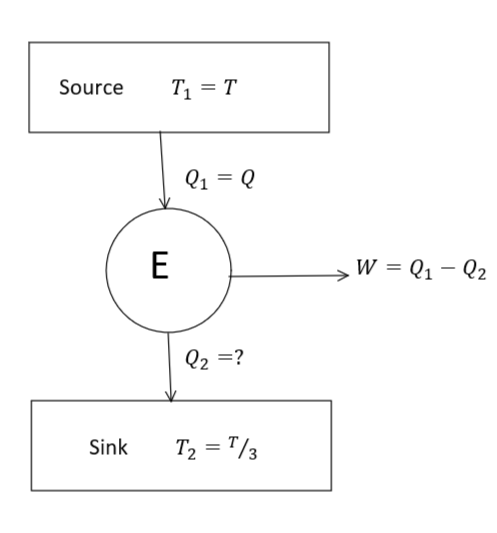
From eq. (1) and (2), we get
$\dfrac{{{Q_1} - {Q_2}}}{{{Q_1}}} = 1 - \dfrac{{{T_2}}}{{{T_1}}}$
$1 - \dfrac{{{Q_2}}}{{{Q_1}}} = 1 - \dfrac{{{T_2}}}{{{T_1}}}$ … (3)
Substituting the given values in eq. (3), we get
$ \Rightarrow \dfrac{{{Q_2}}}{Q}=\dfrac {T/3}{T}$
$ \Rightarrow {Q_2} = \dfrac{Q}{3}$
Thus, the amount of heat rejected is $\dfrac{Q}{3}$.
Hence, the correct option is (B) $\dfrac{Q}{3}$.
Note: Since this is a problem of multiple-choice question (numerical-based), it is essential that given conditions are analyzed carefully to give an accurate solution. While writing an answer to this kind of numerical problem, always keep in mind to use the mathematical proven relations to find the solution.
Complete answer:
We know that the efficiency of Carnot Heat Engine is given as: -
${\eta _{carnot}} = 1 - \dfrac{{{T_2}}}{{{T_1}}}$ … (1)
where
${T_2} = $Lower Absolute Temperature = Temperature of the Sink
and, ${T_1} = $Higher Absolute Temperature = Temperature of the Source
Also, the Efficiency of Carnot Engine in terms of work done can be given as: -
${\eta _{carnot}} = \dfrac{W}{{{Q_1}}} = \dfrac{{{Q_1} - {Q_2}}}{{{Q_1}}}$ … (2)
where
$W = $Work Done in the process
${Q_1} = $Heat taken up from the Source
${Q_2} = $Heat transferred to the Sink
The above-given problem can be illustrated by a diagram given as follows: -
From eq. (1) and (2), we get
$\dfrac{{{Q_1} - {Q_2}}}{{{Q_1}}} = 1 - \dfrac{{{T_2}}}{{{T_1}}}$
$1 - \dfrac{{{Q_2}}}{{{Q_1}}} = 1 - \dfrac{{{T_2}}}{{{T_1}}}$ … (3)
Substituting the given values in eq. (3), we get
$ \Rightarrow \dfrac{{{Q_2}}}{Q}=\dfrac {T/3}{T}$
$ \Rightarrow {Q_2} = \dfrac{Q}{3}$
Thus, the amount of heat rejected is $\dfrac{Q}{3}$.
Hence, the correct option is (B) $\dfrac{Q}{3}$.
Note: Since this is a problem of multiple-choice question (numerical-based), it is essential that given conditions are analyzed carefully to give an accurate solution. While writing an answer to this kind of numerical problem, always keep in mind to use the mathematical proven relations to find the solution.
Recently Updated Pages
JEE Main 2023 April 6 Shift 1 Question Paper with Answer Key

JEE Main 2023 April 6 Shift 2 Question Paper with Answer Key
JEE Main 2023 (January 31 Evening Shift) Question Paper with Solutions [PDF]
JEE Main 2023 January 30 Shift 2 Question Paper with Answer Key
JEE Main 2023 January 25 Shift 1 Question Paper with Answer Key
JEE Main 2023 January 24 Shift 2 Question Paper with Answer Key
Trending doubts
JEE Main 2026: Session 2 Registration Open, City Intimation Slip, Exam Dates, Syllabus & Eligibility
JEE Main 2026 Application Login: Direct Link, Registration, Form Fill, and Steps
JEE Main Marking Scheme 2026- Paper-Wise Marks Distribution and Negative Marking Details
Understanding the Angle of Deviation in a Prism
Hybridisation in Chemistry – Concept, Types & Applications
How to Convert a Galvanometer into an Ammeter or Voltmeter
Other Pages
JEE Advanced Marks vs Ranks 2025: Understanding Category-wise Qualifying Marks and Previous Year Cut-offs
Laws of Motion Class 11 Physics Chapter 4 CBSE Notes - 2025-26
Waves Class 11 Physics Chapter 14 CBSE Notes - 2025-26
Mechanical Properties of Fluids Class 11 Physics Chapter 9 CBSE Notes - 2025-26
Thermodynamics Class 11 Physics Chapter 11 CBSE Notes - 2025-26
Units And Measurements Class 11 Physics Chapter 1 CBSE Notes - 2025-26