




A car moves $40m$ east then, turns towards north and moves $30m$, turns ${45^ \circ }$ east of north moves $20\sqrt 2 m$. Given that, east is the positive $x - axis$ and north is positive $y - axis$. Find the net displacement of the car.
(A) $50\hat i + 60\hat j$
(B) $60\hat i + 50\hat j$
(C) $30\hat i + 40\hat j$
(D) $40\hat i + 30\hat j$
Answer
 Verified
232.8k+ views
Hint Find all the required distances travelled by the car for calculating the et displacement by using the Pythagoras theorem. Some of them can also be founded by using the –
$\Rightarrow$ \[
\sin \theta = \dfrac{{Perpendicular}}{{Hypoteneuse}} \\
\cos \theta = \dfrac{{Base}}{{Hypoteneuse}} \\
\]
Step by Step Solution
The map of travelling of the car can be shown in the figure –
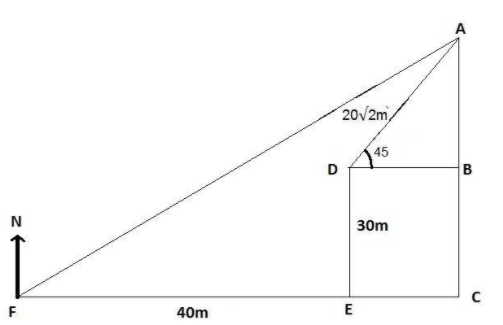
From the figure,
We can conclude that $F$ is the starting position of the car and $A$ is the finishing position of the car. So, the net displacement of the car is $FA$.
Distance of $CE$ is equal to the distance of $BD$.
Therefore, in triangle $ABD$-
$\Rightarrow$ $
\cos \theta = \dfrac{{Base}}{{Hypotenuse}} \\
\cos \theta = \dfrac{{BD}}{{AD}} \\
$
Now, putting the values of base and hypotenuse from the triangle $ABD$-
$\Rightarrow$ $
\cos {45^ \circ } = \dfrac{{BD}}{{AD}} \\
\Rightarrow BD = AD\cos {45^ \circ } \\
BD = 20\sqrt 2 \times \dfrac{1}{{\sqrt 2 }} \\
$
Cancelling $\sqrt 2 $ on numerator and denominator, we get –
$\Rightarrow$ $BD = 20m$
Now, the distance $FC$ can be calculated by –
$\Rightarrow$ $
FC = FE + EC \\
FC = 40m + BD \\
\therefore FC = 40 + 20 = 60m \\
$
In the figure, we can see that –
$\Rightarrow$ $
DE = BC \\
\because DE = 30m \\
\therefore BC = 30m \\
$
Again, in triangle $ABD$-
$\Rightarrow$ $
\sin \theta = \dfrac{{Perpendicular}}{{Hypotenuse}} \\
\sin \theta = \dfrac{{AB}}{{AD}} \\
\Rightarrow AB = AD\sin \theta \\
$
Putting the values from the question –
$\Rightarrow$ $
AB = 20\sqrt 2 \sin {45^ \circ } \\
AB = 20\sqrt 2 \times \dfrac{1}{{\sqrt 2 }} \\
AB = 20m \\
$
So, $AC$ can be calculated as –
$\Rightarrow$ $
AC = AB + BC \\
AC = 20 + 30 = 50m \\
$
We know that, Pythagoras theorem is –
$\Rightarrow$ $Hypotenuse = \sqrt {{{\left( {Perpendicular} \right)}^2} + {{\left( {Base} \right)}^2}} $
Now, in triangle $AFC$ -
Using the Pythagoras theorem, we get –
$\Rightarrow$ $AF = \sqrt {{{\left( {FC} \right)}^2} + {{\left( {AC} \right)}^2}} \cdots \left( 1 \right)$
We already got the values for $FC$ and $AC$
Therefore, putting the values of $FC$ and $AC$ in equation $\left( 1 \right)$, we get –
$\Rightarrow$ $
AF = \sqrt {{{\left( {60} \right)}^2} + {{\left( {50} \right)}^2}} \\
AF = \sqrt {3600 + 2500} \\
AF = \sqrt {6100} \\
AF = 78.10m \\
$
Hence, we got the net displacement travelled by the car. Now, to find the angle –
$\Rightarrow$ $
\tan AFC = \dfrac{{AC}}{{FC}} \\
\tan AFC = \dfrac{{50}}{{60}} = \dfrac{5}{6} \\
$
To calculate angle $AFC$, we have to find the inverse of $\tan $-
$\Rightarrow$ $
angle\left( {AFC} \right) = {\tan ^{ - 1}}\left( {\dfrac{5}{6}} \right) \\
angle\left( {AFC} \right) = {40^ \circ } \\
$
$ \Rightarrow {90^ \circ } - {40^ \circ } = {50^ \circ }$
Hence, the net displacement travelled by the car is $78.1m$ and is ${50^ \circ }$ east.
As given in question, $x - axis$ is the east. So, it is denoted by $\hat i$
Hence, the net displacement will be $50\hat i + 60\hat j$.
Therefore, the correct option is (A).
Note Pythagoras theorem states that, “in a triangle the square of hypotenuse is equal to the addition of square of perpendicular and square of base”. This method is used when the triangle is right – an angled triangle. It is useful when we know the two sides of the triangle, then, we can easily know the third side of the triangle.
$\Rightarrow$ \[
\sin \theta = \dfrac{{Perpendicular}}{{Hypoteneuse}} \\
\cos \theta = \dfrac{{Base}}{{Hypoteneuse}} \\
\]
Step by Step Solution
The map of travelling of the car can be shown in the figure –
From the figure,
We can conclude that $F$ is the starting position of the car and $A$ is the finishing position of the car. So, the net displacement of the car is $FA$.
Distance of $CE$ is equal to the distance of $BD$.
Therefore, in triangle $ABD$-
$\Rightarrow$ $
\cos \theta = \dfrac{{Base}}{{Hypotenuse}} \\
\cos \theta = \dfrac{{BD}}{{AD}} \\
$
Now, putting the values of base and hypotenuse from the triangle $ABD$-
$\Rightarrow$ $
\cos {45^ \circ } = \dfrac{{BD}}{{AD}} \\
\Rightarrow BD = AD\cos {45^ \circ } \\
BD = 20\sqrt 2 \times \dfrac{1}{{\sqrt 2 }} \\
$
Cancelling $\sqrt 2 $ on numerator and denominator, we get –
$\Rightarrow$ $BD = 20m$
Now, the distance $FC$ can be calculated by –
$\Rightarrow$ $
FC = FE + EC \\
FC = 40m + BD \\
\therefore FC = 40 + 20 = 60m \\
$
In the figure, we can see that –
$\Rightarrow$ $
DE = BC \\
\because DE = 30m \\
\therefore BC = 30m \\
$
Again, in triangle $ABD$-
$\Rightarrow$ $
\sin \theta = \dfrac{{Perpendicular}}{{Hypotenuse}} \\
\sin \theta = \dfrac{{AB}}{{AD}} \\
\Rightarrow AB = AD\sin \theta \\
$
Putting the values from the question –
$\Rightarrow$ $
AB = 20\sqrt 2 \sin {45^ \circ } \\
AB = 20\sqrt 2 \times \dfrac{1}{{\sqrt 2 }} \\
AB = 20m \\
$
So, $AC$ can be calculated as –
$\Rightarrow$ $
AC = AB + BC \\
AC = 20 + 30 = 50m \\
$
We know that, Pythagoras theorem is –
$\Rightarrow$ $Hypotenuse = \sqrt {{{\left( {Perpendicular} \right)}^2} + {{\left( {Base} \right)}^2}} $
Now, in triangle $AFC$ -
Using the Pythagoras theorem, we get –
$\Rightarrow$ $AF = \sqrt {{{\left( {FC} \right)}^2} + {{\left( {AC} \right)}^2}} \cdots \left( 1 \right)$
We already got the values for $FC$ and $AC$
Therefore, putting the values of $FC$ and $AC$ in equation $\left( 1 \right)$, we get –
$\Rightarrow$ $
AF = \sqrt {{{\left( {60} \right)}^2} + {{\left( {50} \right)}^2}} \\
AF = \sqrt {3600 + 2500} \\
AF = \sqrt {6100} \\
AF = 78.10m \\
$
Hence, we got the net displacement travelled by the car. Now, to find the angle –
$\Rightarrow$ $
\tan AFC = \dfrac{{AC}}{{FC}} \\
\tan AFC = \dfrac{{50}}{{60}} = \dfrac{5}{6} \\
$
To calculate angle $AFC$, we have to find the inverse of $\tan $-
$\Rightarrow$ $
angle\left( {AFC} \right) = {\tan ^{ - 1}}\left( {\dfrac{5}{6}} \right) \\
angle\left( {AFC} \right) = {40^ \circ } \\
$
$ \Rightarrow {90^ \circ } - {40^ \circ } = {50^ \circ }$
Hence, the net displacement travelled by the car is $78.1m$ and is ${50^ \circ }$ east.
As given in question, $x - axis$ is the east. So, it is denoted by $\hat i$
Hence, the net displacement will be $50\hat i + 60\hat j$.
Therefore, the correct option is (A).
Note Pythagoras theorem states that, “in a triangle the square of hypotenuse is equal to the addition of square of perpendicular and square of base”. This method is used when the triangle is right – an angled triangle. It is useful when we know the two sides of the triangle, then, we can easily know the third side of the triangle.
Recently Updated Pages
JEE Main 2023 April 6 Shift 1 Question Paper with Answer Key

JEE Main 2023 April 6 Shift 2 Question Paper with Answer Key
JEE Main 2023 (January 31 Evening Shift) Question Paper with Solutions [PDF]
JEE Main 2023 January 30 Shift 2 Question Paper with Answer Key
JEE Main 2023 January 25 Shift 1 Question Paper with Answer Key
JEE Main 2023 January 24 Shift 2 Question Paper with Answer Key
Trending doubts
JEE Main 2026: Session 2 Registration Open, City Intimation Slip, Exam Dates, Syllabus & Eligibility
JEE Main 2026 Application Login: Direct Link, Registration, Form Fill, and Steps
Understanding the Angle of Deviation in a Prism
Hybridisation in Chemistry – Concept, Types & Applications
How to Convert a Galvanometer into an Ammeter or Voltmeter
Understanding Uniform Acceleration in Physics
Other Pages
JEE Advanced Marks vs Ranks 2025: Understanding Category-wise Qualifying Marks and Previous Year Cut-offs
Laws of Motion Class 11 Physics Chapter 4 CBSE Notes - 2025-26
Waves Class 11 Physics Chapter 14 CBSE Notes - 2025-26
Mechanical Properties of Fluids Class 11 Physics Chapter 9 CBSE Notes - 2025-26
Thermodynamics Class 11 Physics Chapter 11 CBSE Notes - 2025-26
Units And Measurements Class 11 Physics Chapter 1 CBSE Notes - 2025-26