




A broad beam of light of wavelength 683nm is sent directly downward through the top plate of a pair of glass plates. The plates are 120mm long, touch at the left end, and are separated by $48.0\mu m$ at the right end. The air between the plates acts as a thin film. How many bright fringes will be seen by an observer looking down through the top plate?

Answer
 Verified
233.1k+ views
Hint Bright or dark fringe pattern is a result of interference or diffraction. Interference occurs when two waves superimpose onto each other. Here, we observe the superimposition of two reflected waves. You have to recall that when a wave reflects normally from the surface of a denser medium back into the rarer medium, a phase difference of $\pi $ is introduced.
Complete Step by step solution
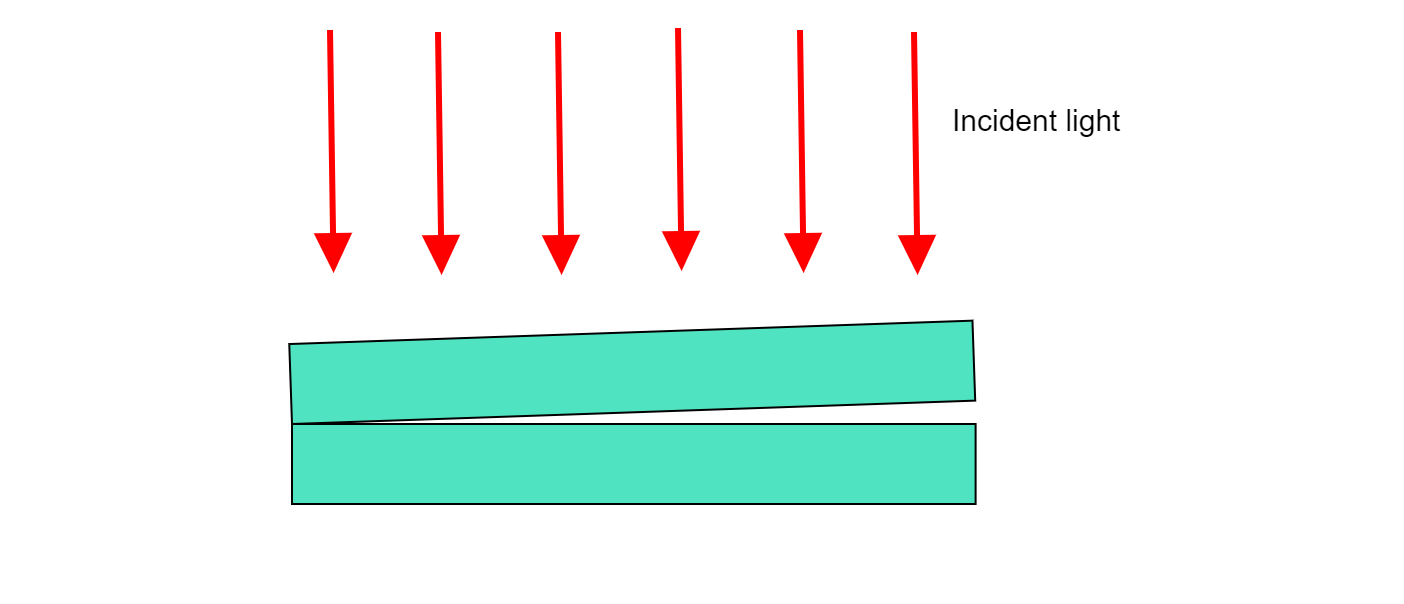
In this problem, the interference of the two waves is taking place. One is reflected from the plate-air interface (top of the air thin film) and the other is reflected from the air-plate interface (bottom of the air thin film).
We know that, any wave that is reflected normally from the surface of a rarer medium back into the denser medium undergoes no phase change. However, the same cannot be said for a wave reflected normally from the surface of the denser medium back into the rarer medium. In such cases, a phase difference of $\pi $ is introduced.
In the case of thin- film interference, the condition for constructive interference is given as,
$2L = \left( {n + \dfrac{1}{2}} \right)\lambda $ $ - - - - (1)$
where,
$L$ is the thickness of the thin film,
$\lambda $ is the wavelength of the light.
For this problem, we consider the right most part of this system, where the thickness of the thin film is $48.0\mu m$ .
Thus, $L = 48\mu m$ .
$ \Rightarrow L = 48 \times {10^ - }^6m$
Given, $\lambda = 683nm$ .
$ \Rightarrow \lambda = 683 \times {10^ - }^9m$
Using these numerical values in equation (1), we get
$2 \times 48 \times {10^ - }^6 = \left( {n + \dfrac{1}{2}} \right)683 \times {10^ - }^9$
$ \Rightarrow \left( {n + \dfrac{1}{2}} \right) = \dfrac{{2 \times 48 \times {{10}^ - }^6}}{{683 \times {{10}^ - }^9}}$
Solving this, we get
$\left( {n + \dfrac{1}{2}} \right) \simeq 140.5$
$ \Rightarrow n = 140$ .
So, $140$ bright fringes will be seen by an observer looking down through the top plate.
Note The condition for bright or dark fringes should be correct to approach such problems. Often units of wavelength, thickness, etc. are not SI units. Converting them to the SI unit will help you to avoid any mistakes.
Complete Step by step solution
In this problem, the interference of the two waves is taking place. One is reflected from the plate-air interface (top of the air thin film) and the other is reflected from the air-plate interface (bottom of the air thin film).
We know that, any wave that is reflected normally from the surface of a rarer medium back into the denser medium undergoes no phase change. However, the same cannot be said for a wave reflected normally from the surface of the denser medium back into the rarer medium. In such cases, a phase difference of $\pi $ is introduced.
In the case of thin- film interference, the condition for constructive interference is given as,
$2L = \left( {n + \dfrac{1}{2}} \right)\lambda $ $ - - - - (1)$
where,
$L$ is the thickness of the thin film,
$\lambda $ is the wavelength of the light.
For this problem, we consider the right most part of this system, where the thickness of the thin film is $48.0\mu m$ .
Thus, $L = 48\mu m$ .
$ \Rightarrow L = 48 \times {10^ - }^6m$
Given, $\lambda = 683nm$ .
$ \Rightarrow \lambda = 683 \times {10^ - }^9m$
Using these numerical values in equation (1), we get
$2 \times 48 \times {10^ - }^6 = \left( {n + \dfrac{1}{2}} \right)683 \times {10^ - }^9$
$ \Rightarrow \left( {n + \dfrac{1}{2}} \right) = \dfrac{{2 \times 48 \times {{10}^ - }^6}}{{683 \times {{10}^ - }^9}}$
Solving this, we get
$\left( {n + \dfrac{1}{2}} \right) \simeq 140.5$
$ \Rightarrow n = 140$ .
So, $140$ bright fringes will be seen by an observer looking down through the top plate.
Note The condition for bright or dark fringes should be correct to approach such problems. Often units of wavelength, thickness, etc. are not SI units. Converting them to the SI unit will help you to avoid any mistakes.
Recently Updated Pages
JEE Main 2023 April 6 Shift 1 Question Paper with Answer Key

JEE Main 2023 April 6 Shift 2 Question Paper with Answer Key
JEE Main 2023 (January 31 Evening Shift) Question Paper with Solutions [PDF]
JEE Main 2023 January 30 Shift 2 Question Paper with Answer Key
JEE Main 2023 January 25 Shift 1 Question Paper with Answer Key
JEE Main 2023 January 24 Shift 2 Question Paper with Answer Key
Trending doubts
JEE Main 2026: Session 2 Registration Open, City Intimation Slip, Exam Dates, Syllabus & Eligibility
JEE Main 2026 Application Login: Direct Link, Registration, Form Fill, and Steps
Understanding the Angle of Deviation in a Prism
Hybridisation in Chemistry – Concept, Types & Applications
How to Convert a Galvanometer into an Ammeter or Voltmeter
Understanding Uniform Acceleration in Physics
Other Pages
JEE Advanced Marks vs Ranks 2025: Understanding Category-wise Qualifying Marks and Previous Year Cut-offs
Laws of Motion Class 11 Physics Chapter 4 CBSE Notes - 2025-26
Waves Class 11 Physics Chapter 14 CBSE Notes - 2025-26
Mechanical Properties of Fluids Class 11 Physics Chapter 9 CBSE Notes - 2025-26
Thermodynamics Class 11 Physics Chapter 11 CBSE Notes - 2025-26
Units And Measurements Class 11 Physics Chapter 1 CBSE Notes - 2025-26