




A boy is walking away from a well at a speed of $1.0m/s$ in the direction at right angles to the wall. As he walks, he blows a whistle steadily. An observer towards whom the boy is walking hears $4.0$ beats per second. If the speed of sound is $340m/s$ , what is the frequency of the whistle (in $Hz$) ?
Answer
 Verified
284.1k+ views
Hint: We will be using the basics of Doppler Effect that suggests the change in frequency of the wave with respect to the observer’s movement. However here the source is moving while the observer is at rest. Consider the reflection of the sound by the wall and this results in superposition of waves, and thus a beat is produced too.
Formulas used: We will be using the formula for Doppler effect, ${f_o} = \dfrac{{v + {v_o}}}{{v + {v_s}}}{f_s}$ where ${f_o}$ is the observer frequency of sound waves , ${f_s}$ is the actual frequency of sound waves, $v$ is the speed of sound waves in that medium, ${v_o}$ is the speed at which the observer is moving, and ${v_s}$ is the speed of the source of sound waves. We will also be using the relation $beats = {f_2} - {f_1}$ where ${f_2}$ and ${f_1}$ are frequencies of the two sound waves involved in the interference.
Complete Step by Step answer:
We know that sound is a wave that could travel in different mediums with different characteristics. For example, in solids they propagate via transverse waves while in gases they are longitudinal. As they are waves, they experience every property of waves like the frequency, amplitude, speed, and direction. They can also be reflected, refracted, or diffracted during their course of propagation in any medium.
The Doppler Effect specifies the change in frequency of the wave with respect to the movement of the observer and takes into consideration the reflection of sound waves. Here we can see that the boy who is walking is the source of sound. Thus the speed at which he is moving is the speed of source of sound waves, ${v_s} = 1.0m/s$ and the observer seems to be at rest, so the speed of the observer will be ${v_o} = 0m/s$. The speed of sound in air is, $v = 340m/s$ .
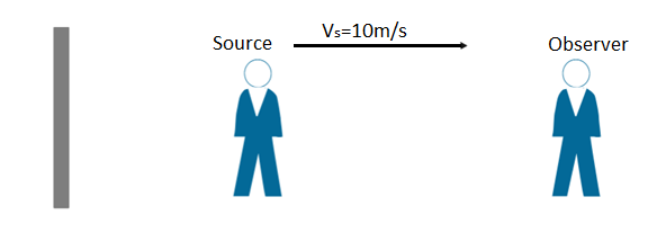
So let us consider the first case in which the sound of the whistle is heard by the observer directly, then ${f_o} = \dfrac{{v + {v_o}}}{{v - {v_s}}}{f_s}$ [ $v - {v_s}$ because both the sound and the source are moving in the same direction]
Substituting the values $v = 340m/s,{v_o} = 0m/s,{v_s} = 1m/s$ we get,
$ \Rightarrow {f_o} = \dfrac{{340 + 0}}{{340 - 1}} \times {f_s}$
Now consider the case when the sound heard by the whistle is the one that is reflected by the wall,
${f_o} = \dfrac{{v + {v_o}}}{{v + {v_s}}}{f_s}$ . Substituting the values to the equation we get,
\[ \Rightarrow {f'_o} = \dfrac{{340 + 0}}{{340 + 1}} \times {f_s}\]
We also know that the beat frequency produced by these waves is, ${f_b} = 4Hz$
${f_b} = {f_o} - {f'_o}$. Substituting the values and solving we get,
\[4 = \dfrac{{340}}{{339}} \times {f_s} - \dfrac{{340}}{{341}} \times {f_s}\]
$ \Rightarrow 4 = 340{f_s}(\dfrac{{341 - 339}}{{339 \times 341}})$
Solving for ${f_s}$
${f_s} = \dfrac{{4 \times 339 \times 341}}{{2 \times 340}}$
$ \Rightarrow {f_s} = 679.9Hz$
Thus, the frequency of sound waves at the source is ${f_s} = 679.9Hz$ .
Note:
We have used different signs in the denominator for the two cases. This is because the formula that lets you calculate Doppler effect is given by,
${f_{o = }} = {f_s}\dfrac{{{v_{rel}}(o,v)}}{{{v_{rel}}(s,v)}}$ which clearly indicates that the numerator is the relative velocity between speed of sound and observer while the denominator is the relative velocity between source and the speed of sound. Therefore, the signs change in the denominator.
Formulas used: We will be using the formula for Doppler effect, ${f_o} = \dfrac{{v + {v_o}}}{{v + {v_s}}}{f_s}$ where ${f_o}$ is the observer frequency of sound waves , ${f_s}$ is the actual frequency of sound waves, $v$ is the speed of sound waves in that medium, ${v_o}$ is the speed at which the observer is moving, and ${v_s}$ is the speed of the source of sound waves. We will also be using the relation $beats = {f_2} - {f_1}$ where ${f_2}$ and ${f_1}$ are frequencies of the two sound waves involved in the interference.
Complete Step by Step answer:
We know that sound is a wave that could travel in different mediums with different characteristics. For example, in solids they propagate via transverse waves while in gases they are longitudinal. As they are waves, they experience every property of waves like the frequency, amplitude, speed, and direction. They can also be reflected, refracted, or diffracted during their course of propagation in any medium.
The Doppler Effect specifies the change in frequency of the wave with respect to the movement of the observer and takes into consideration the reflection of sound waves. Here we can see that the boy who is walking is the source of sound. Thus the speed at which he is moving is the speed of source of sound waves, ${v_s} = 1.0m/s$ and the observer seems to be at rest, so the speed of the observer will be ${v_o} = 0m/s$. The speed of sound in air is, $v = 340m/s$ .
So let us consider the first case in which the sound of the whistle is heard by the observer directly, then ${f_o} = \dfrac{{v + {v_o}}}{{v - {v_s}}}{f_s}$ [ $v - {v_s}$ because both the sound and the source are moving in the same direction]
Substituting the values $v = 340m/s,{v_o} = 0m/s,{v_s} = 1m/s$ we get,
$ \Rightarrow {f_o} = \dfrac{{340 + 0}}{{340 - 1}} \times {f_s}$
Now consider the case when the sound heard by the whistle is the one that is reflected by the wall,
${f_o} = \dfrac{{v + {v_o}}}{{v + {v_s}}}{f_s}$ . Substituting the values to the equation we get,
\[ \Rightarrow {f'_o} = \dfrac{{340 + 0}}{{340 + 1}} \times {f_s}\]
We also know that the beat frequency produced by these waves is, ${f_b} = 4Hz$
${f_b} = {f_o} - {f'_o}$. Substituting the values and solving we get,
\[4 = \dfrac{{340}}{{339}} \times {f_s} - \dfrac{{340}}{{341}} \times {f_s}\]
$ \Rightarrow 4 = 340{f_s}(\dfrac{{341 - 339}}{{339 \times 341}})$
Solving for ${f_s}$
${f_s} = \dfrac{{4 \times 339 \times 341}}{{2 \times 340}}$
$ \Rightarrow {f_s} = 679.9Hz$
Thus, the frequency of sound waves at the source is ${f_s} = 679.9Hz$ .
Note:
We have used different signs in the denominator for the two cases. This is because the formula that lets you calculate Doppler effect is given by,
${f_{o = }} = {f_s}\dfrac{{{v_{rel}}(o,v)}}{{{v_{rel}}(s,v)}}$ which clearly indicates that the numerator is the relative velocity between speed of sound and observer while the denominator is the relative velocity between source and the speed of sound. Therefore, the signs change in the denominator.
Recently Updated Pages
How to Calculate Moment of Inertia: Step-by-Step Guide & Formulas

Dimensions of Charge: Dimensional Formula, Derivation, SI Units & Examples
Mass vs Weight: Key Differences Explained for Students
Uniform Acceleration Explained: Formula, Examples & Graphs
JEE Main 2025-26 Mock Test: Binomial Theorem & Quick Practice
Properties of Solids and Liquids Mock Test 2025
Trending doubts
JEE Main 2026: Exam Dates, Session 2 Updates, City Slip, Admit Card & Latest News
Understanding the Electric Field of a Uniformly Charged Ring
Understanding Atomic Structure for Beginners
Derivation of Equation of Trajectory Explained for Students
Electron Gain Enthalpy and Electron Affinity Explained
How to Convert a Galvanometer into an Ammeter or Voltmeter
Other Pages
JEE Advanced Percentile vs Marks 2026: JEE Main Cutoff, AIR & IIT Admission Guide
CBSE Notes Class 11 Physics Chapter 1 - Units And Measurements - 2026-27
NCERT Solutions For Class 11 Physics Chapter 1 Units And Measurements - 2026-27 Free PDF Download (Login Required)
NCERT Solutions For Class 11 Physics Chapter 2 Motion In A Straight Line - 2026-27 Free PDF Download (Login Required)
Important Questions For Class 11 Physics Chapter 1 Units and Measurement - 2026-27
CBSE Notes Class 11 Physics Chapter 2 - Motion in a Straight Line - 2026-27