




A body is thrown vertically upward in air and air resistance is taken into account. The time of ascent is ${t_1}$ and time of descent is ${t_2}$, then which of the following is true
(A) ${t_1} = {t_2}$
(B) ${t_1} > {t_2}$
(C) ${t_1} < {t_2}$
(D) Cannot be predicted
Answer
 Verified
260.4k+ views
Hint:In order to solve this question, we should know that air resistance force always acts in a direction opposite to that of direction of motion of the body, so here we will find effective acceleration of body in both cases and then using newton’s equation of motion to find relation between time of ascent and time of descent.
Formula used:
$v = u + at$
${v^2} - {u^2} = 2aS$
$S = ut + \dfrac{1}{2}a{t^2}$
where,
v is the final velocity, u is the initial velocity of the body
S is the distance covered, a is the acceleration of the body and t denotes time taken by the body.
Complete answer:
Let us assume the acceleration due to air resistance force is ‘a’ and acceleration due to gravity is ‘g’ and total height reached by the body is H, during ascent and descent of the particle the net acceleration acting on the particle is shown in the diagram as
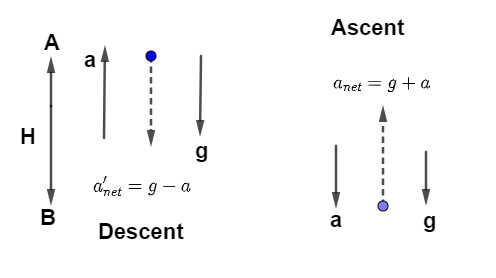
Now, During ascent time taken by the body to rise with initial velocity u and net acceleration ${a_{net}} = g + a$ is
using equation $v = u + at$ as final velocity during ascent is zero and net acceleration will be taken as negative so ${t_1} = \dfrac{u}{{g + a}}$ and height H reached by the body can be calculated using ${v^2} - {u^2} = 2aS$ we get
$
{u^2} = 2(g + a)H \\
\Rightarrow H = \dfrac{{{u^2}}}{{2(g + a)}} \to (i) \\
$
Now, during the descent the distance covered by the body will be H with acceleration $a{'_{net}} = g - a$ with time ${t_2}$ so using newton’s equation of motion as
$S = ut + \dfrac{1}{2}a{t^2}$ and since initial velocity is zero during descent so we get,
$H = \dfrac{1}{2}(g - a){t_2}^2$ using the value of H from equation (i) we get,
$
\dfrac{{{u^2}}}{{2(g + a)}} = \dfrac{1}{2}(g - a){t_2}^2 \\
{t_2} = \dfrac{u}{{g + a}}\sqrt {\dfrac{{g + a}}{{g - a}}} \\
$
using the value ${t_1} = \dfrac{u}{{g + a}}$ we get,
${t_2} = {t_1}\sqrt {\dfrac{{g + a}}{{g - a}}} $
now since, we know that $\dfrac{{g + a}}{{g - a}} > 1$ so,
${t_2} > {t_1}$ or ${t_1} < {t_2}$
So, the time of descent will be larger than the time of ascent.
Hence, the correct answer is ${t_1} > {t_2}$
Hence, the correct option is Option (B).
Note:Always pay attention while calculating the acceleration values during ascent and descent. Also consider the effect of gravity on the motion of the body during ascent and descent.
Formula used:
$v = u + at$
${v^2} - {u^2} = 2aS$
$S = ut + \dfrac{1}{2}a{t^2}$
where,
v is the final velocity, u is the initial velocity of the body
S is the distance covered, a is the acceleration of the body and t denotes time taken by the body.
Complete answer:
Let us assume the acceleration due to air resistance force is ‘a’ and acceleration due to gravity is ‘g’ and total height reached by the body is H, during ascent and descent of the particle the net acceleration acting on the particle is shown in the diagram as
Now, During ascent time taken by the body to rise with initial velocity u and net acceleration ${a_{net}} = g + a$ is
using equation $v = u + at$ as final velocity during ascent is zero and net acceleration will be taken as negative so ${t_1} = \dfrac{u}{{g + a}}$ and height H reached by the body can be calculated using ${v^2} - {u^2} = 2aS$ we get
$
{u^2} = 2(g + a)H \\
\Rightarrow H = \dfrac{{{u^2}}}{{2(g + a)}} \to (i) \\
$
Now, during the descent the distance covered by the body will be H with acceleration $a{'_{net}} = g - a$ with time ${t_2}$ so using newton’s equation of motion as
$S = ut + \dfrac{1}{2}a{t^2}$ and since initial velocity is zero during descent so we get,
$H = \dfrac{1}{2}(g - a){t_2}^2$ using the value of H from equation (i) we get,
$
\dfrac{{{u^2}}}{{2(g + a)}} = \dfrac{1}{2}(g - a){t_2}^2 \\
{t_2} = \dfrac{u}{{g + a}}\sqrt {\dfrac{{g + a}}{{g - a}}} \\
$
using the value ${t_1} = \dfrac{u}{{g + a}}$ we get,
${t_2} = {t_1}\sqrt {\dfrac{{g + a}}{{g - a}}} $
now since, we know that $\dfrac{{g + a}}{{g - a}} > 1$ so,
${t_2} > {t_1}$ or ${t_1} < {t_2}$
So, the time of descent will be larger than the time of ascent.
Hence, the correct answer is ${t_1} > {t_2}$
Hence, the correct option is Option (B).
Note:Always pay attention while calculating the acceleration values during ascent and descent. Also consider the effect of gravity on the motion of the body during ascent and descent.
Recently Updated Pages
Algebra Made Easy: Step-by-Step Guide for Students

JEE Isolation, Preparation and Properties of Non-metals Important Concepts and Tips for Exam Preparation
JEE Energetics Important Concepts and Tips for Exam Preparation
Chemical Properties of Hydrogen - Important Concepts for JEE Exam Preparation
JEE General Topics in Chemistry Important Concepts and Tips
JEE Amino Acids and Peptides Important Concepts and Tips for Exam Preparation
Trending doubts
JEE Main 2026: Exam Dates, Session 2 Updates, City Slip, Admit Card & Latest News
JEE Main Participating Colleges 2026 - A Complete List of Top Colleges
Hybridisation in Chemistry – Concept, Types & Applications
Understanding the Electric Field of a Uniformly Charged Ring
Derivation of Equation of Trajectory Explained for Students
Understanding Atomic Structure for Beginners
Other Pages
JEE Advanced 2026 Notification Out with Exam Date, Registration (Extended), Syllabus and More
JEE Advanced Marks vs Ranks 2025: Understanding Category-wise Qualifying Marks and Previous Year Cut-offs
CBSE Notes Class 11 Physics Chapter 1 - Units And Measurements - 2025-26
NCERT Solutions For Class 11 Physics Chapter 1 Units And Measurements - 2025-26
Important Questions For Class 11 Physics Chapter 1 Units and Measurement - 2025-26
JEE Advanced Weightage Chapter Wise 2026 for Physics, Chemistry, and Mathematics