




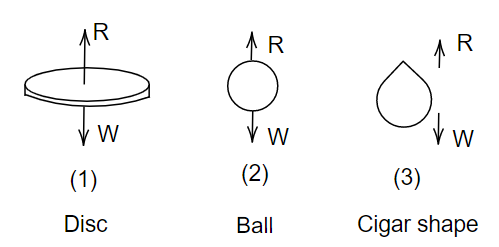
When a body falls in air, the resistance of air depends to a great extent on the shape of the body, 3 different shapes are given. Identify the combination of air resistances that truly represents the physical situation. (The cross-sectional areas are the same).
A. 1 < 2 < 3
B. 2 < 3 < 1
C. 3 < 2 < 1
D. 3 < 1 < 2
Answer
 Verified
270.6k+ views
Hint: Before going to solve this question let us understand the streamlined flow. The streamlined flow is also referred to as laminar flow. When there is no turbulence and fluctuations in velocity then it is called streamlined flow. It is a path traced by a particle in a flow.
Complete step by step solution:

Image: Three different shapes having the same area of cross-section.
Resistance experienced by the body when it is moving in an air medium depends upon its shape. So here we have three different shapes. Now we have to identify the correct option depending upon the shape whether it is in the increasing or in decreasing order of resistance.
Usually even in also and in airplanes has an aerodynamic shape which means it allows the streamlined flow of the fluids. By that time the air resistance will be less. So, if you observe the three diagrams. The first one is circular, the second is spherical, and the third is cigar (aerodynamic) in shape. Let us assume that the area of the cross-section remains the same.
As we can see here the weight is acting downwards and the resistance in an upward direction. During that time, the region available for that air resistance is less in the third diagram and comparatively more in the second one and it is still more in the first diagram. Therefore, in the third diagram, it is streamlined, so the air resistance of this will be the least. For the first diagram, the surface area is maximum so air resistance is minimum.
Hence, option C is the correct answer.
Note:In this question, it is important to remember that, when a body moving through a fluid has a streamlined shape (a bullet) has very little air resistance due to its inherent shape when compared to a flat plate moving through the same fluid with the phase of the plate in the direction of motion.
Complete step by step solution:
Image: Three different shapes having the same area of cross-section.
Resistance experienced by the body when it is moving in an air medium depends upon its shape. So here we have three different shapes. Now we have to identify the correct option depending upon the shape whether it is in the increasing or in decreasing order of resistance.
Usually even in also and in airplanes has an aerodynamic shape which means it allows the streamlined flow of the fluids. By that time the air resistance will be less. So, if you observe the three diagrams. The first one is circular, the second is spherical, and the third is cigar (aerodynamic) in shape. Let us assume that the area of the cross-section remains the same.
As we can see here the weight is acting downwards and the resistance in an upward direction. During that time, the region available for that air resistance is less in the third diagram and comparatively more in the second one and it is still more in the first diagram. Therefore, in the third diagram, it is streamlined, so the air resistance of this will be the least. For the first diagram, the surface area is maximum so air resistance is minimum.
Hence, option C is the correct answer.
Note:In this question, it is important to remember that, when a body moving through a fluid has a streamlined shape (a bullet) has very little air resistance due to its inherent shape when compared to a flat plate moving through the same fluid with the phase of the plate in the direction of motion.
Recently Updated Pages
Circuit Switching vs Packet Switching: Key Differences Explained

Dimensions of Pressure in Physics: Formula, Derivation & SI Unit
JEE General Topics in Chemistry Important Concepts and Tips
JEE Extractive Metallurgy Important Concepts and Tips for Exam Preparation
JEE Atomic Structure and Chemical Bonding important Concepts and Tips
JEE Amino Acids and Peptides Important Concepts and Tips for Exam Preparation
Trending doubts
JEE Main 2026: Exam Dates, Session 2 Updates, City Slip, Admit Card & Latest News
JEE Main Participating Colleges 2026 - A Complete List of Top Colleges
Understanding the Electric Field of a Uniformly Charged Ring
Understanding Atomic Structure for Beginners
Derivation of Equation of Trajectory Explained for Students
JEE Main Marking Scheme 2026- Paper-Wise Marks Distribution and Negative Marking Details
Other Pages
JEE Advanced 2026 Notification Out with Exam Date, Registration (Extended), Syllabus and More
JEE Advanced Percentile vs Marks 2026: JEE Main Cutoff, AIR & IIT Admission Guide
CBSE Notes Class 11 Physics Chapter 1 - Units And Measurements - 2026-27
JEE Advanced 2026 Marks vs Rank: Estimate IIT Rank from Your Score
NCERT Solutions For Class 11 Physics Chapter 1 Units And Measurements - 2025-26
Important Questions For Class 11 Physics Chapter 1 Units and Measurement - 2025-26