




A block of mass $m = 4kg$ is placed over a rough inclined plane as shown in Fig. The coefficient of friction between the block and the plane is $\mu = 0.5$. A force $F = 10N$ is applied on the block at an angle of ${30^ \circ }$. Find the contact force between the block and the plane.
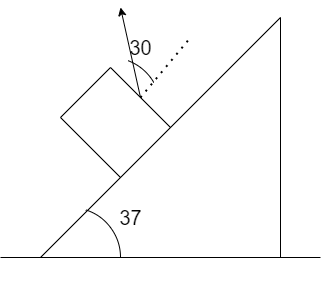
A) $10.5\sqrt 5 N$
B) $13.5\sqrt 5 N$
C) $12.5\sqrt 5 N$
D) $10\sqrt 5 N$
Answer
 Verified
249.6k+ views
Hint: A contact force is the force that can be exerted by one object on the other object if they are in contact or physically touching each other. Also when two objects or surfaces are in contact with each other, then friction force will be acting on two surfaces.
Complete step by step solution:
Step I: The resultant contact force acting on the body is the net normal force and the frictional force. It is written as
$R = \sqrt {{{(N)}^2} + {{(F)}^2}} $---(i)
Where N is the normal force and F is the frictional force.
The normal force is acting along the y-axis and the frictional force is acting on the x-axis.
Step II: Since the block is placed on an inclined plane, so the normal force will have two components- vertical and horizontal.
Normal force is given by
$N = mg$
Horizontal component is $mg\sin {37^ \circ }$
Vertical component is $mg\cos {37^ \circ }$
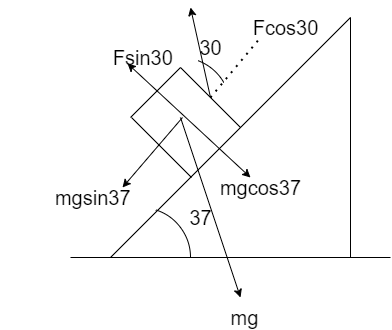
Step III: Also the friction force will be resolved into two components.
Horizontal component is $F\cos {30^ \circ }$
Vertical component is $F\sin {30^ \circ }$
Step IV: The mass on the inclined plane is balanced, so the net forces along the x axis will be zero. Hence,
${F_x} + mg\sin {37^ \circ } - F\cos {30^ \circ } = 0$
$\Rightarrow {F_x} + (4 \times 10 \times \dfrac{3}{5}) - (10 \times \dfrac{{\sqrt 3 }}{2}) = 0$
$\Rightarrow {F_x} = - 24 + 5\sqrt 3 $
$\Rightarrow {F_x} = - 24 + 3.66$
$\Rightarrow {F_x} = - 15.34$
Step V: Similarly the effect of the forces on y-axis will also be zero. Therefore,
${F_y} = 0$
${N_y} + mg\cos {37^ \circ } - F\sin {30^ \circ } = 0$
$\Rightarrow {N_y} + (4 \times 10 \times \dfrac{4}{5}) - (10 \times \dfrac{1}{2}) = 0$
$\Rightarrow {N_y} = - 32 + 5$
$\Rightarrow {N_y} = - 27$
Step VI: Substituting the values in equation (i),
$R = \sqrt {{{( - 15.34)}^2} + {{( - 27)}^2}} $
The total contact force is
$R = 13.5\sqrt 5 $
Hence Option (B) is the right answer.
Note: It is important to note that coefficient of friction is the relation between the force of friction and normal force of two surfaces. The value of coefficient is always less than $1$. This value shows that the value of normal force is equal and balanced by the frictional force.
Complete step by step solution:
Step I: The resultant contact force acting on the body is the net normal force and the frictional force. It is written as
$R = \sqrt {{{(N)}^2} + {{(F)}^2}} $---(i)
Where N is the normal force and F is the frictional force.
The normal force is acting along the y-axis and the frictional force is acting on the x-axis.
Step II: Since the block is placed on an inclined plane, so the normal force will have two components- vertical and horizontal.
Normal force is given by
$N = mg$
Horizontal component is $mg\sin {37^ \circ }$
Vertical component is $mg\cos {37^ \circ }$
Step III: Also the friction force will be resolved into two components.
Horizontal component is $F\cos {30^ \circ }$
Vertical component is $F\sin {30^ \circ }$
Step IV: The mass on the inclined plane is balanced, so the net forces along the x axis will be zero. Hence,
${F_x} + mg\sin {37^ \circ } - F\cos {30^ \circ } = 0$
$\Rightarrow {F_x} + (4 \times 10 \times \dfrac{3}{5}) - (10 \times \dfrac{{\sqrt 3 }}{2}) = 0$
$\Rightarrow {F_x} = - 24 + 5\sqrt 3 $
$\Rightarrow {F_x} = - 24 + 3.66$
$\Rightarrow {F_x} = - 15.34$
Step V: Similarly the effect of the forces on y-axis will also be zero. Therefore,
${F_y} = 0$
${N_y} + mg\cos {37^ \circ } - F\sin {30^ \circ } = 0$
$\Rightarrow {N_y} + (4 \times 10 \times \dfrac{4}{5}) - (10 \times \dfrac{1}{2}) = 0$
$\Rightarrow {N_y} = - 32 + 5$
$\Rightarrow {N_y} = - 27$
Step VI: Substituting the values in equation (i),
$R = \sqrt {{{( - 15.34)}^2} + {{( - 27)}^2}} $
The total contact force is
$R = 13.5\sqrt 5 $
Hence Option (B) is the right answer.
Note: It is important to note that coefficient of friction is the relation between the force of friction and normal force of two surfaces. The value of coefficient is always less than $1$. This value shows that the value of normal force is equal and balanced by the frictional force.
Recently Updated Pages
JEE Isolation, Preparation and Properties of Non-metals Important Concepts and Tips for Exam Preparation

Isoelectronic Definition in Chemistry: Meaning, Examples & Trends
Ionisation Energy and Ionisation Potential Explained
Iodoform Reactions - Important Concepts and Tips for JEE
Introduction to Dimensions: Understanding the Basics
Instantaneous Velocity Explained: Formula, Examples & Graphs
Trending doubts
JEE Main 2026: Exam Dates, Session 2 Updates, City Slip, Admit Card & Latest News
Hybridisation in Chemistry – Concept, Types & Applications
JEE Main 2026 Application Login: Direct Link, Registration, Form Fill, and Steps
Understanding the Electric Field of a Uniformly Charged Ring
Derivation of Equation of Trajectory Explained for Students
JEE Main Marking Scheme 2026- Paper-Wise Marks Distribution and Negative Marking Details
Other Pages
JEE Advanced Marks vs Ranks 2025: Understanding Category-wise Qualifying Marks and Previous Year Cut-offs
JEE Advanced 2026 - Exam Date (Released), Syllabus, Registration, Eligibility, Preparation, and More
CBSE Notes Class 11 Physics Chapter 1 - Units And Measurements - 2025-26
Important Questions For Class 11 Physics Chapter 1 Units and Measurement - 2025-26
NCERT Solutions For Class 11 Physics Chapter 1 Units And Measurements - 2025-26
CBSE Notes Class 11 Physics Chapter 4 - Laws of Motion - 2025-26