




A block has been placed on an inclined plane. The slope angle $\theta $ of the plane is such that the block slides down the plane at a constant speed. The coefficient of kinetic friction is equal to
(A) \[\sin \theta \]
(B) \[\cos \theta \]
(C) \[\sec \theta \]
(D) $\tan \theta $
Answer
 Verified
258k+ views
Hint: We find all the forces acting on the block and add them based on their direction to find the coefficient of friction. Here, the block is moving in a straight path, so, distance and displacement are the same and hence, speed and velocity will also be the same. The acceleration will be zero because velocity is constant, due to which the force acting on the body due to acceleration is zero. To solve this problem, we find the forces acting on the block and add them and equate them to zero.
Formula used:
Kinetic Friction force ${f_k} = \mu {F_N}$
Here, Kinetic Friction force is represented by ${f_k}$
Coefficient of kinetic friction is represented by $\mu $
Normal force is represented by ${F_N}$
Complete step by step solution:
Free body diagram of the block
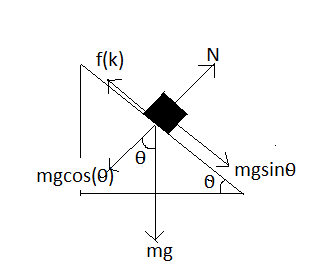
From the free body diagram, the normal force is equal to ${F_N} = mgcos\theta $
Friction force action between the block and the surface is equal to
${f_K} = \mu {F_N} = \mu mgcos\theta $
Adding all the forces along the plane of inclination
$mg\sin \theta - \mu mgcos\theta = ma$
Since the velocity is constant, acceleration is zero, and the force applied due to the acceleration is also zero.
Solving the equation, we get
$ mg\sin \theta - \mu mgcos\theta = ma $
$ mg\sin \theta - \mu mgcos\theta = 0 $
$ \Rightarrow \mu = \dfrac{{mg\sin \theta }}{{mgcos\theta }} $
$ \Rightarrow \mu = \tan \theta $
Hence the coefficient of friction is equal to \[\mu = \tan \theta \] for which the block moves at a constant speed.
Option (D) \[\mu = \tan \theta \] is the correct answer.
Note: The angle of inclination at which the block just starts to move with a constant speed or acceleration along an inclined surface is called the Angle of Repose. It can also be defined as the maximum angle of inclination at which the block remains at rest. The angle of inclination is equal to the angle made by the weight of the body with its horizontal component.
Formula used:
Kinetic Friction force ${f_k} = \mu {F_N}$
Here, Kinetic Friction force is represented by ${f_k}$
Coefficient of kinetic friction is represented by $\mu $
Normal force is represented by ${F_N}$
Complete step by step solution:
Free body diagram of the block
From the free body diagram, the normal force is equal to ${F_N} = mgcos\theta $
Friction force action between the block and the surface is equal to
${f_K} = \mu {F_N} = \mu mgcos\theta $
Adding all the forces along the plane of inclination
$mg\sin \theta - \mu mgcos\theta = ma$
Since the velocity is constant, acceleration is zero, and the force applied due to the acceleration is also zero.
Solving the equation, we get
$ mg\sin \theta - \mu mgcos\theta = ma $
$ mg\sin \theta - \mu mgcos\theta = 0 $
$ \Rightarrow \mu = \dfrac{{mg\sin \theta }}{{mgcos\theta }} $
$ \Rightarrow \mu = \tan \theta $
Hence the coefficient of friction is equal to \[\mu = \tan \theta \] for which the block moves at a constant speed.
Option (D) \[\mu = \tan \theta \] is the correct answer.
Note: The angle of inclination at which the block just starts to move with a constant speed or acceleration along an inclined surface is called the Angle of Repose. It can also be defined as the maximum angle of inclination at which the block remains at rest. The angle of inclination is equal to the angle made by the weight of the body with its horizontal component.
Recently Updated Pages
Circuit Switching vs Packet Switching: Key Differences Explained

Dimensions of Pressure in Physics: Formula, Derivation & SI Unit
JEE General Topics in Chemistry Important Concepts and Tips
JEE Extractive Metallurgy Important Concepts and Tips for Exam Preparation
JEE Atomic Structure and Chemical Bonding important Concepts and Tips
JEE Amino Acids and Peptides Important Concepts and Tips for Exam Preparation
Trending doubts
JEE Main 2026: Exam Dates, Session 2 Updates, City Slip, Admit Card & Latest News
JEE Main Participating Colleges 2026 - A Complete List of Top Colleges
JEE Main Colleges 2026: Complete List of Participating Institutes
JEE Main Marking Scheme 2026- Paper-Wise Marks Distribution and Negative Marking Details
Hybridisation in Chemistry – Concept, Types & Applications
Understanding the Electric Field of a Uniformly Charged Ring
Other Pages
JEE Advanced 2026 - Exam Date (Released), Syllabus, Registration, Eligibility, Preparation, and More
JEE Advanced Marks vs Ranks 2025: Understanding Category-wise Qualifying Marks and Previous Year Cut-offs
CBSE Notes Class 11 Physics Chapter 1 - Units And Measurements - 2025-26
NCERT Solutions For Class 11 Physics Chapter 1 Units And Measurements - 2025-26
Important Questions For Class 11 Physics Chapter 1 Units and Measurement - 2025-26
JEE Advanced Weightage 2025 Chapter-Wise for Physics, Maths and Chemistry