




A $1kg$ block situated on a rough incline is connected to a spring of negligible mass having spring constant $100N{m^{ - 1}}$ as shown in figure. The block is released from rest with the spring in the un starched position. The block moves $10cm$ down the incline before coming to rest. The co-0efficient of friction between the block and the incline is____________. (Take $g = 10m{s^{ - 2}}$ and assume that the pulley is frictionless.)
A) $0.2$
B) $0.3$
C) $0.5$
D) $0.6$
Answer
 Verified
249.6k+ views
Hint: Rembert, to solve the question in which there are different forces are acting, consider the whole system is equilibrium and equate the net force acting in the opposite direction. Do not forget the required unit conversions.
Complete step by step solution:
Let’s define all the terms given in the question itself:
Mass of the block is, $m = 1kg$
Angle of the inclined plane is, $\theta = 45^\circ $
Spring constant of the spring to which the block is connected, $K = 100N{m^{ - 1}}$
Distance of the movement of block down the inclined plane before coming to rest:
$x = 10cm$$ = 10 \times {10^{ - 2}}m$
Value of gravitational constant, $g = 10m{s^{ - 2}}$
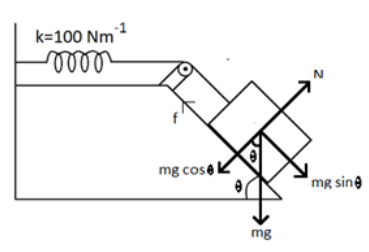
From the figure,
We know the value of the frictional force is given by the equation:
$f = \mu N$
Where, $\mu $ is the coefficient of friction between the block and the incline plane.
$N$ is the normal force acting on the block on the inclined plane.
From the diagram, we can understand that the value of $N$ is given by,
$N = mg\cos \theta $
So, frictional force, $f = \mu mg\cos \theta $
When we consider the net force acting down through the incline (from the diagram)
$ = mg\sin \theta - f$
$ = mg\sin \theta - \mu mg\cos \theta $
$ = mg(\sin \theta - \mu \cos \theta )$
For the equilibrium condition, it should be follow the following condition:
That is, Work done = Potential energy of stretched spring…………….. (1)
The work done in terms of the net force acting and the distance moved is given by,
Work done= \[\] \[net{\text{ }}force{\text{ }}acting \times {\text{ }}distance{\text{ }}moved\]
\[W = mg(\sin \theta - \mu \cos \theta ) \times x\]
Stretched spring’s potential energy of the is given by,
$P.E. = \dfrac{1}{2}K{x^2}$
Applying these values to the equation (1)
$ \Rightarrow mg(\sin \theta - \mu \cos \theta ) \times x = \dfrac{1}{2}K{x^2}$
$ \Rightarrow 2mg(\sin \theta - \mu \cos \theta ) = Kx$
Applying all the known values of all the terms in this equation, we get,
$2 \times 1 \times 10 \times (\sin 45 - \mu \cos 45) = 100 \times 10 \times {10^{ - 2}}$ $\Rightarrow sin45 - \mu \cos 45 = \dfrac{1}{2}$
$ \Rightarrow \dfrac{1}{{\sqrt 2 }} - \dfrac{\mu }{{\sqrt 2 }} = \dfrac{1}{2}$
$ \Rightarrow 1 - \mu = \dfrac{{\sqrt 2 }}{2}$
$ \Rightarrow \mu = \dfrac{{\sqrt 2 - 1}}{{\sqrt 2 }}$
$ \therefore \mu = 0.3$
That is, the co-0efficient of friction in-between the block and the incline is given by , $\mu = 0.3$
Final answers option (B), $0.3$.
Note: There are essentially two kinds of coefficients; static and kinetic. The static coefficient of friction is the coefficient of friction that applies to objects that are motionless. The kinetic or sliding coefficient of friction is the coefficient of friction that applies to objects that are in motion.
Complete step by step solution:
Let’s define all the terms given in the question itself:
Mass of the block is, $m = 1kg$
Angle of the inclined plane is, $\theta = 45^\circ $
Spring constant of the spring to which the block is connected, $K = 100N{m^{ - 1}}$
Distance of the movement of block down the inclined plane before coming to rest:
$x = 10cm$$ = 10 \times {10^{ - 2}}m$
Value of gravitational constant, $g = 10m{s^{ - 2}}$
From the figure,
We know the value of the frictional force is given by the equation:
$f = \mu N$
Where, $\mu $ is the coefficient of friction between the block and the incline plane.
$N$ is the normal force acting on the block on the inclined plane.
From the diagram, we can understand that the value of $N$ is given by,
$N = mg\cos \theta $
So, frictional force, $f = \mu mg\cos \theta $
When we consider the net force acting down through the incline (from the diagram)
$ = mg\sin \theta - f$
$ = mg\sin \theta - \mu mg\cos \theta $
$ = mg(\sin \theta - \mu \cos \theta )$
For the equilibrium condition, it should be follow the following condition:
That is, Work done = Potential energy of stretched spring…………….. (1)
The work done in terms of the net force acting and the distance moved is given by,
Work done= \[\] \[net{\text{ }}force{\text{ }}acting \times {\text{ }}distance{\text{ }}moved\]
\[W = mg(\sin \theta - \mu \cos \theta ) \times x\]
Stretched spring’s potential energy of the is given by,
$P.E. = \dfrac{1}{2}K{x^2}$
Applying these values to the equation (1)
$ \Rightarrow mg(\sin \theta - \mu \cos \theta ) \times x = \dfrac{1}{2}K{x^2}$
$ \Rightarrow 2mg(\sin \theta - \mu \cos \theta ) = Kx$
Applying all the known values of all the terms in this equation, we get,
$2 \times 1 \times 10 \times (\sin 45 - \mu \cos 45) = 100 \times 10 \times {10^{ - 2}}$ $\Rightarrow sin45 - \mu \cos 45 = \dfrac{1}{2}$
$ \Rightarrow \dfrac{1}{{\sqrt 2 }} - \dfrac{\mu }{{\sqrt 2 }} = \dfrac{1}{2}$
$ \Rightarrow 1 - \mu = \dfrac{{\sqrt 2 }}{2}$
$ \Rightarrow \mu = \dfrac{{\sqrt 2 - 1}}{{\sqrt 2 }}$
$ \therefore \mu = 0.3$
That is, the co-0efficient of friction in-between the block and the incline is given by , $\mu = 0.3$
Final answers option (B), $0.3$.
Note: There are essentially two kinds of coefficients; static and kinetic. The static coefficient of friction is the coefficient of friction that applies to objects that are motionless. The kinetic or sliding coefficient of friction is the coefficient of friction that applies to objects that are in motion.
Recently Updated Pages
JEE Isolation, Preparation and Properties of Non-metals Important Concepts and Tips for Exam Preparation

Isoelectronic Definition in Chemistry: Meaning, Examples & Trends
Ionisation Energy and Ionisation Potential Explained
Iodoform Reactions - Important Concepts and Tips for JEE
Introduction to Dimensions: Understanding the Basics
Instantaneous Velocity Explained: Formula, Examples & Graphs
Trending doubts
JEE Main 2026: Exam Dates, Session 2 Updates, City Slip, Admit Card & Latest News
Hybridisation in Chemistry – Concept, Types & Applications
JEE Main 2026 Application Login: Direct Link, Registration, Form Fill, and Steps
Understanding the Electric Field of a Uniformly Charged Ring
Derivation of Equation of Trajectory Explained for Students
JEE Main Marking Scheme 2026- Paper-Wise Marks Distribution and Negative Marking Details
Other Pages
JEE Advanced Marks vs Ranks 2025: Understanding Category-wise Qualifying Marks and Previous Year Cut-offs
JEE Advanced 2026 - Exam Date (Released), Syllabus, Registration, Eligibility, Preparation, and More
CBSE Notes Class 11 Physics Chapter 1 - Units And Measurements - 2025-26
Important Questions For Class 11 Physics Chapter 1 Units and Measurement - 2025-26
NCERT Solutions For Class 11 Physics Chapter 1 Units And Measurements - 2025-26
CBSE Notes Class 11 Physics Chapter 4 - Laws of Motion - 2025-26