








How Do You Calculate Electric Flux Through a Cone?
Electric flux through a cone or disc quantifies the amount of electric field passing through these open surfaces. This concept is essential for understanding field distribution over non-planar geometries, applying surface integrals, and solving problems using symmetry in electrostatics, especially in JEE Main Physics.
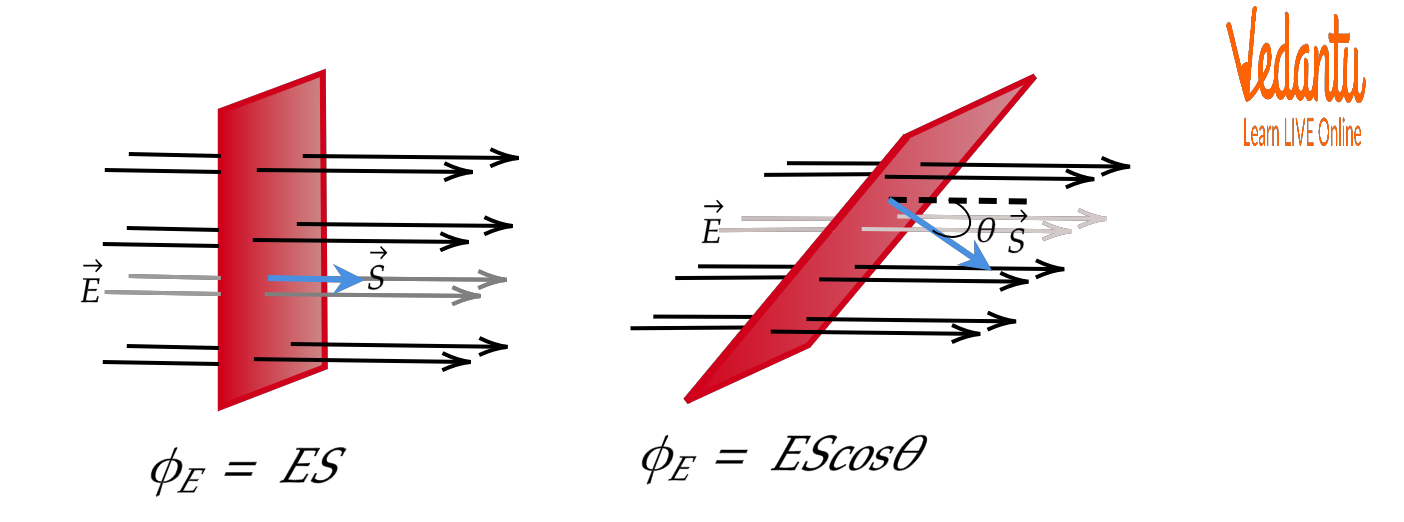
Definition and Mathematical Expression of Electric Flux
Electric flux, denoted by $\Phi$, is defined as the surface integral of the electric field vector $\vec{E}$ with the area vector $\vec{dA}$ over a given surface. For a general surface, the expression is $\Phi = \int_{S} \vec{E} \cdot \vec{dA}$. The SI unit of flux is volt-metre (V·m), equivalent to newton-metre$^2$ per coulomb (N·m$^2$/C).
For a uniform field and a flat surface, the flux simplifies to $\Phi = E \, A \cos\theta$, where $A$ is the area and $\theta$ is the angle between the field and the surface normal. Area vector $\vec{dA}$ is always perpendicular to the surface at each point.
Electric Flux Through a Disc: Formula and Calculation
A disc is a flat, circular surface and an open geometry. In a uniform electric field $E$ making an angle $\theta$ with the disc’s normal, the electric flux through the disc is given by:
$\Phi = E \, A \cos\theta$
Here, $A = \pi R^2$, with $R$ as the radius of the disc. Maximum flux occurs when $\theta = 0^\circ$; if the field is parallel to the disc’s plane, $\theta = 90^\circ$ and flux is zero.
If a point charge $q$ is placed on the axis at distance $a$ above the centre, the flux through the disc becomes:
$\Phi = \dfrac{q}{2\varepsilon_0} \left[1 - \dfrac{a}{\sqrt{a^2 + R^2}}\right]$
This result uses the concept of solid angle subtended by the disc at the charge location.
Electric Flux Through a Cone: Concepts and Formula
A cone is a curved, open surface. Calculation of flux over its lateral surface involves integrating the field over the curved area, accounting for local orientation. For a uniform field $E$ making angle $\alpha$ with the cone’s axis and slant height $l$, the curved area $A = \pi r l$, where $r$ is the base radius.
The general formula for electric flux through the cone’s curved surface is:
$\Phi = E \cdot \pi r l \cos\alpha$
If $E$ is parallel to the axis, $\alpha = 0$, and thus $\Phi = E \cdot \pi r l$. Only the curved surface contributes when the field does not enter through the base.
When a point charge $q$ is at the apex, and the cone subtends a solid angle $\Omega$, the flux through the cone is:
$\Phi = \dfrac{q}{4\pi\varepsilon_0} \cdot \dfrac{\Omega}{4\pi}$
This approach utilizes solid angle and is applicable for sections of spherical surfaces as well.
Comparison with Other Open and Closed Surfaces
Flux through open surfaces like discs, cones, and rings depends on surface orientation and field direction. Closed surfaces such as spheres or cylinders use Gauss’s law, linking net flux to enclosed charge irrespective of field direction. Understanding this difference is key for problems where surfaces partially enclose field lines. To study field mapping concepts, see Electric Field Lines.
| Surface Type | Flux Formula (if in uniform $E$) |
|---|---|
| Disc (radius $R$) | $\Phi = E\pi R^2 \cos\theta$ |
| Cone (base $r$; slant $l$; axis angle $\alpha$) | $\Phi = E\pi r l\cos\alpha$ |
| Ring (no area) | Zero (along symmetry axis) |
| Closed Sphere | $\Phi = \dfrac{q}{\varepsilon_0}$ (if $q$ inside) |
| Closed Cylinder | $\Phi = \dfrac{q_{\text{encl}}}{\varepsilon_0}$ |
Worked Example: Flux Through a Disc in a Uniform Electric Field
Given: Disc radius $R = 0.2$ m, electric field $E = 100$ N/C, angle with normal $\theta = 30^\circ$. Calculate the electric flux through the disc.
Area $A = \pi R^2 = \pi \times (0.2)^2 = \pi \times 0.04 \approx 0.126$ m$^2$.
$\Phi = E A \cos\theta = 100 \times 0.126 \times \cos 30^\circ = 100 \times 0.126 \times 0.866 \approx 10.9$ V·m
Always use the SI unit for flux and ensure correct angle calculation. More such examples are addressed in Electric Field Intensity.
Conceptual Points and Common Pitfalls
For open surfaces, electric flux is nonzero only if the field has a component perpendicular to the surface. For closed surfaces, flux relates only to enclosed charge by Gauss’s law. Students often confuse flux values for open rings and discs; a disc has area and hence nonzero flux, while a ring usually yields zero flux along its axis.
Negative flux indicates the field direction is opposite to the surface normal. For more detailed electrostatics, refer to Introduction to Electrostatics.
Applications of Electric Flux Calculations
Calculating electric flux through discs and cones assists in analyzing electrostatic shielding, capacitor plate fields, and field mapping in detectors. These calculations strengthen concepts required for advanced applications, such as capacitance.
Mastering these topics is essential for accurate use of surface integrals and for relating flux through surfaces with physical interpretations, as tested in competitive exams and in problems on Electrostatic Potential and Capacitance.


FAQs on Understanding Electric Flux Through a Cone or Disc
1. What is the electric flux through a cone placed in a uniform electric field?
The electric flux through a cone placed in a uniform electric field depends on the orientation of the cone’s axis relative to the field direction. For a cone with its base perpendicular to the electric field and vertex pointing away:
- If the field is perpendicular to the base, the flux through the surface of the cone is the same as through its circular base.
- The flux through the curved surface is zero if field lines are parallel to the cone's axis.
- Total electric flux, Φ = E × A × cosθ, where E is field strength, A is base area, and θ is the angle between the field and the normal to the base.
2. How do you calculate the electric flux through a disc?
Electric flux through a disc is calculated by multiplying the external electric field by the area of the disc and the cosine of the angle between the field and the disc’s normal.
- Use the formula: Φ = E × A × cosθ
- E = magnitude of the electric field
- A = area of the disc (πr²)
- θ = angle between the electric field and normal to the disc
3. What is electric flux and what are its units?
Electric flux measures the total number of electric field lines passing perpendicular through a surface.
- It is denoted as Φ and given by Φ = E · A · cosθ
- The SI unit is Newton-metre squared per coulomb (N·m²/C)
- It helps in applying Gauss’s law and calculating electric fields
4. Does the electric flux through a closed surface depend on the surface shape?
The total electric flux through a closed surface depends only on the net charge enclosed, not the shape of the surface.
- This is known as the flux invariance principle according to Gauss’s law
- Any shape—sphere, cube, disc—enclosing the same charge yields identical total flux values
5. How does Gauss’s law relate to electric flux through a surface?
Gauss’s law states that the electric flux through any closed surface is equal to the net charge enclosed divided by the permittivity of free space (ε₀).
- Mathematically, Φ = Q_enclosed / ε₀
- This law connects surface flux to the quantity of enclosed charge
6. What is the formula to find the electric flux through the curved surface of a cone if the axis is parallel to the electric field?
If a cone’s axis is parallel to a uniform electric field, the electric flux through the curved surface is zero.
- This is because the field is parallel to the surface at every point
- No field lines pass perpendicularly through the curved part
- All the flux passes through the base itself
7. What are some common applications of electric flux calculations in physics?
Calculating electric flux is essential for:
- Solving problems using Gauss’s law
- Determining electric field strength near symmetrical charge distributions (like spheres, cylinders, and discs)
- Explaining field patterns for conducting shapes
- Understanding basic principles in electromagnetism and electrostatics
8. When is the electric flux through a disc maximum and minimum?
For a disc in a uniform electric field:
- Maximum flux occurs when the field is perpendicular (normal) to the disc’s surface (θ = 0°)
- Minimum flux (i.e., zero) occurs when the field is parallel to the disc’s surface (θ = 90°)
- Flux depends on orientation—use Φ = E × A × cosθ
9. Can electric flux be negative? What does negative electric flux signify?
Yes, electric flux can be negative.
- Negative flux indicates field lines are entering the surface rather than leaving it
- This occurs when the angle between field and surface normal is more than 90 degrees
- Negative flux often represents a field directed inwards to a closed surface
10. What is the difference between electric flux through an open surface like a disc and a closed surface like a sphere?
The electric flux through an open surface like a disc can be nonzero even if there is no charge on the disc itself, as it depends on the external field. For a closed surface like a sphere:
- Flux depends only on enclosed charge, per Gauss’s law
- For no enclosed charge, total flux is zero, regardless of field outside
- For an open surface, flux is determined by the external field and orientation
