






Key Reasons the British Arrived in India and How Their Rule Began
The question of when and why the British landed on Indian territory is an important topic in Indian history and General Knowledge. The British initially came to India for trade, but over time, they established political control and ruled the country for nearly two centuries. Understanding the timeline, reasons, and consequences of their arrival helps students and competitive exam aspirants grasp the foundations of modern Indian history. This topic is frequently asked in school exams and competitive exams such as UPSC, SSC, Railways, and other state-level tests.
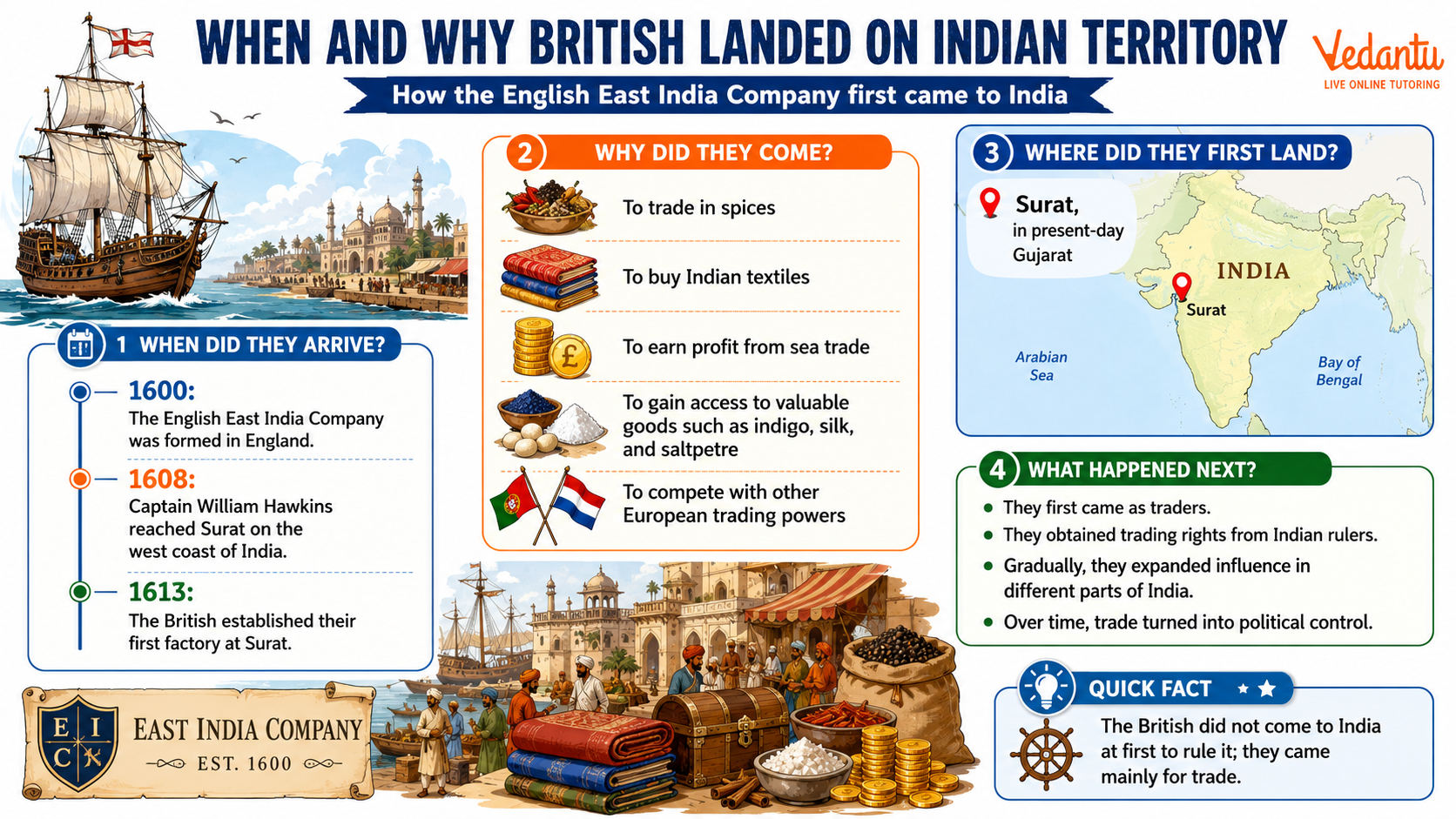
When Did the British First Land in India?
The British first arrived in India at the beginning of the 17th century. Their arrival was connected to trade and commerce rather than direct political ambition in the early stage.
Arrival of the British East India Company
- In 1600, the British East India Company was established by Queen Elizabeth I through a royal charter.
- In 1608, Captain William Hawkins arrived at the port of Surat in Gujarat.
- In 1615, Sir Thomas Roe visited the Mughal Emperor Jahangir’s court to seek permission for trade.
- In 1613, the British established their first factory at Surat after receiving permission from the Mughal authorities.
These early establishments were trading centers known as factories. The British gradually expanded their trade network to other regions such as Madras, Bombay, and Calcutta.
Why Did the British Come to India?
The British came to India mainly for economic and strategic reasons. At that time, India was known for its wealth, spices, textiles, and other valuable goods. European nations were competing to control trade routes and resources.
Main Reasons for British Arrival
- Trade and Profit - India was famous for spices, silk, cotton textiles, indigo, and other goods. The British wanted direct access to these products without relying on middlemen.
- Competition with European Powers - The Portuguese, Dutch, and French were already active in Indian trade. The British wanted to compete and gain dominance.
- Expansion of Markets - Britain needed markets to sell its manufactured goods after the Industrial Revolution.
- Strategic Importance - India’s geographical location made it important for controlling trade routes in Asia.
Initially, their purpose was limited to commerce. However, internal conflicts among Indian rulers and the weakening of the Mughal Empire provided the British with opportunities to interfere in political matters.
Transformation from Traders to Rulers
Over time, the British East India Company shifted from trade to political control. They used diplomacy, military strength, and alliances to expand their influence.
Key Events That Strengthened British Control
- Battle of Plassey (1757) - The British defeated Siraj ud Daulah, marking the beginning of British political dominance in India.
- Battle of Buxar (1764) - Strengthened British control over Bengal and surrounding regions.
- Diwani Rights (1765) - The Mughal Emperor granted the Company the right to collect revenue in Bengal, Bihar, and Orissa.
- Subsidiary Alliance and Doctrine of Lapse - Policies used to annex Indian states.
These events gradually turned the British from traders into rulers. By the mid 19th century, large parts of India were under British control.
Important Timeline of British Arrival in India
| Year | Event | Significance |
|---|---|---|
| 1600 | East India Company formed | Start of British trade ambitions |
| 1608 | Arrival at Surat | First British landing in India |
| 1757 | Battle of Plassey | Beginning of political control |
| 1765 | Diwani Rights granted | Revenue control in Bengal |
This timeline shows how the British presence in India evolved from commercial interests to administrative and political authority.
Impact of British Landing on India
The arrival of the British had long lasting consequences for India’s economy, society, and politics. While they introduced modern education, railways, and legal systems, their policies also led to economic exploitation and social disruption.
Major Impacts
- Drain of wealth from India to Britain.
- Decline of traditional industries like handloom textiles.
- Introduction of Western education and legal reforms.
- Growth of Indian nationalism leading to the freedom struggle.
The British rule officially ended in 1947 when India gained independence after a long struggle.
Conclusion
The British first landed on Indian territory in 1608 at Surat with the aim of trade through the East India Company. Their primary motive was economic profit, but over time, political ambitions grew stronger. Through military victories, strategic alliances, and administrative control, they established dominance over India. Understanding when and why the British came to India provides a clear foundation for studying the freedom movement and modern Indian history. This topic remains highly important for academic learning and competitive examinations.
FAQs on When and Why the British Landed on Indian Territory: Causes and Historical Impact
1. When did the British first land in Indian territory?
The British first landed in Indian territory in 1608 at Surat.
- The ship Hector arrived at Surat under Captain William Hawkins.
- They came as traders representing the British East India Company (EIC).
- This marked the beginning of British presence in India and later colonial rule.
- It was during the reign of Mughal Emperor Jahangir.
(People also ask: When did British rule start in India? How did the East India Company enter India?)
2. Why did the British come to India initially?
The British came to India mainly for trade and economic profit.
- They wanted valuable goods like spices, silk, cotton, indigo, and tea.
- India was known as the “Golden Bird” due to its wealth.
- The East India Company aimed to compete with Portuguese and Dutch traders.
- Trade later turned into political control and colonization.
(PAS: British trade in India, reasons for British colonization, economic motives of British Empire)
3. What was the role of the British East India Company in India?
The British East India Company played a key role in establishing British rule in India.
- Founded in 1600 by Queen Elizabeth I.
- Set up trading factories in Surat, Madras, Bombay, and Calcutta.
- Won the Battle of Plassey (1757), gaining political power.
- Gradually expanded control over Indian territories.
(People also search: East India Company history, Battle of Plassey significance, British expansion in India)
4. How did trade turn into British political control in India?
British trade turned into political control through military victories and alliances.
- Victory in the Battle of Plassey (1757) against Siraj-ud-Daulah.
- Win at the Battle of Buxar (1764) strengthened control in Bengal.
- Introduction of policies like Subsidiary Alliance and Doctrine of Lapse.
- Weakening of the Mughal Empire helped British expansion.
(PAA: How did British conquer India? What was Subsidiary Alliance?)
5. Who allowed the British to trade in India?
Mughal Emperor Jahangir granted permission to the British to trade in India.
- Captain William Hawkins visited Jahangir’s court.
- Later, Sir Thomas Roe secured trade privileges.
- The British established trading posts called factories.
- Mughal support helped expand British commercial activities.
(Related queries: Mughal-British relations, Jahangir and East India Company)
6. Which European powers came to India before the British?
Several European powers arrived in India before the British.
- Portuguese (1498) led by Vasco da Gama.
- Dutch (1602) through the Dutch East India Company.
- French via the French East India Company.
- The British competed with them for trade dominance.
(PAS: European colonization in India, Portuguese in India history)
7. What was the significance of the Battle of Plassey?
The Battle of Plassey (1757) marked the beginning of British political rule in India.
- Fought between Robert Clive and Siraj-ud-Daulah.
- Resulted in British control over Bengal.
- Provided huge revenue and resources to the East India Company.
- Opened the path for further British expansion.
(People also ask: Why was Battle of Plassey important? Who won Battle of Plassey?)
8. Why was India important to the British Empire?
India was important to the British Empire due to its wealth, resources, and strategic location.
- Provided raw materials like cotton, jute, tea, and indigo.
- Served as a large market for British manufactured goods.
- Strengthened Britain’s global trade network.
- Called the “Jewel in the Crown” of the British Empire.
(Related searches: Importance of India to Britain, economic impact of British rule)
9. How long did British rule last in India?
British rule in India lasted for nearly 200 years, from 1757 to 1947.
- Company rule from 1757 to 1858.
- Direct Crown rule after the Revolt of 1857.
- Ended with India’s Independence on 15 August 1947.
- Period known as the British Raj.
(PAA: When did British Raj start? When did India gain independence?)
10. What were the main consequences of British landing in India?
The British landing in India led to major political, economic, and social changes.
- Establishment of colonial rule and loss of Indian sovereignty.
- Economic exploitation and drain of wealth.
- Introduction of railways, telegraph, and English education.
- Rise of the Indian National Movement for independence.
(People also search: Effects of British rule in India, impact of colonization on India)
