






Who Were the Indian Rail Ministers and Their Tenure?
The Railway Ministers of India play a crucial role in managing and developing the Indian Railways, one of the largest railway networks in the world. Indian Railways is a lifeline of the nation, connecting cities, towns, and villages while supporting economic growth, trade, and national integration. The Railway Minister heads the Ministry of Railways and is responsible for policy-making, infrastructure expansion, safety measures, modernization, and passenger services. This topic is important for General Knowledge and competitive exams such as UPSC, SSC, Railways, and other state-level examinations.
About the Ministry of Railways
The Ministry of Railways is a ministry under the Government of India that oversees the operations of Indian Railways. The Railway Minister is a Cabinet Minister and works with Ministers of State and senior railway officials to implement policies and projects.
- Formulates railway policies and long-term plans
- Presents the Railway Budget - earlier separate, now merged with Union Budget since 2017
- Ensures railway safety and modernization
- Oversees infrastructure projects like new lines and electrification
- Improves passenger amenities and freight services
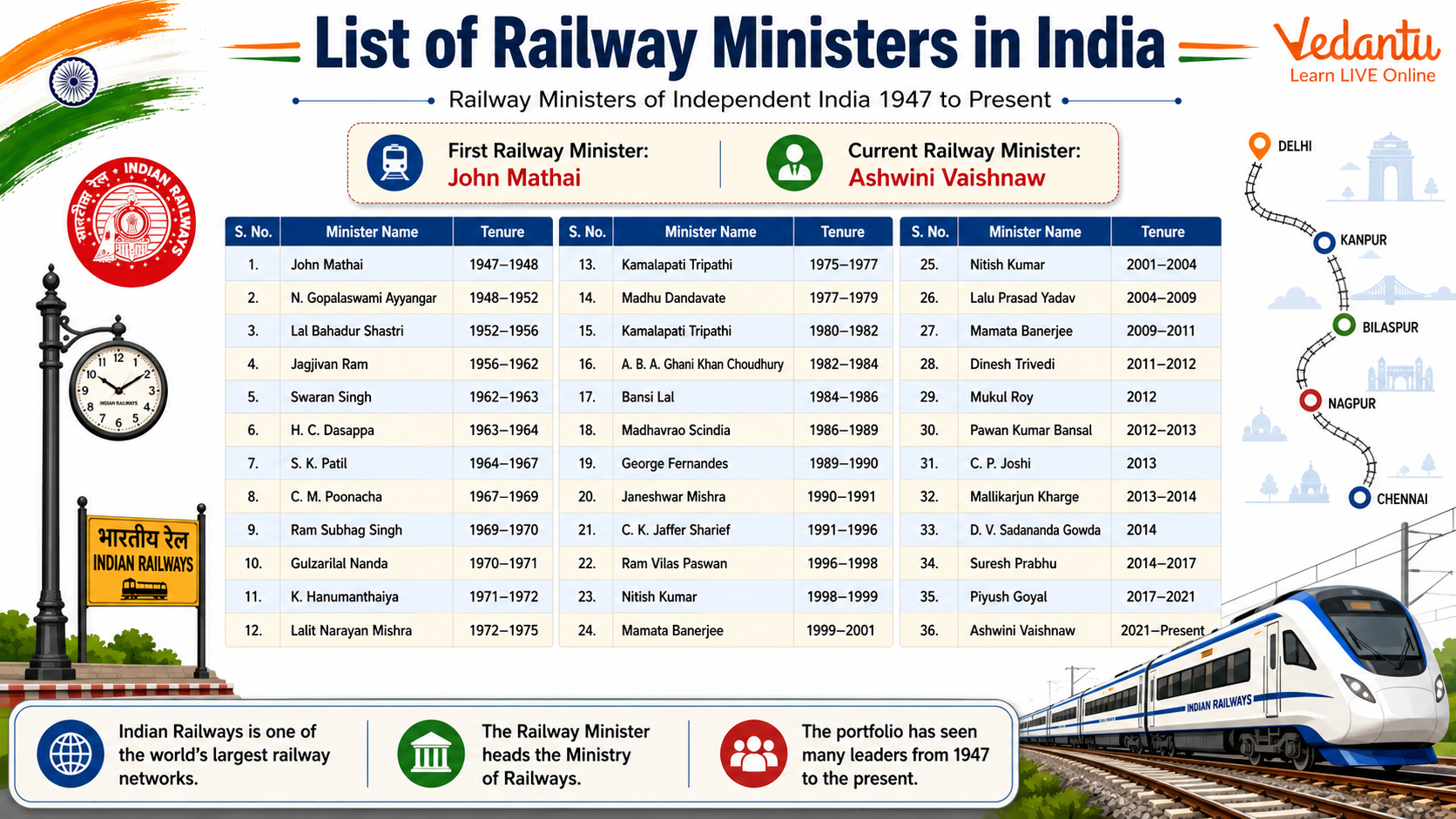
List of Railway Ministers of India (1947 - Present)
| Name | Tenure | Remarks |
|---|---|---|
| John Mathai | 1947 - 1948 | First Railway Minister of Independent India |
| Lal Bahadur Shastri | 1951 - 1956 | Resigned after railway accident |
| Jagjivan Ram | 1956 - 1962 | Longest continuous tenure in early years |
| Madhavrao Scindia | 1986 - 1989 | Modernization initiatives |
| Nitish Kumar | 1998 - 1999, 2001 - 2004 | Focus on safety reforms |
| Lalu Prasad Yadav | 2004 - 2009 | Financial turnaround of Railways |
| Mamata Banerjee | 1999 - 2001, 2009 - 2011 | Introduced new passenger services |
| Suresh Prabhu | 2014 - 2017 | Digital reforms and cleanliness drives |
| Piyush Goyal | 2017 - 2021 | 100 percent electrification push |
| Ashwini Vaishnaw | 2021 - Present | High speed rail and modernization focus |
Note: Several other leaders have served as Railway Ministers between these tenures. The above table highlights some of the most notable Railway Ministers in India for exam-oriented preparation.
Important Contributions of Railway Ministers
1. Safety Reforms
Railway Ministers have introduced various safety measures such as anti-collision devices, track modernization, and elimination of unmanned level crossings to reduce accidents.
2. Electrification and Modernization
Indian Railways has moved towards large-scale electrification of railway lines to reduce fuel dependency and carbon emissions. Modern coaches, bio-toilets, and Vande Bharat trains have been introduced in recent years.
3. Financial Reforms
Some Railway Ministers focused on improving revenue through freight reforms, public-private partnerships, and better ticketing systems.
4. Passenger Amenities
Improvements include online ticket booking, station redevelopment, Wi-Fi facilities at stations, and enhanced catering services.
Merger of Railway Budget with Union Budget
Until 2016, the Railway Budget was presented separately from the General Budget. In 2017, the Government of India merged the Railway Budget with the Union Budget to streamline financial management and reduce administrative processes.
- Ended the 92-year-old practice of separate Railway Budget
- Allowed better financial integration
- Reduced procedural delays
Why Railway Ministers Are Important for India
Indian Railways transports millions of passengers daily and plays a vital role in freight transportation. The decisions taken by the Railway Minister impact economic development, employment, regional connectivity, and national security.
- Supports industrial growth
- Connects remote and rural areas
- Generates large-scale employment
- Strengthens national integration
Exam Preparation Tips
For competitive exams, focus on important Railway Ministers, their tenure, major reforms, and recent developments in Indian Railways.
- Remember the first Railway Minister of Independent India - John Mathai
- Note ministers who introduced major reforms such as Lalu Prasad Yadav and Piyush Goyal
- Stay updated with the current Railway Minister
- Prepare short notes for quick revision
Conclusion
The Railway Ministers of India have significantly contributed to the growth and transformation of Indian Railways since independence. From safety reforms to electrification and digital transformation, their leadership has shaped one of the largest railway systems in the world. Understanding their roles, tenure, and contributions is essential for General Knowledge and competitive examinations. Regular revision of key ministers and recent updates will help students score better in exams.
FAQs on Railway Ministers in India: Complete List, Terms and Contributions
1. Who was the first Railway Minister of India?
The first Railway Minister of India was Dr. John Mathai, who served in 1947 after Independence.
• He was part of Jawaharlal Nehru’s cabinet.
• He later became the Finance Minister of India.
• His tenure marked the early restructuring of Indian Railways post-independence.
This is an important fact for GK, UPSC, SSC, and Railway exams.
2. Who is the current Railway Minister of India?
The current Railway Minister of India is Ashwini Vaishnaw (as of 2026).
• He took office in July 2021.
• He also serves as the Minister of Communications and Electronics & IT.
• He oversees modernization projects like Vande Bharat trains and railway electrification.
This question is frequently asked in current affairs and competitive exams.
3. How many Railway Ministers has India had so far?
India has had more than 40 Railway Ministers since 1947, including those with additional charge.
• Several ministers served short tenures.
• Some leaders held the portfolio multiple times.
• The position operates under the Ministry of Railways, Government of India.
The number may vary slightly due to interim appointments and cabinet reshuffles.
4. Who was the longest-serving Railway Minister of India?
The longest-serving Railway Minister of India was Lalu Prasad Yadav.
• He served from 2004 to 2009.
• He was known for turning Indian Railways into a financially profitable organization.
• His tenure is often cited in discussions about railway reforms and management strategies.
This topic is popular in People Also Ask (PAA) queries about railway history.
5. Who was the first woman Railway Minister of India?
The first woman Railway Minister of India was Mamata Banerjee.
• She first held the position in 1999.
• She later served again in 2009–2011.
• She introduced several new trains and passenger-friendly initiatives.
This is a key fact in Indian political history and women leaders in India.
6. What are the main responsibilities of the Railway Minister of India?
The Railway Minister of India heads the Ministry of Railways and oversees national rail operations.
• Policy-making and railway budget planning
• Expansion and modernization of Indian Railways
• Passenger safety and infrastructure development
• Implementation of projects like high-speed rail and electrification
The minister plays a crucial role in managing one of the world’s largest rail networks.
7. When was the separate Railway Budget abolished in India?
The separate Railway Budget was abolished in 2017.
• It was merged with the General Union Budget.
• The decision was implemented during the tenure of Suresh Prabhu.
• The merger aimed to streamline financial planning and reduce procedural delays.
This reform is significant in Indian economic and railway administration history.
8. Which Railway Minister introduced major railway reforms in India?
Several Railway Ministers introduced major reforms, notably Lalu Prasad Yadav and Suresh Prabhu.
• Lalu Prasad focused on financial turnaround strategies.
• Suresh Prabhu emphasized digitalization, transparency, and safety reforms.
• Recent reforms include station redevelopment and semi-high-speed trains.
These reforms are often discussed in UPSC and railway exam preparation.
9. Under which ministry does the Railway Minister work?
The Railway Minister heads the Ministry of Railways, Government of India.
• It operates under the Union Cabinet.
• The ministry manages Indian Railways, one of the largest rail networks globally.
• It handles policy, operations, safety, and infrastructure projects.
This is a common GK question related to Indian government structure.
10. Why is the Railway Minister important in Indian governance?
The Railway Minister of India is important because Indian Railways is a lifeline of the nation’s transport system.
• It connects urban and rural India.
• It supports economic growth and freight movement.
• It generates large-scale employment opportunities.
• It plays a key role in infrastructure development and national integration.
The position is highly significant in Indian polity, governance, and public administration.
