






How Alkalis Form Alkaline Solutions in Water (pH Explained)
An alkali is a special type of base that dissolves in water to produce hydroxide ions. An alkaline solution is a solution that contains these hydroxide ions and has a pH value greater than 7. Understanding alkalis and alkaline solutions is important in chemistry, especially for students preparing for competitive exams like NEET. These concepts are closely related to acids, bases, pH scale, indicators, and chemical reactions in everyday life.
What Is an Alkali?
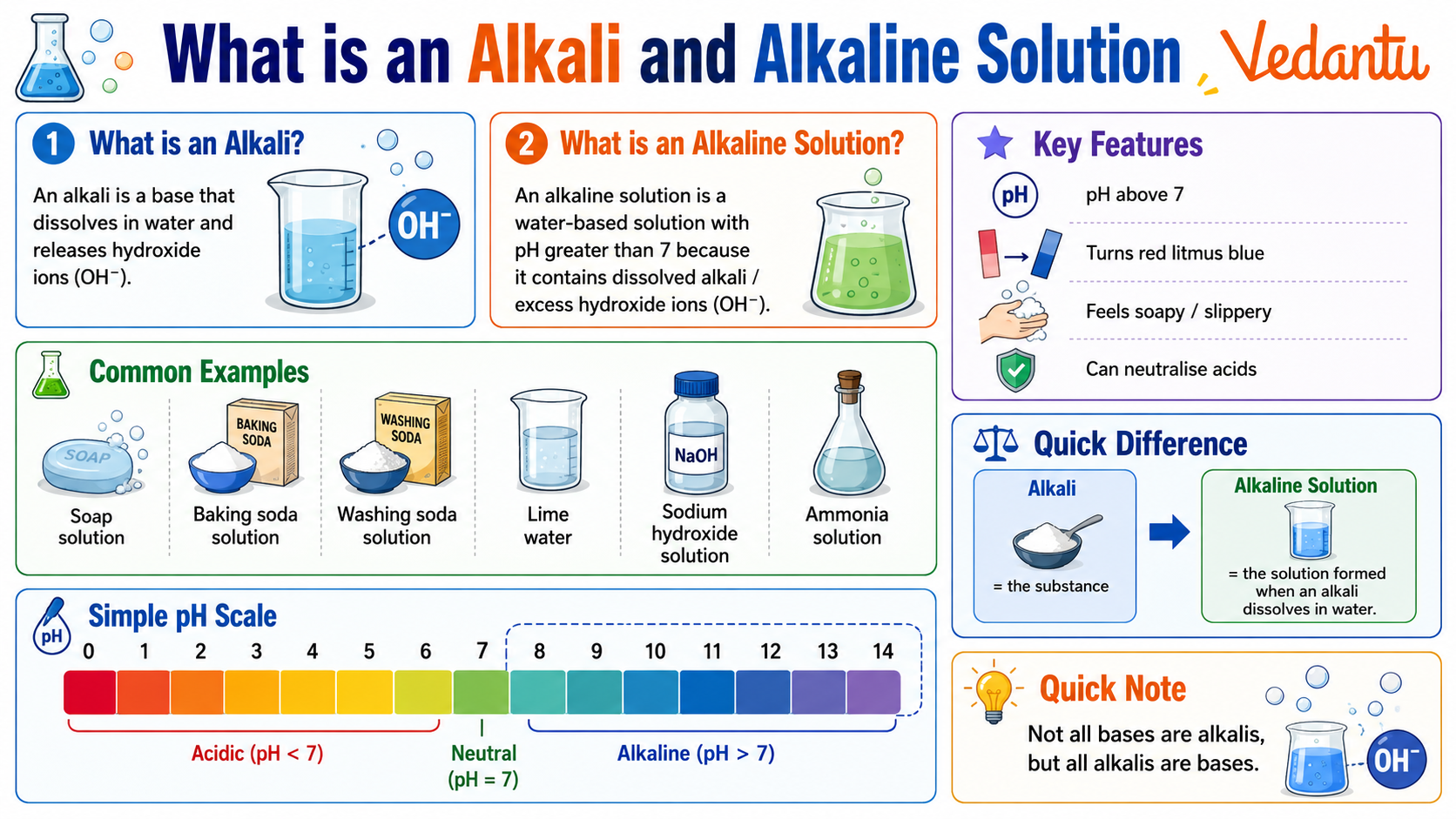
An alkali is a base that is soluble in water. When dissolved in water, it releases hydroxide ions (OH-) which make the solution basic or alkaline. Not all bases are alkalis. Only those bases that dissolve in water are called alkalis.
Definition of Alkali
An alkali is a water-soluble base that produces hydroxide ions (OH-) when dissolved in water.
Common Examples of Alkalis
- Sodium hydroxide (NaOH) - also called caustic soda
- Potassium hydroxide (KOH)
- Calcium hydroxide Ca(OH)2 - also known as slaked lime
- Ammonium hydroxide (NH4OH)
What Is an Alkaline Solution?
An alkaline solution is a solution that contains hydroxide ions and has a pH value greater than 7. These solutions turn red litmus paper blue and feel slippery to touch. The strength of an alkaline solution depends on the concentration of hydroxide ions present in it.
Characteristics of Alkaline Solutions
- pH value greater than 7
- Turns red litmus paper blue
- Feels soapy or slippery
- Can neutralize acids to form salt and water
Difference Between Base and Alkali
| Property | Base | Alkali |
|---|---|---|
| Solubility | May or may not dissolve in water | Always soluble in water |
| Hydroxide Ions | May produce OH- in solution | Produces OH- in water |
| Example | Copper oxide (CuO) | Sodium hydroxide (NaOH) |
All alkalis are bases, but not all bases are alkalis. This distinction is important in understanding chemical reactions and properties.
pH Scale and Alkaline Nature
The pH scale ranges from 0 to 14 and measures the acidity or basicity of a solution. A pH value of 7 is neutral. Values below 7 indicate acidic solutions, while values above 7 indicate alkaline solutions.
pH Values of Some Common Alkaline Substances
- Soap solution - pH around 9 to 10
- Baking soda solution - pH around 8 to 9
- Sodium hydroxide solution - pH around 13 to 14
Chemical Reactions of Alkalis
Alkalis participate in important chemical reactions, especially neutralization reactions.
Neutralization Reaction
When an alkali reacts with an acid, it forms salt and water. This reaction is called neutralization.
- Example: NaOH + HCl → NaCl + H2O
Such reactions are important in controlling soil acidity, treating indigestion, and industrial processes.
Uses of Alkalis in Daily Life
Alkalis are widely used in homes and industries due to their chemical properties.
- Manufacture of soaps and detergents
- Paper and textile industries
- Water treatment processes
- Neutralizing acidic soils in agriculture
- Antacids to relieve stomach acidity
Important Points for NEET Preparation
For NEET and other competitive exams, students should clearly understand the conceptual difference between bases and alkalis, the role of hydroxide ions, and the significance of pH values.
- Remember that all alkalis are bases but not all bases are alkalis.
- Focus on pH scale interpretation and indicator color changes.
- Practice chemical equations involving neutralization.
- Understand real life applications for conceptual clarity.
Conclusion
An alkali is a water-soluble base that produces hydroxide ions in solution, while an alkaline solution is any solution with a pH greater than 7 containing hydroxide ions. These concepts are fundamental in chemistry and are essential for understanding acid-base reactions, pH scale, and practical applications in daily life and industry. A strong grasp of alkalis and alkaline solutions helps students build a solid foundation for higher studies and competitive examinations like NEET.
FAQs on What Is an Alkali and an Alkaline Solution in Chemistry?
1. What is an alkali?
An alkali is a base that dissolves in water to produce hydroxide ions (OH⁻).
• It is a water-soluble base.
• Produces hydroxide ions (OH⁻) in aqueous solution.
• Turns red litmus paper blue.
• Has a pH value greater than 7.
Common examples include sodium hydroxide (NaOH) and potassium hydroxide (KOH). (People also ask: Is every base an alkali? What is the difference between base and alkali?)
2. What is an alkaline solution?
An alkaline solution is a water-based solution that contains dissolved alkali and has a pH above 7.
• Contains OH⁻ ions in water.
• Has a pH between 7 and 14.
• Feels soapy and tastes bitter (not to be tested directly).
• Neutralizes acids in a neutralization reaction.
This term is often used interchangeably with basic solution. (People also search: properties of alkaline solutions, alkaline meaning in chemistry)
3. What is the difference between a base and an alkali?
The main difference is that all alkalis are bases, but not all bases are alkalis.
• Base: A substance that neutralizes acids and may or may not dissolve in water.
• Alkali: A base that is soluble in water.
• Example of base: Copper oxide (CuO) (insoluble).
• Example of alkali: Sodium hydroxide (NaOH) (soluble).
This distinction is important in understanding acid-base chemistry. (PAA: Are all bases soluble in water?)
4. What are common examples of alkalis?
Common examples of alkalis are substances that dissolve in water to form alkaline solutions.
• Sodium hydroxide (NaOH) – caustic soda
• Potassium hydroxide (KOH)
• Calcium hydroxide (Ca(OH)₂) – slaked lime
• Ammonium hydroxide (NH₄OH)
These alkalis are widely used in industry, soaps, detergents, and cleaning agents. (People also search: strong and weak alkalis examples)
5. What are the properties of alkalis?
Alkalis have characteristic physical and chemical properties.
• Taste bitter and feel soapy.
• Turn red litmus paper blue.
• Have pH greater than 7.
• Conduct electricity in aqueous solution.
• React with acids to form salt and water.
These properties help identify alkaline substances in laboratories and exams.
6. How do alkalis react with acids?
Alkalis react with acids in a neutralization reaction to form salt and water.
• Acid + Alkali → Salt + Water
• Example: HCl + NaOH → NaCl + H₂O
• The reaction reduces acidity and alkalinity.
This process is important in chemical reactions, soil treatment, and medicine. (PAA: What is neutralization in chemistry?)
7. What is the pH range of an alkaline solution?
An alkaline solution has a pH value greater than 7 on the pH scale.
• pH 7 – Neutral (pure water)
• pH 8–14 – Alkaline range
• Strong alkalis have pH close to 14.
The pH scale measures acidity and basicity, making it essential in acid-base chemistry.
8. Are all alkaline solutions strong?
No, alkaline solutions can be strong or weak depending on the concentration of hydroxide ions.
• Strong alkalis: Completely ionize in water (e.g., NaOH, KOH).
• Weak alkalis: Partially ionize (e.g., NH₄OH).
• Strength depends on degree of ionization and pH value.
This concept is important for competitive exams and understanding strong vs weak bases.
9. What are the uses of alkalis in daily life?
Alkalis are widely used in household and industrial applications.
• Manufacturing soaps and detergents.
• Cleaning agents like bleach and drain cleaners.
• Treating acidic soil in agriculture.
• Used in paper, textile, and chemical industries.
These uses highlight the importance of alkaline substances in everyday life.
10. How can you test if a solution is alkaline?
You can test an alkaline solution using indicators and pH measurement tools.
• Turns red litmus paper blue.
• Phenolphthalein turns pink.
• Universal indicator shows blue to purple color.
• pH meter reading above 7 confirms alkalinity.
These methods are commonly used in laboratories and school experiments to identify bases and alkalis.
