






Key Provisions of the UAPA 1967 and Its Major Amendments
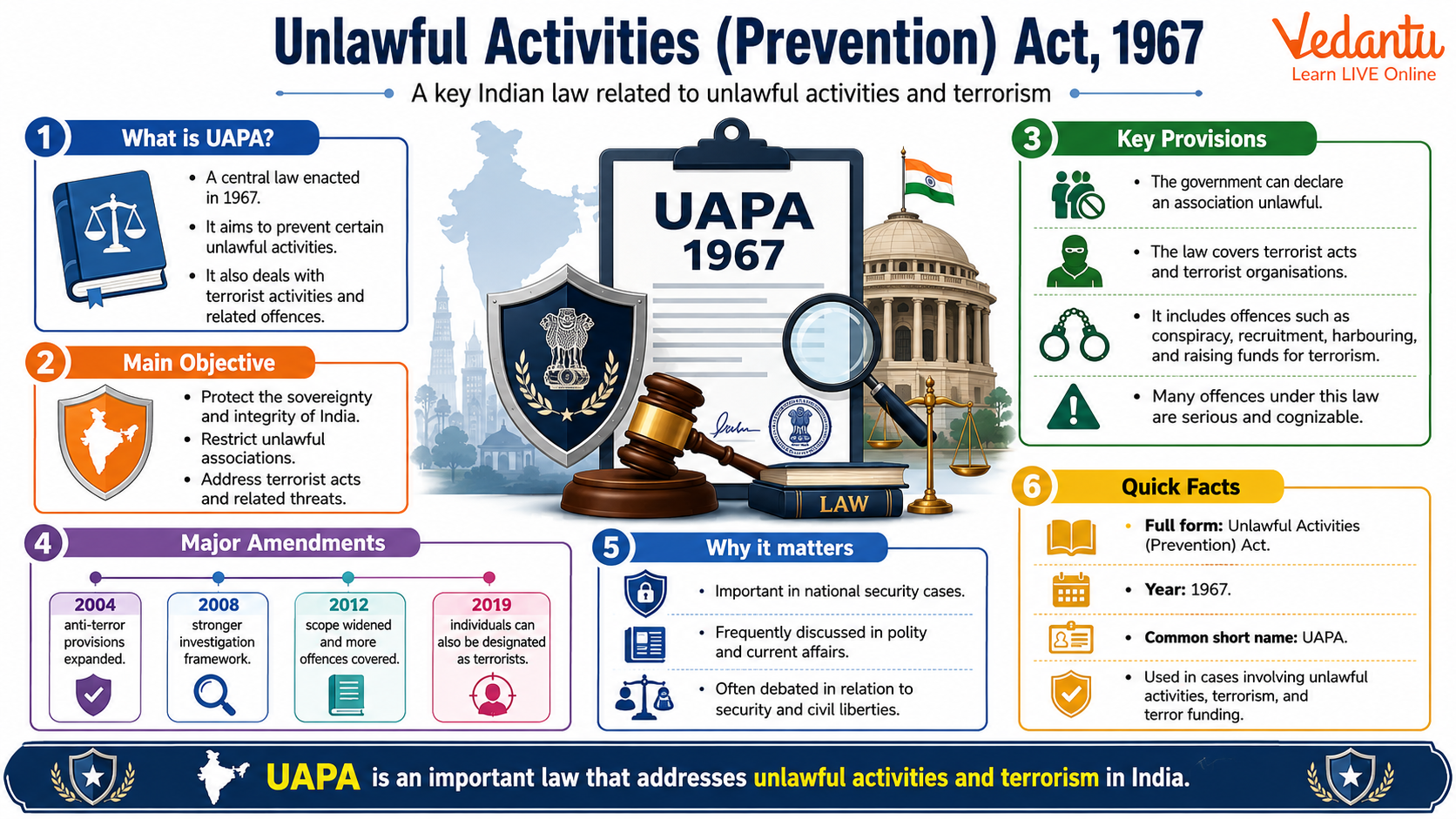
The Unlawful Activities Prevention Act 1967 (UAPA) is one of the most important anti-terror and national security laws in India. Enacted by the Parliament of India, this Act aims to prevent unlawful activities and terrorist actions that threaten the sovereignty and integrity of the country. Over the years, the law has been amended multiple times to strengthen the legal framework against terrorism, secessionist movements, and organized extremist activities. The UAPA is highly relevant for students preparing for competitive exams such as UPSC, SSC, State PSC, and other government examinations, as it frequently appears in questions related to polity, internal security, and current affairs.
Background and Need for UAPA 1967
The Unlawful Activities Prevention Act was enacted in 1967 in the backdrop of rising secessionist tendencies and challenges to India’s unity and sovereignty. The law empowered the government to impose restrictions on associations and organizations involved in unlawful activities.
- To safeguard the sovereignty and integrity of India.
- To deal with organizations promoting secession or disintegration.
- To provide a legal mechanism to ban unlawful associations.
- To strengthen national security and internal stability.
After the repeal of earlier anti-terror laws such as TADA and POTA, several provisions related to terrorism were incorporated into the UAPA through amendments.
Objectives of the Unlawful Activities Prevention Act
The main objective of the UAPA is to prevent activities that threaten India’s sovereignty and integrity. Over time, its scope has expanded to include terrorism and related offenses.
- Prevent unlawful and anti-national activities.
- Declare associations and individuals as terrorists.
- Investigate and prosecute terror financing.
- Enable seizure of property related to terrorism.
- Empower investigative agencies like the National Investigation Agency.
Major Amendments to UAPA
The UAPA has undergone significant amendments to strengthen anti-terror laws in India. Each amendment expanded the scope and powers under the Act.
Key Amendments in UAPA
| Year | Key Changes | Purpose |
|---|---|---|
| 2004 | Incorporated POTA provisions | Included terrorist activities and organizations |
| 2019 | Allowed designation of individuals as terrorists | Strengthened preventive action |
The 2004 amendment marked a turning point by formally adding terrorism-related offenses into the Act. The 2019 amendment empowered the central government to designate individuals, not just organizations, as terrorists.
Important Provisions of UAPA
1. Declaration of Unlawful Association
The central government can declare any association unlawful if it is involved in activities that threaten India’s sovereignty and integrity.
2. Terrorist Activities
The Act defines terrorist acts broadly, including use of bombs, firearms, or other hazardous means to threaten national security or public order.
3. Terror Financing
Raising funds for terrorist activities is punishable under UAPA. Authorities can seize properties linked to terror financing.
4. Extended Detention
The Act allows extended detention periods for investigation, and bail provisions are stricter compared to ordinary criminal law.
5. Role of NIA
The National Investigation Agency is empowered to investigate and prosecute offenses under UAPA across India.
Criticism and Concerns
While the UAPA plays a crucial role in national security, it has also been criticized for potential misuse and impact on civil liberties.
- Stringent bail conditions.
- Extended pre-trial detention.
- Broad definition of terrorist activities.
- Concerns regarding fundamental rights.
Importance of UAPA for Competitive Exams
The Unlawful Activities Prevention Act 1967 is an important topic under Indian Polity and Internal Security. Questions may be asked about its objectives, amendments, provisions, and recent developments.
- Frequently asked in UPSC Prelims and Mains.
- Relevant for State PSC and SSC exams.
- Important for essays and internal security topics.
Conclusion
The Unlawful Activities Prevention Act 1967 remains a central pillar of India’s counter-terrorism framework. It provides the government with legal authority to combat unlawful and terrorist activities that threaten national integrity. While it strengthens internal security, debates around its implementation and civil liberties continue. For students and aspirants, understanding the provisions, amendments, and significance of UAPA is essential for comprehensive preparation in General Knowledge and competitive examinations.
FAQs on Unlawful Activities (Prevention) Act 1967 Explained for Students
1. What is the Unlawful Activities Prevention Act (UAPA) 1967?
The Unlawful Activities (Prevention) Act, 1967 (UAPA) is India’s primary anti-terror law aimed at preventing unlawful activities and terrorism.
• Enacted in 1967 to deal with activities threatening India’s sovereignty and integrity
• Amended in 2004, 2008, 2012, and 2019 to strengthen anti-terror provisions
• Allows the government to designate individuals and organizations as terrorists
• Replaced earlier laws like POTA and TADA
It is commonly discussed in topics such as anti-terror laws in India, national security legislation, and internal security.
2. Why was the UAPA enacted in 1967?
The UAPA 1967 was enacted to curb activities that threatened India’s unity and sovereignty.
• Addressed secessionist movements after the 1962 Sino-Indian War
• Empowered the government to ban unlawful associations
• Strengthened constitutional provisions under Article 19(2)
The Act ensures protection against threats to national integrity, internal security, and public order.
3. What are the main features of the Unlawful Activities Prevention Act?
The UAPA includes strict provisions to prevent terrorism and unlawful activities.
• Defines terrorist acts and terrorist organizations
• Allows designation of individuals as terrorists (2019 Amendment)
• Extends detention period up to 180 days without charge sheet
• Empowers National Investigation Agency (NIA)
• Provides for seizure of terror-related property
These features make UAPA one of the strongest anti-terror laws in India.
4. What changes were introduced in the UAPA Amendment 2019?
The UAPA Amendment Act, 2019 strengthened the government’s power to combat terrorism.
• Allowed the government to declare individuals as terrorists (not just organizations)
• Empowered the NIA Director-General to approve property seizure
• Expanded NIA’s jurisdiction to investigate terrorism cases nationwide
This amendment is frequently asked in UPSC, SSC, and other competitive exams.
5. What is meant by ‘unlawful activity’ under UAPA?
Under UAPA, ‘unlawful activity’ refers to actions that threaten India’s sovereignty and integrity.
• Supports cession or secession of Indian territory
• Disrupts territorial integrity
• Causes disaffection against India
The term is broader than terrorism and includes activities against national unity and constitutional order.
6. How is UAPA different from TADA and POTA?
The UAPA replaced earlier anti-terror laws like TADA (1985) and POTA (2002).
• TADA and POTA were repealed due to misuse allegations
• UAPA is a continuing law with multiple amendments
• Covers both unlawful activities and terrorism
Unlike TADA and POTA, UAPA remains the central counter-terrorism legislation in India.
7. What are the punishments under the Unlawful Activities Prevention Act?
Punishments under UAPA are severe and depend on the nature of the offence.
• Imprisonment up to life imprisonment
• Death penalty in extreme terrorism cases
• Heavy fines and property seizure
• Extended pre-trial detention
The Act aims to deter terrorist activities and protect national security.
8. What role does the National Investigation Agency (NIA) play under UAPA?
The National Investigation Agency (NIA) is empowered to investigate offences under UAPA.
• Can investigate terrorism cases across India without state consent
• Handles cases related to terror funding and terror networks
• Authorized to attach and seize properties linked to terrorism
NIA plays a crucial role in enforcing anti-terror laws in India.
9. Why is UAPA often criticized?
The UAPA faces criticism for potential misuse and strict bail provisions.
• Difficult to obtain bail under Section 43D(5)
• Extended detention without charge sheet
• Concerns over impact on civil liberties and freedom of speech
Debates continue regarding balancing national security and fundamental rights.
10. Is UAPA important for competitive exams?
Yes, the Unlawful Activities Prevention Act 1967 is highly important for competitive exams.
• Frequently asked in UPSC, SSC, State PCS, CDS exams
• Relevant under Indian Polity and Internal Security
• Questions focus on amendments, features, and criticisms
Understanding UAPA helps in preparing for topics related to anti-terror legislation and national security laws.
