






How High Can the World’s Highest Flying Birds Soar?
Birds are among the most fascinating creatures on Earth, and some species are capable of flying at astonishing altitudes. The highest flying birds in the world can soar thousands of meters above sea level, crossing mountains, oceans, and extreme weather conditions. Their unique respiratory systems, strong wings, and special adaptations allow them to survive in thin air where oxygen levels are very low. In this article, we explore the Top 10 Highest Flying Birds in the World, their maximum recorded altitudes, and the remarkable features that make such high-altitude flight possible.
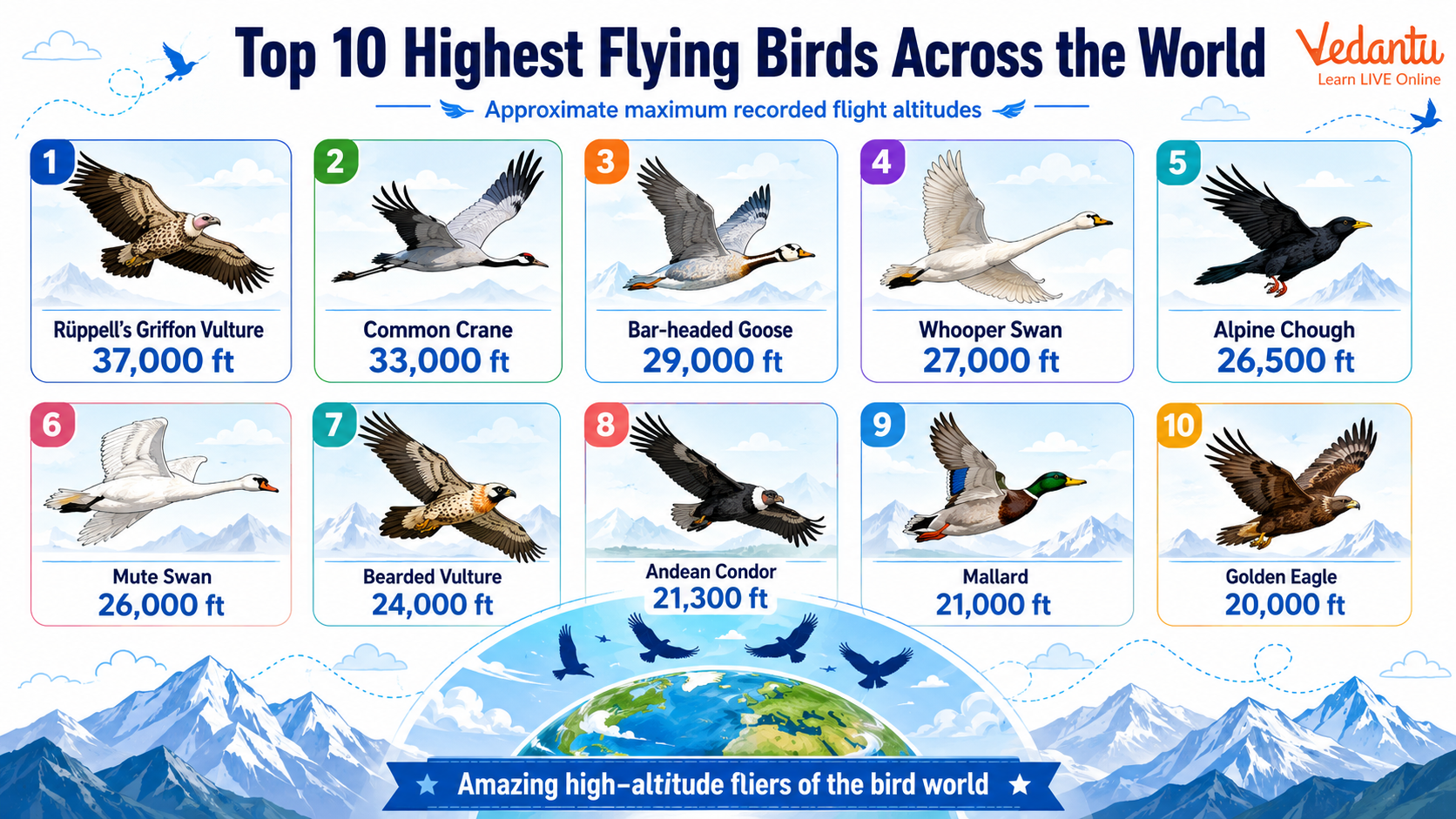
Top 10 Highest Flying Birds In The World
| Bird Name | Maximum Recorded Altitude | Region |
|---|---|---|
| Ruppell's Griffon Vulture | 37,000 feet | Africa |
| Bar-headed Goose | 29,000 feet | Asia |
| Whooper Swan | 27,000 feet | Europe and Asia |
| Andean Condor | 21,000 feet | South America |
| Alpine Chough | 26,500 feet | Europe and Asia |
| Bearded Vulture | 24,000 feet | Europe, Africa, Asia |
| Common Crane | 33,000 feet | Europe and Asia |
| Yellow-billed Chough | 26,000 feet | Mountain Regions |
| Golden Eagle | 20,000 feet | Northern Hemisphere |
| Lammergeier | 24,000 feet | Mountain Regions |
The Ruppell's Griffon Vulture holds the record for the highest confirmed bird flight, reaching about 37,000 feet, which is nearly the cruising altitude of commercial airplanes. Many of these birds are migratory species that cross mountain ranges such as the Himalayas, Andes, and Alps.
Why Do Some Birds Fly So High?
High-altitude flight is mainly linked to migration, predator avoidance, and energy efficiency. Flying at higher altitudes can help birds use favorable wind currents and avoid obstacles such as mountains.
- To cross mountain ranges like the Himalayas
- To take advantage of strong tailwinds
- To reduce competition and avoid predators
- For long-distance seasonal migration
Adaptations That Help Birds Fly at High Altitudes
Flying at extreme heights requires special biological adaptations because oxygen levels decrease as altitude increases. These birds have evolved efficient respiratory and circulatory systems.
1. Efficient Respiratory System
Birds have air sacs that allow continuous airflow through their lungs. This system is more efficient than the human respiratory system and helps them absorb more oxygen even in thin air.
2. High Hemoglobin Affinity
Species like the Bar-headed Goose have hemoglobin that binds oxygen more effectively, enabling survival at altitudes above 25,000 feet.
3. Large Wingspan
Large wings help in gliding and conserving energy. Birds such as condors and vultures rely on thermal currents to stay airborne with minimal effort.
4. Strong Muscles and Heart
High-altitude birds have powerful flight muscles and strong hearts that pump oxygen-rich blood efficiently throughout the body.
Interesting Facts About High-Flying Birds
- The Bar-headed Goose migrates over the Himalayas, one of the highest mountain ranges in the world.
- Ruppell's Griffon Vulture once collided with an aircraft at 37,000 feet, confirming its record altitude.
- Andean Condors can soar for hours without flapping their wings.
- High-altitude birds can tolerate freezing temperatures and low oxygen levels.
Importance of Studying High-Altitude Birds
Studying the highest flying birds helps scientists understand how animals adapt to extreme environments. Their physiology provides insights into oxygen efficiency, climate adaptation, and even medical research related to hypoxia. For students and competitive exam aspirants, this topic is important in general knowledge, biology, and environmental science sections.
Conclusion
The Top 10 Highest Flying Birds in the World demonstrate nature's extraordinary ability to adapt and survive in extreme conditions. From the record-breaking Ruppell's Griffon Vulture to the resilient Bar-headed Goose, these birds showcase powerful flight, advanced respiratory systems, and remarkable endurance. Understanding these species not only enhances general knowledge but also highlights the wonders of biodiversity and evolution.
FAQs on Top 10 Highest Flying Birds Across the World
1. What are the top 10 highest flying birds in the world?
The highest flying birds in the world are species known for reaching extreme altitudes during migration or flight.
- Rüppell’s Griffon Vulture – up to 37,000 ft
- Bar-headed Goose – over 29,000 ft
- Whooper Swan – around 27,000 ft
- Alpine Chough
- Bearded Vulture (Lammergeier)
- Andean Condor
- Common Crane
- Yellow-billed Chough
- Mallard Duck
- Golden Eagle
These high-altitude birds are often discussed in GK questions, competitive exams, and wildlife studies.
2. Which bird holds the record for flying at the highest altitude?
Rüppell’s Griffon Vulture holds the world record for the highest flying bird.
- Recorded at 37,000 feet (11,300 meters)
- Spotted near an aircraft over Africa
- Adapted to low oxygen levels
It is recognized in aviation and wildlife records as the highest altitude flying bird in the world.
3. How high can the Bar-headed Goose fly?
The Bar-headed Goose can fly over 29,000 feet, crossing the Himalayas during migration.
- Flies above Mount Everest region
- Has efficient lungs and hemoglobin
- Known for long-distance migration
It is often cited in GK and biology topics as one of the highest flying migratory birds.
4. Why can some birds fly at very high altitudes?
High-flying birds have special adaptations that allow them to survive in low-oxygen environments.
- Large and powerful lungs
- Efficient oxygen absorption
- Strong wing muscles
- Lightweight body structure
These physiological adaptations help them fly in thin air, cold temperatures, and strong winds at extreme heights.
5. Do eagles fly higher than other birds?
Eagles can fly at high altitudes, but they are not the highest flying birds in the world.
- Golden Eagle can reach around 15,000–20,000 ft
- Uses thermal currents to soar
- Common in mountainous regions
Although powerful, eagles do not surpass species like the Rüppell’s Griffon Vulture or Bar-headed Goose in altitude records.
6. Which migratory bird flies over the Himalayas?
The Bar-headed Goose is famous for flying over the Himalayas.
- Migrates between Central Asia and India
- Crosses peaks above 29,000 ft
- Has unique respiratory efficiency
It is widely studied in wildlife biology and migration studies for its high-altitude endurance.
7. How do high flying birds survive low oxygen levels?
High-altitude birds survive low oxygen through special biological adaptations.
- High-affinity hemoglobin
- Faster breathing rate
- Efficient blood circulation
- Large lung capacity
These features allow them to function in thin air conditions where most animals cannot survive.
8. What is the typical flying altitude of most birds?
Most birds usually fly between 500 and 5,000 feet above ground level.
- Small birds fly at lower altitudes
- Migratory birds fly higher
- Weather and wind affect flight height
Only a few species qualify as extreme high-altitude flyers above 20,000 feet.
9. Are vultures among the highest flying birds?
Yes, vultures are among the highest flying birds in the world.
- Rüppell’s Griffon Vulture holds the altitude record
- Uses thermal air currents to soar
- Has excellent eyesight at high altitudes
Vultures are commonly featured in GK lists of top high-flying birds.
10. Why is the study of highest flying birds important?
Studying the highest flying birds helps scientists understand flight adaptation and aviation safety.
- Improves knowledge of oxygen efficiency
- Helps prevent bird-aircraft collisions
- Supports wildlife conservation
- Useful for competitive exams and GK preparation
These birds provide insights into avian physiology, migration patterns, and extreme survival.
