






Why the IUCN Red List of Threatened Species Is Important for Biodiversity Protection
The IUCN Red Data Book is one of the most important global documents for biodiversity conservation. Prepared by the International Union for Conservation of Nature (IUCN), it provides detailed information about the conservation status of plant and animal species across the world. The relevance of the IUCN Red Data Book lies in its role as a scientific tool for identifying endangered species, guiding conservation policies, and raising awareness about biodiversity loss. It is widely used by researchers, governments, environmentalists, and students preparing for competitive exams like NEET and UPSC.
What is the IUCN Red Data Book?
The IUCN Red Data Book, also known as the IUCN Red List of Threatened Species, is a comprehensive inventory of the global conservation status of biological species. It assesses species based on scientific criteria and categorizes them according to their risk of extinction.
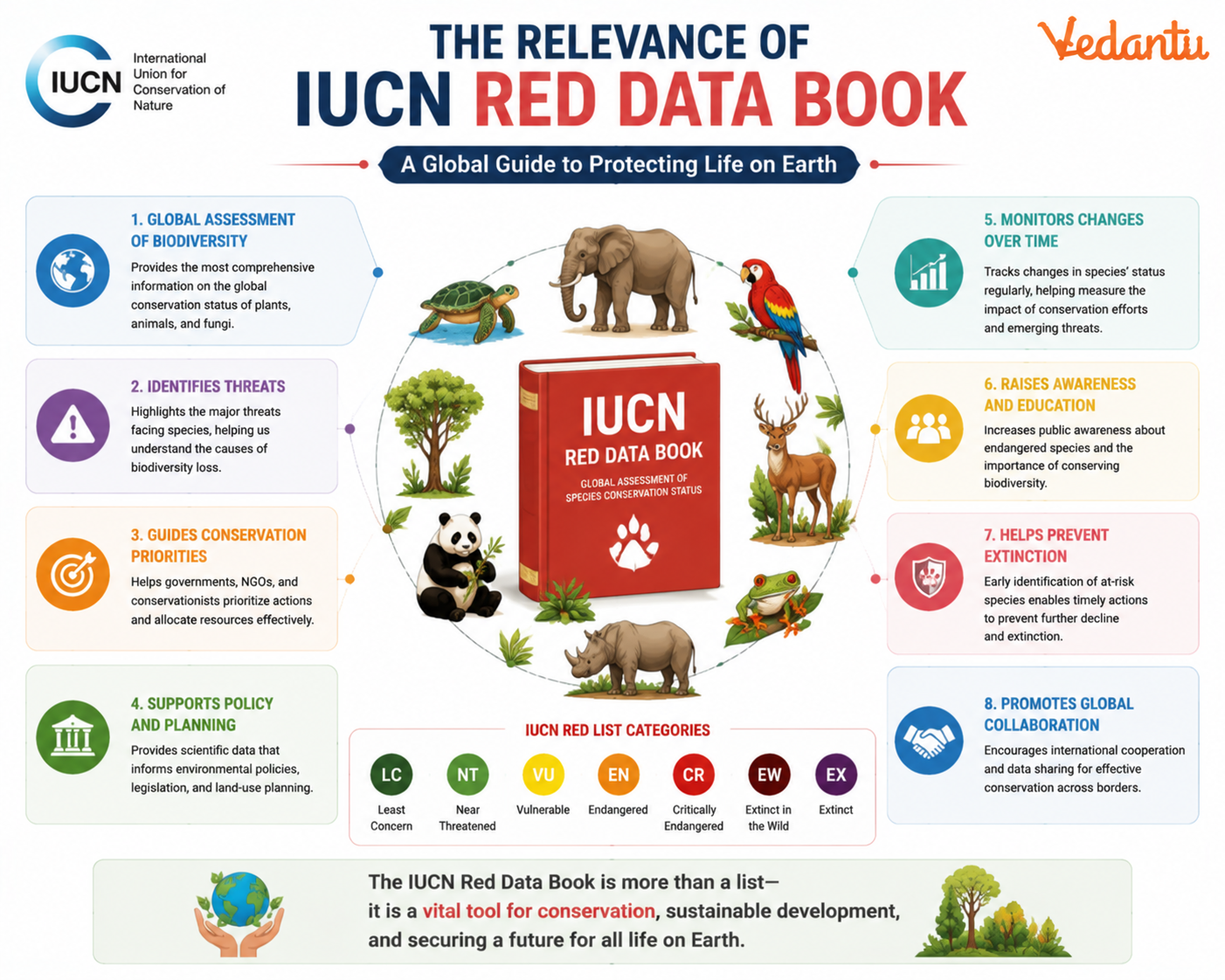
- Prepared and maintained by the International Union for Conservation of Nature.
- First introduced in 1964.
- Covers animals, plants, fungi, and other organisms.
- Updated regularly based on scientific research and field data.
Major Categories in the IUCN Red Data Book
Species are classified into different categories depending on their population size, rate of decline, geographic distribution, and risk of extinction.
IUCN Conservation Categories
| Category | Meaning | Example |
|---|---|---|
| Extinct (EX) | No known individuals remaining | Dodo |
| Endangered (EN) | Very high risk of extinction | Tiger |
| Least Concern (LC) | Low risk of extinction | House Sparrow |
Other important categories include Critically Endangered (CR), Vulnerable (VU), Near Threatened (NT), Data Deficient (DD), and Not Evaluated (NE). These classifications help scientists and policymakers prioritize conservation actions.
Relevance of the IUCN Red Data Book
1. Conservation Planning
The Red Data Book helps governments and environmental organizations identify species that require urgent protection. It assists in designing wildlife sanctuaries, national parks, and conservation programs.
2. Policy Formulation
International agreements such as CITES and national biodiversity laws often rely on IUCN data. It provides a scientific foundation for environmental legislation and wildlife protection acts.
3. Scientific Research
Researchers use Red List data to study population trends, habitat loss, climate change effects, and ecological balance. It also helps in monitoring species recovery programs.
4. Public Awareness and Education
By publishing updated lists of threatened species, the IUCN spreads awareness about biodiversity loss. It encourages public participation in conservation activities and sustainable practices.
5. Global Biodiversity Monitoring
The Red Data Book serves as a global indicator of the health of biodiversity. Changes in species categories reflect environmental conditions and human impact on ecosystems.
Criteria Used for Assessment
The IUCN follows strict scientific criteria to evaluate species. These include quantitative measures to ensure accuracy and consistency.
- Rate of population decline over time.
- Geographic range and distribution.
- Total population size.
- Degree of population fragmentation.
- Probability of extinction in the wild.
Importance for NEET and Competitive Exams
The IUCN Red Data Book is an important topic in Biology, particularly in the chapter on Biodiversity and Conservation. Questions may be asked about its categories, objectives, and significance in environmental protection.
- Understand the full forms of EX, EN, CR, VU, and LC.
- Remember that IUCN is a global organization.
- Focus on differences between Endangered, Vulnerable, and Critically Endangered categories.
- Revise examples of species under different categories.
Conclusion
The relevance of the IUCN Red Data Book extends beyond classification of species. It acts as a global conservation tool, a scientific database, and a policy guide for protecting biodiversity. By identifying threatened species and monitoring their status, it plays a vital role in preventing extinction and maintaining ecological balance. For students and aspirants, understanding the IUCN Red Data Book is essential not only for examinations but also for developing awareness about environmental sustainability and conservation responsibility.
FAQs on Relevance of the IUCN Red Data Book in Conservation Studies
1. What is the IUCN Red Data Book?
The IUCN Red Data Book is a global record of the conservation status of plant and animal species.
- Published by the International Union for Conservation of Nature (IUCN)
- Lists species as Endangered, Vulnerable, Critically Endangered, etc.
- Also known as the IUCN Red List of Threatened Species
- Acts as a scientific tool for biodiversity conservation and wildlife protection
It helps governments, researchers, and students understand which species face extinction risk.
2. Why is the IUCN Red Data Book important?
The relevance of the IUCN Red Data Book lies in its role in preventing species extinction and promoting conservation planning.
- Identifies species at risk of extinction
- Guides wildlife conservation policies
- Supports environmental laws and protection programs
- Raises global awareness about biodiversity loss
It is widely used in competitive exams and environmental studies.
3. Who prepares and maintains the IUCN Red List?
The IUCN (International Union for Conservation of Nature) prepares and updates the Red List with expert support.
- Founded in 1948
- Headquarters in Gland, Switzerland
- Works with scientists, conservationists, and NGOs worldwide
- Uses scientific criteria to assess species survival status
It is considered the most trusted global authority on threatened species.
4. What are the main categories in the IUCN Red Data Book?
The IUCN Red List categories classify species based on their extinction risk.
- Extinct (EX)
- Extinct in the Wild (EW)
- Critically Endangered (CR)
- Endangered (EN)
- Vulnerable (VU)
- Near Threatened (NT)
- Least Concern (LC)
These categories help in understanding the conservation priority of species.
5. How does the IUCN Red Data Book help in wildlife conservation?
The IUCN Red Data Book supports wildlife conservation by providing scientific data for action.
- Identifies species needing urgent protection
- Helps create protected areas and national parks
- Assists in framing environmental policies
- Encourages international cooperation for endangered species
It acts as a foundation for global biodiversity management strategies.
6. What is the difference between the Red Data Book and Red List?
The terms Red Data Book and IUCN Red List are often used interchangeably, but the Red List is the updated digital version.
- Red Data Book: Earlier printed records of threatened species
- Red List: Modern online database regularly updated
- Both assess threatened and endangered species
Today, the Red List is the primary global reference for conservation status.
7. How are species classified in the IUCN Red List?
Species in the IUCN Red List are classified using scientific criteria based on population trends and threats.
- Rate of population decline
- Geographic range size
- Habitat fragmentation
- Probability of extinction
This evidence-based system ensures accuracy in determining conservation status.
8. How is the IUCN Red Data Book useful for students and competitive exams?
The IUCN Red Data Book is important for exams as it covers key topics in environment and ecology.
- Frequently asked in UPSC, SSC, and State PSC exams
- Helps understand endangered species in India and the world
- Strengthens knowledge of biodiversity and conservation
It is a vital GK topic for environmental awareness and academic studies.
9. Does the IUCN Red Data Book include plants and marine species?
Yes, the IUCN Red Data Book includes animals, plants, fungi, and marine species.
- Covers terrestrial and aquatic ecosystems
- Assesses forest species, freshwater species, and marine life
- Provides data on coral reefs, mammals, birds, reptiles, and flora
It offers a comprehensive overview of global biodiversity status.
10. How often is the IUCN Red List updated?
The IUCN Red List is updated regularly to reflect new scientific data and conservation outcomes.
- Updated multiple times a year
- Based on latest research and field surveys
- Reflects changes in species population and threat levels
Regular updates ensure accurate tracking of global extinction risks and conservation progress.
