






Complete Year-Wise List of India’s Finance Ministers and Their Terms
The List of Finance Ministers of India is an important topic in General Knowledge and competitive examinations. The Finance Minister of India heads the Ministry of Finance and is responsible for managing the country's economic policies, taxation system, budget presentation, financial regulations, and overall fiscal management. Since Independence in 1947, several distinguished leaders have served as Finance Minister and played a crucial role in shaping India's economic development. Understanding the chronology, major reforms, and contributions of these ministers is essential for students, aspirants of UPSC, SSC, Banking, and other government exams.
Role of the Finance Minister of India
The Finance Minister is one of the most important members of the Union Cabinet. The ministry deals with economic policy making, budget preparation, taxation, financial institutions, capital markets, and expenditure management. The Finance Minister also represents India in international financial institutions such as the World Bank, IMF, and G20 meetings.
Key Responsibilities
- Presentation of the Union Budget in Parliament every year.
- Formulation of taxation policies including direct and indirect taxes.
- Management of government expenditure and fiscal deficit.
- Regulation of banking, insurance, and financial markets.
- Handling economic crises and implementing reforms.
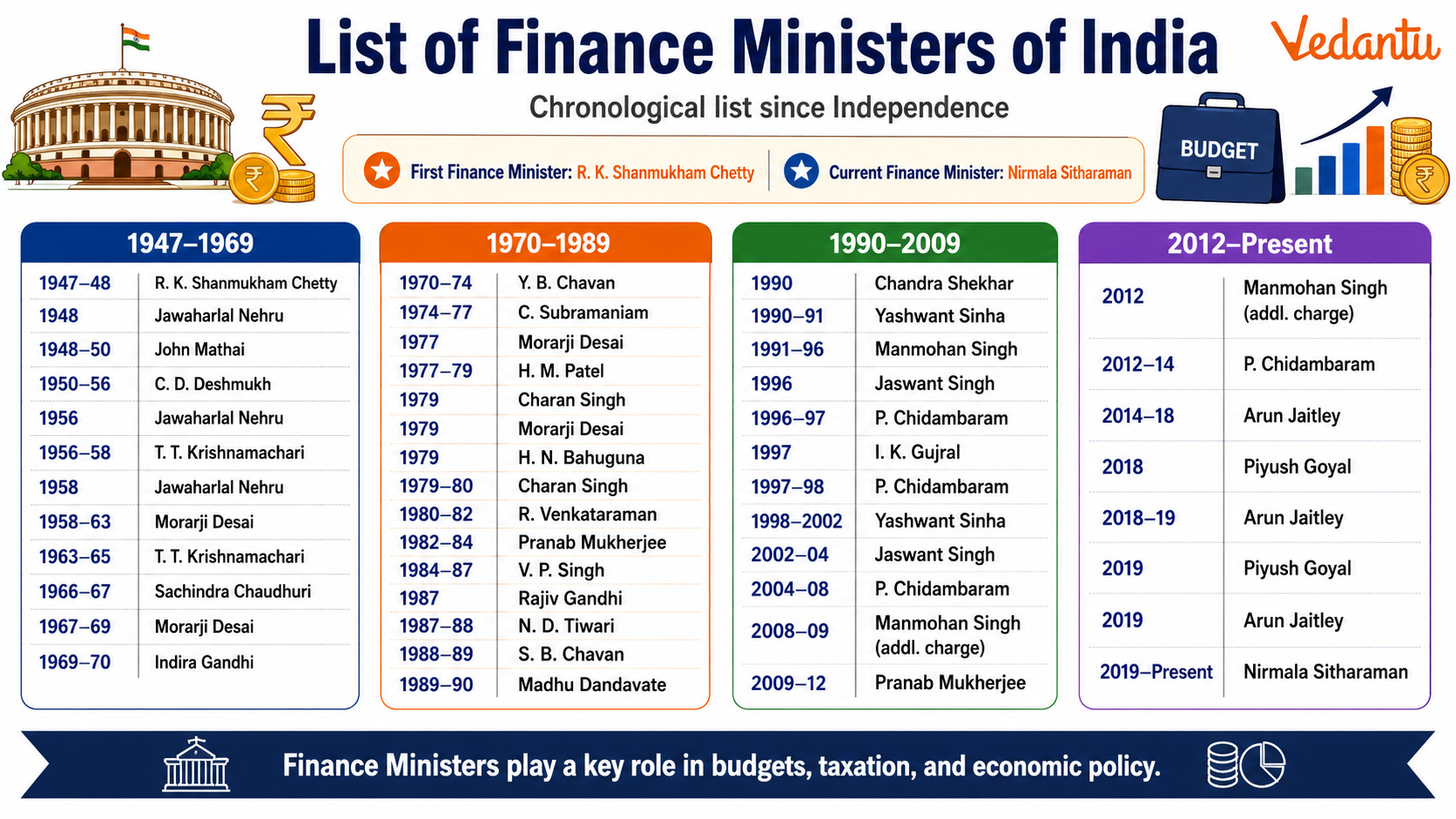
List of Finance Ministers of India (1947 - Present)
| Finance Minister | Tenure | Prime Minister |
|---|---|---|
| R. K. Shanmukham Chetty | 1947 - 1948 | Jawaharlal Nehru |
| John Mathai | 1949 - 1950 | Jawaharlal Nehru |
| C. D. Deshmukh | 1950 - 1956 | Jawaharlal Nehru |
| T. T. Krishnamachari | 1956 - 1958, 1964 - 1966 | J. Nehru, L. B. Shastri |
| Morarji Desai | 1958 - 1963, 1967 - 1969 | Nehru, Indira Gandhi |
| Y. B. Chavan | 1970 - 1974 | Indira Gandhi |
| C. Subramaniam | 1975 - 1977 | Indira Gandhi |
| H. M. Patel | 1977 - 1979 | Morarji Desai |
| R. Venkataraman | 1980 - 1982 | Indira Gandhi |
| Pranab Mukherjee | 1982 - 1984, 2009 - 2012 | Indira Gandhi, Manmohan Singh |
| V. P. Singh | 1984 - 1987 | Rajiv Gandhi |
| Manmohan Singh | 1991 - 1996 | P. V. Narasimha Rao |
| P. Chidambaram | 1996 - 1998, 2004 - 2008, 2012 - 2014 | Various |
| Yashwant Sinha | 1998 - 2002 | Atal Bihari Vajpayee |
| Jaswant Singh | 2002 - 2004 | Atal Bihari Vajpayee |
| Arun Jaitley | 2014 - 2019 | Narendra Modi |
| Nirmala Sitharaman | 2019 - Present | Narendra Modi |
The table above highlights major Finance Ministers from 1947 to the present. Some ministers held office more than once. Nirmala Sitharaman is the first full time woman Finance Minister of India.
Major Economic Reforms by Finance Ministers
1991 Economic Liberalization - Dr. Manmohan Singh
In 1991, India faced a severe balance of payments crisis. As Finance Minister, Dr. Manmohan Singh introduced liberalization, privatization, and globalization reforms. These reforms reduced import restrictions, encouraged foreign investment, and deregulated industries, transforming the Indian economy.
Introduction of GST - Arun Jaitley
The Goods and Services Tax was implemented in 2017. It replaced multiple indirect taxes with a single unified tax system. GST improved tax compliance and simplified the indirect taxation structure in India.
Recent Budget Reforms - Nirmala Sitharaman
Recent budgets have focused on infrastructure development, digital economy, startup promotion, and fiscal consolidation. Policies promoting self reliance and economic recovery after global disruptions have been key highlights.
Important Facts for Competitive Exams
- First Finance Minister of Independent India - R. K. Shanmukham Chetty.
- First woman Finance Minister (full time) - Nirmala Sitharaman.
- Finance Minister who presented the 1991 reform budget - Dr. Manmohan Singh.
- Longest serving Finance Minister - Morarji Desai (multiple terms).
- Union Budget is presented annually in Parliament, usually on 1 February.
How to Prepare This Topic for Exams
- Memorize the first and current Finance Ministers.
- Focus on major economic reforms and the ministers associated with them.
- Remember important years like 1991 reforms and 2017 GST implementation.
- Revise through tables and chronological order for better retention.
Conclusion
The List of Finance Ministers of India reflects the economic journey of the nation from independence to a rapidly growing global economy. Each Finance Minister has contributed through policy decisions, reforms, and budgetary measures that shaped India's financial system. For competitive exams and general awareness, understanding the timeline, major reforms, and key facts related to Finance Ministers is essential. Regular revision of this topic through tables and factual highlights ensures strong performance in GK sections.
FAQs on List of Finance Ministers of India with Tenure and Party Details
1. Who was the first Finance Minister of India?
R.K. Shanmukham Chetty was the first Finance Minister of India and presented independent India’s first Union Budget in 1947.
• Served from 1947 to 1949
• Presented the first Union Budget on 26 November 1947
• Played a key role in shaping India’s early economic and financial policies
• Associated with the formation of India’s post-independence fiscal framework
2. Who is the current Finance Minister of India?
Nirmala Sitharaman is the current Finance Minister of India, serving since 2019.
• First full-time woman Finance Minister of India
• Presented multiple Union Budgets including post-COVID economic recovery budgets
• Oversees key institutions like the Ministry of Finance, RBI coordination, and economic reforms
• Plays a major role in India’s fiscal policy and taxation decisions
3. Who has served as Finance Minister of India for the longest period?
Morarji Desai holds the record for serving the longest as Finance Minister of India.
• Served for about 10 years (1958–1963, 1967–1969)
• Later became the Prime Minister of India
• Known for introducing significant financial discipline and taxation reforms
• Presented multiple Union Budgets during his tenure
4. Who was the first woman Finance Minister of India?
Indira Gandhi was the first woman to hold the post of Finance Minister of India (additional charge), while Nirmala Sitharaman is the first full-time woman Finance Minister.
• Indira Gandhi held the portfolio in 1969–1970
• Nirmala Sitharaman took charge in 2019
• Marked a significant milestone in India’s political and economic leadership history
5. What are the main responsibilities of the Finance Minister of India?
The Finance Minister of India is responsible for managing the country’s economic and financial affairs.
• Presents the annual Union Budget in Parliament
• Oversees taxation, revenue, and expenditure policies
• Supervises financial institutions like RBI, SEBI, and public sector banks
• Frames policies related to economic growth, inflation, and fiscal deficit
6. Who presented the highest number of Union Budgets in India?
Morarji Desai presented the highest number of Union Budgets in India.
• Presented 10 Union Budgets
• Includes both regular and interim budgets
• Known for strong fiscal management and economic planning
• A prominent figure in India’s financial administration history
7. How many Finance Ministers has India had since independence?
India has had multiple Finance Ministers since 1947, including those with additional charge.
• The list includes leaders from different political parties
• Some served multiple non-consecutive terms
• Includes notable names like Manmohan Singh, P. Chidambaram, Pranab Mukherjee, and Arun Jaitley
• The exact number may vary depending on interim and acting appointments
8. Who was the Finance Minister during the 1991 economic reforms?
Dr. Manmohan Singh was the Finance Minister during India’s landmark 1991 economic liberalization reforms.
• Served under Prime Minister P.V. Narasimha Rao
• Introduced policies of Liberalization, Privatization, and Globalization (LPG reforms)
• Reduced import tariffs and deregulated industries
• Transformed India into a more open market economy
9. What is the role of the Finance Minister in presenting the Union Budget?
The Finance Minister presents the Union Budget annually, outlining the government’s revenue and expenditure plans.
• Delivered in the Lok Sabha
• Includes details on tax proposals, fiscal deficit, and sectoral allocations
• Highlights economic policies for the upcoming financial year
• A key event in India’s parliamentary and economic calendar
10. Who are some notable former Finance Ministers of India?
Several Finance Ministers of India have played crucial roles in shaping the country’s economy.
• Pranab Mukherjee – Long-serving and later President of India
• P. Chidambaram – Introduced major tax and economic reforms
• Arun Jaitley – Implemented GST (Goods and Services Tax)
• Yashwant Sinha – Focused on fiscal consolidation and reforms
• Manmohan Singh – Architect of 1991 economic reforms
