






The Constituent Assembly of India: Formation, Key Members and Major Debates
The Constituent Assembly of India was a sovereign body formed to draft and adopt the Constitution of India. It played a historic role in shaping the political, legal, and democratic framework of independent India. The Assembly reflected the aspirations of a newly independent nation and worked through debates, discussions, and committee reports to create one of the most detailed constitutions in the world. Understanding the Constituent Assembly is important for students and competitive exam aspirants as it explains the foundations of Indian democracy.
Background of the Constituent Assembly
The idea of a Constituent Assembly was first proposed by M.N. Roy in 1934. Later, the demand was officially taken up by the Indian National Congress. The British Government accepted the proposal under the Cabinet Mission Plan of 1946, which laid down the procedure for forming the Assembly.
- The Cabinet Mission Plan was announced in 1946.
- Members were indirectly elected by the Provincial Legislative Assemblies.
- Seats were allocated based on population.
- Princely states were given representation.
Composition of the Constituent Assembly
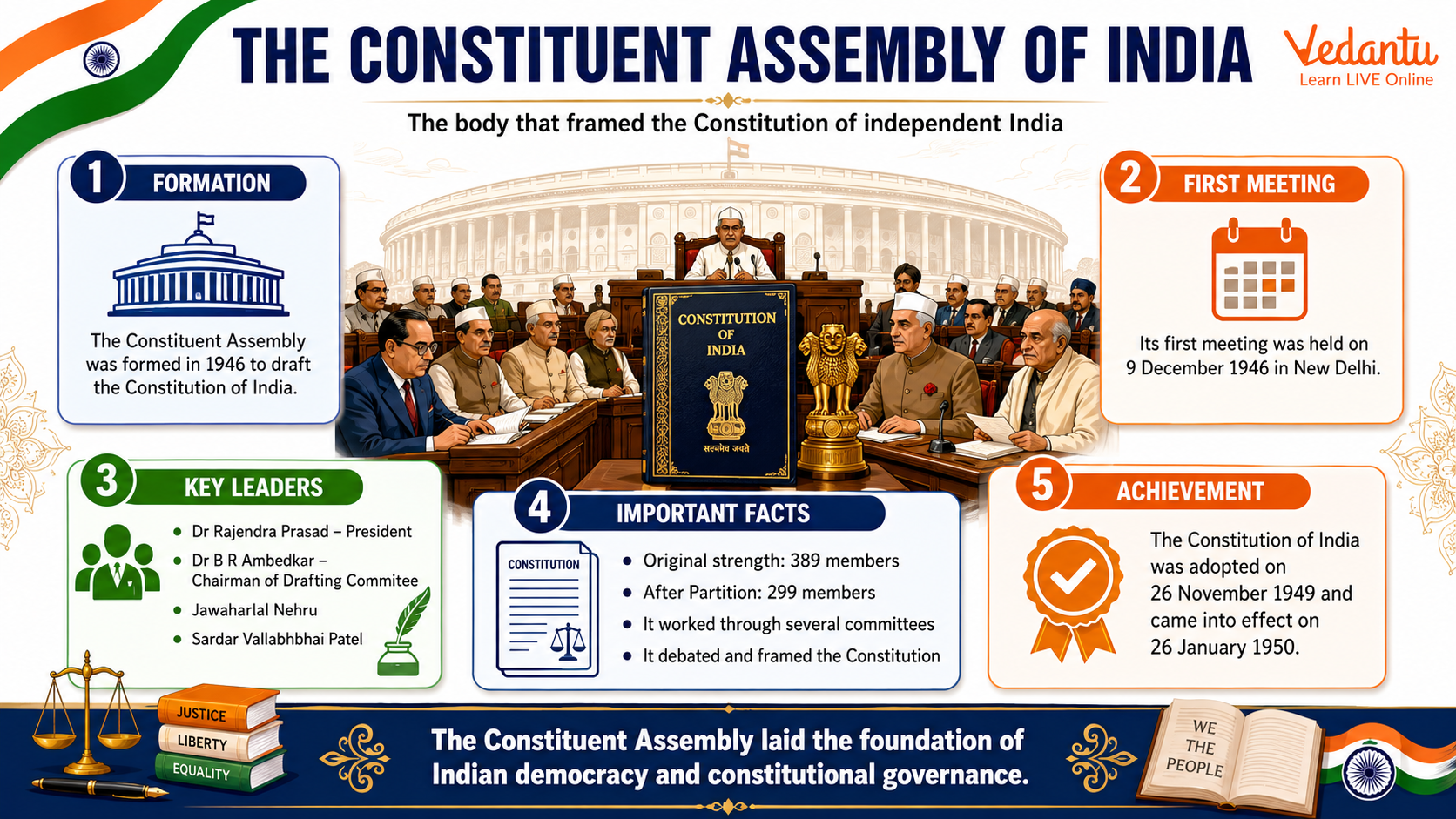
Initially, the Constituent Assembly had 389 members. After the partition of India in 1947, the total strength was reduced to 299 members. The Assembly included representatives from provinces, princely states, and different communities to ensure broad participation.
Composition of the Constituent Assembly
| Category | Before Partition | After Partition |
|---|---|---|
| Total Members | 389 | 299 |
| Provincial Seats | 292 | 229 |
| Princely States | 93 | 70 |
The reduction in strength occurred due to the creation of Pakistan, as members from areas that became part of Pakistan withdrew from the Assembly.
Sessions and Working of the Assembly
The Constituent Assembly held its first meeting on 9 December 1946 in New Delhi. Dr. Sachchidananda Sinha was appointed as the temporary Chairman. Later, Dr. Rajendra Prasad was elected as the permanent President of the Assembly.
- First meeting - 9 December 1946
- Dr. Rajendra Prasad - President of the Assembly
- H.C. Mukherjee - Vice President
- Constitution adopted - 26 November 1949
- Constitution came into force - 26 January 1950
The Assembly took 2 years, 11 months, and 18 days to complete the Constitution. It held 11 sessions over 165 days of meetings.
Major Committees of the Constituent Assembly
To ensure detailed examination of different subjects, the Assembly formed several committees. These committees played a vital role in drafting various parts of the Constitution.
Important Committees and Chairpersons
| Committee | Chairperson | Function |
|---|---|---|
| Drafting Committee | Dr. B.R. Ambedkar | Prepared the draft Constitution |
| Union Powers Committee | Jawaharlal Nehru | Defined powers of the Union |
| Fundamental Rights Committee | Jawaharlal Nehru | Worked on Fundamental Rights |
Among all committees, the Drafting Committee was the most important as it prepared the final draft of the Constitution under the leadership of Dr. B.R. Ambedkar.
Objectives Resolution
Jawaharlal Nehru moved the Objectives Resolution on 13 December 1946. It laid down the guiding principles of the Constitution. Later, it became the basis of the Preamble of India.
- India to be an independent sovereign republic
- Justice, equality, and freedom guaranteed to all citizens
- Safeguards for minorities and backward classes
- Federal structure with residuary powers to the Centre
Significance of the Constituent Assembly
The Constituent Assembly was not merely a drafting body but a representative forum of national leadership. Its debates reflected deep discussions on democracy, secularism, federalism, and social justice.
- Established India as a sovereign democratic republic
- Provided Fundamental Rights to citizens
- Ensured an independent judiciary
- Created a federal system with a strong Centre
Criticism of the Constituent Assembly
Despite its achievements, the Assembly faced some criticism.
- Members were not directly elected by universal adult franchise.
- Dominance of the Indian National Congress.
- Time consuming process of drafting.
Key Facts for Competitive Exams
- First meeting - 9 December 1946
- President - Dr. Rajendra Prasad
- Drafting Committee Chairman - Dr. B.R. Ambedkar
- Adoption of Constitution - 26 November 1949
- Enforcement - 26 January 1950
Conclusion
The Constituent Assembly of India laid the foundation of the world largest democracy. Through detailed debates and inclusive participation, it created a Constitution that continues to guide the nation. Its work reflects the vision, wisdom, and commitment of leaders who shaped modern India. A clear understanding of the Constituent Assembly helps students appreciate the constitutional values and democratic principles that govern the country today.
FAQs on The Constituent Assembly of India and the Making of the Constitution
1. What was the Constituent Assembly of India?
The Constituent Assembly of India was a representative body formed to draft and adopt the Indian Constitution after independence. It played a key role in shaping modern India.
• Established under the Cabinet Mission Plan (1946)
• First met on 9 December 1946
• Drafted the Constitution between 1946 and 1949
• Adopted the Constitution on 26 November 1949
This body is often searched under terms like Constitution making in India, framing of Indian Constitution, and Indian Constitution drafting body.
2. When was the Constituent Assembly formed?
The Constituent Assembly was formed in 1946 under the provisions of the Cabinet Mission Plan. It began its work before India officially became independent.
• Elections held in July 1946
• First meeting: 9 December 1946
• Became a sovereign body after 15 August 1947
This period marks the beginning of constitution making in independent India and is important for competitive exams like UPSC, SSC, and State PSC.
3. Who was the Chairman of the Constituent Assembly?
Dr. Rajendra Prasad was the permanent Chairman (President) of the Constituent Assembly of India. He later became the first President of India.
• Temporary Chairman: Dr. Sachchidananda Sinha
• Elected President on 11 December 1946
• Guided the Assembly until the Constitution was adopted
His leadership is often associated with Indian constitutional history and founding leaders of India.
4. Who was the Chairman of the Drafting Committee?
Dr. B. R. Ambedkar was the Chairman of the Drafting Committee of the Constituent Assembly. He is known as the Chief Architect of the Indian Constitution.
• Drafting Committee formed on 29 August 1947
• Responsible for preparing the final draft
• Played a key role in shaping Fundamental Rights and Directive Principles
He is widely searched under Father of Indian Constitution and Dr. BR Ambedkar role in Constitution.
5. How many members were there in the Constituent Assembly?
The Constituent Assembly originally had 389 members, representing British India and princely states.
• 292 from British Provinces
• 93 from Princely States
• 4 from Chief Commissioner’s Provinces
• After Partition, reduced to 299 members
This composition reflects the representative structure of constitution making in India.
6. How long did the Constituent Assembly take to draft the Indian Constitution?
The Constituent Assembly took 2 years, 11 months, and 18 days to draft the Indian Constitution.
• Started: 9 December 1946
• Adopted: 26 November 1949
• Came into effect: 26 January 1950
• Total sessions: 11 sessions
This timeline is crucial in understanding the making of the Indian Constitution and its historical significance.
7. What were the major functions of the Constituent Assembly?
The main function of the Constituent Assembly was to draft and adopt the Constitution of India. It also performed legislative duties after independence.
• Framed the Indian Constitution
• Debated provisions like Fundamental Rights and Federal Structure
• Adopted the National Flag (22 July 1947)
• Functioned as the Provisional Parliament of India
These roles highlight its importance in Indian political development and constitutional governance.
8. What was the significance of 26 November 1949?
26 November 1949 is the day when the Constitution of India was adopted by the Constituent Assembly.
• Known as Constitution Day (since 2015)
• Final draft approved and signed
• Marked completion of constitution drafting process
This date is significant in Indian constitutional history and is frequently asked in GK and competitive exams.
9. What was the role of the Cabinet Mission Plan in the Constituent Assembly?
The Cabinet Mission Plan of 1946 proposed the formation of the Constituent Assembly to draft India’s Constitution.
• Sent by the British Government
• Suggested election of members by provincial assemblies
• Aimed to ensure representation of different communities
It laid the foundation for constitution making in India and the transition from British rule to independence.
10. When did the Constituent Assembly become the Provisional Parliament of India?
The Constituent Assembly became the Provisional Parliament of India on 26 January 1950, when the Constitution came into force.
• India became a Republic
• Replaced the British-era legislative system
• Continued functioning until the first general elections in 1952
This transition marks the beginning of parliamentary democracy in India and the implementation of the Indian Constitution.
