






Key Concepts and Formulas in Work, Power and Energy Explained
Work, power and energy are fundamental concepts in physics that explain how forces cause motion and how energy is transferred in physical systems. These topics form the foundation of mechanics and are essential for understanding real-world phenomena such as motion of vehicles, operation of machines, lifting objects, and electricity generation. In competitive exams like NEET, questions from work, power and energy frequently test conceptual clarity and numerical problem-solving skills. This summary provides clear definitions, formulas, units, important laws, and key differences to help students revise effectively.
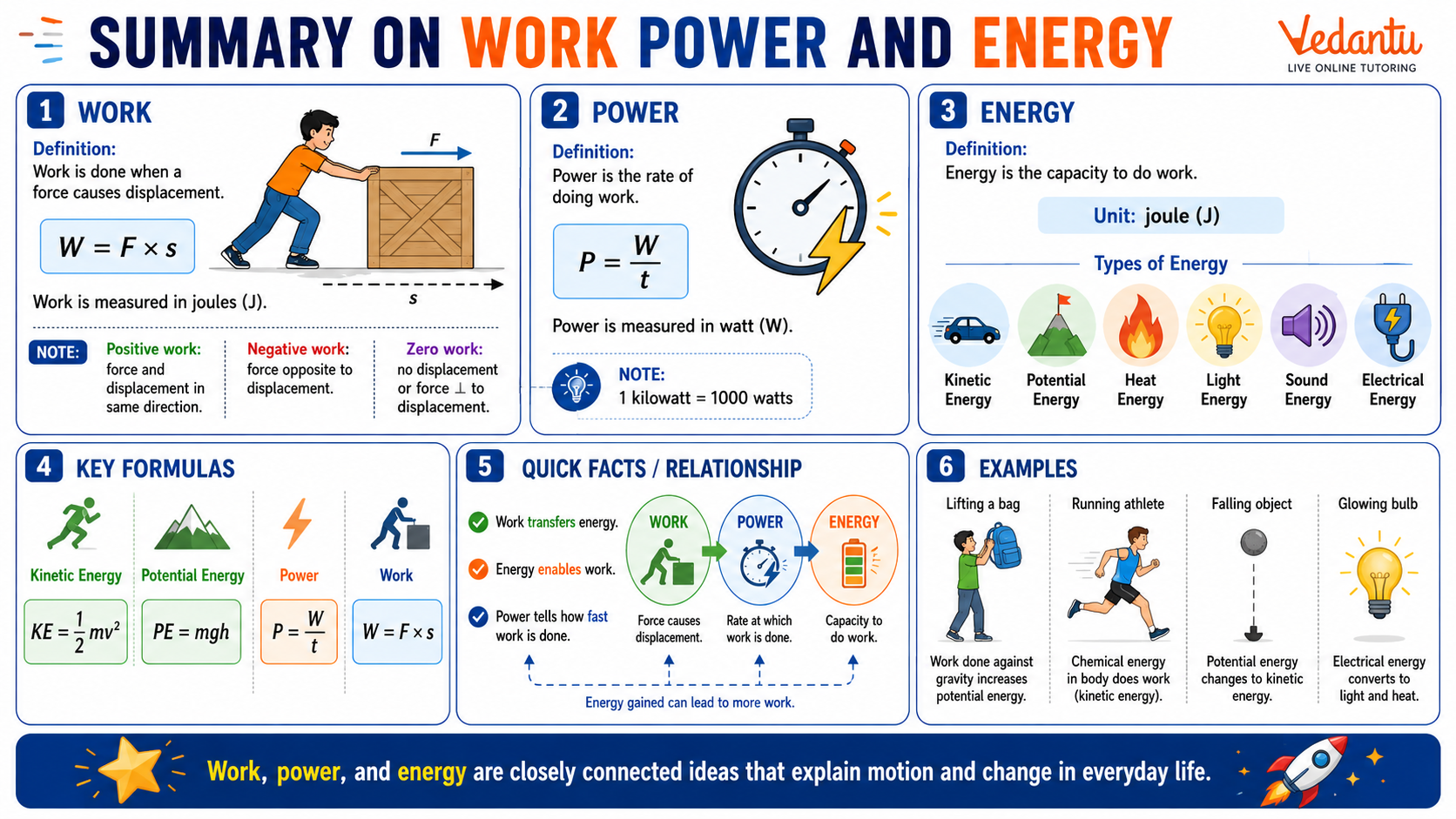
Meaning of Work in Physics
In physics, work is said to be done when a force applied on an object causes displacement in the direction of the force. If there is no displacement, no work is done even if force is applied.
Formula for Work
Work done (W) is calculated as:
W = F × s × cosθ
- F = Applied force
- s = Displacement
- θ = Angle between force and displacement
SI Unit of Work
The SI unit of work is Joule (J). One joule is the work done when a force of 1 newton moves an object by 1 meter in the direction of the force.
Types of Work
- Positive Work - When force and displacement are in the same direction.
- Negative Work - When force acts opposite to displacement, such as friction.
- Zero Work - When displacement is zero or force is perpendicular to displacement.
Energy
Energy is the capacity to do work. Any object that can perform work possesses energy. Energy exists in various forms and can be transformed from one form to another but cannot be created or destroyed.
Forms of Mechanical Energy
- Kinetic Energy - Energy possessed by a body due to its motion.
- Potential Energy - Energy possessed by a body due to its position or configuration.
Kinetic Energy
Formula: KE = 1/2 mv²
- m = Mass of the object
- v = Velocity of the object
Kinetic energy depends on both mass and the square of velocity. Even a small increase in speed greatly increases kinetic energy.
Potential Energy
Gravitational Potential Energy: PE = mgh
- m = Mass
- g = Acceleration due to gravity
- h = Height above ground
Potential energy increases with height. When an object falls, potential energy converts into kinetic energy.
Law of Conservation of Energy
The law of conservation of energy states that energy can neither be created nor destroyed. It can only change from one form to another. In an isolated system, the total energy remains constant.
For example, when a ball is thrown upward, its kinetic energy gradually converts into potential energy. At the highest point, kinetic energy becomes zero and potential energy is maximum.
Power
Power is the rate at which work is done or energy is transferred. It tells us how fast work is performed.
Formula for Power
Power = Work / Time
P = W / t
SI Unit of Power
The SI unit of power is Watt (W). One watt is equal to one joule per second.
Another common unit is horsepower (hp), where 1 hp = 746 watts.
Comparison of Work, Energy and Power
| Quantity | Definition | SI Unit |
|---|---|---|
| Work | Force causing displacement | Joule |
| Energy | Capacity to do work | Joule |
| Power | Rate of doing work | Watt |
Work and energy have the same unit because energy is the ability to do work. Power is different as it measures how quickly work is done.
Important Points for NEET Preparation
- Memorize all formulas and SI units.
- Understand the angle concept in work done formula.
- Practice numerical problems involving kinetic and potential energy.
- Focus on conservation of energy applications.
- Be careful with unit conversions such as joule to kilojoule and watt to horsepower.
Conclusion
Work, power and energy are core concepts in physics that explain motion, force interactions, and energy transformations. A strong understanding of formulas, units, and practical applications is essential for solving NEET level questions accurately. By mastering these principles and practicing regularly, students can build a solid foundation in mechanics and improve their performance in competitive examinations.
FAQs on Summary on Work, Power and Energy for Students
1. What is work in physics?
Work in physics is done when a force causes displacement in an object in the direction of the force.
• Formula: Work (W) = Force (F) × Displacement (s)
• SI unit: Joule (J)
• Work is zero if there is no displacement
• Work depends on both force and distance moved
In simple terms, work, force, and motion are interconnected concepts in Work, Power and Energy chapter.
2. What is energy and what are its main forms?
Energy is the capacity to do work and exists in different forms in nature.
• Kinetic Energy – energy of motion
• Potential Energy – energy stored due to position
• Mechanical Energy – sum of kinetic and potential energy
• Other forms: Heat, Light, Chemical, Electrical Energy
Energy transformation and conservation are key topics in physics and competitive exams.
3. What is kinetic energy?
Kinetic Energy is the energy possessed by a body due to its motion.
• Formula: KE = ½ mv²
• Depends on mass (m) and velocity (v)
• SI unit: Joule (J)
• Greater speed means greater kinetic energy
Examples include a moving car, flowing water, and a flying ball.
4. What is potential energy?
Potential Energy is the energy stored in an object due to its position or configuration.
• Formula (Gravitational PE): PE = mgh
• Depends on mass (m), gravity (g), and height (h)
• Example: Water stored in a dam, a stretched spring
This concept explains stored energy and energy transformation in physics.
5. What is power in physics?
Power is the rate at which work is done or energy is transferred.
• Formula: Power (P) = Work / Time
• SI unit: Watt (W)
• 1 Watt = 1 Joule per second
• Higher power means work is done faster
Power is an important concept in electricity, machines, and mechanical systems.
6. What is the law of conservation of energy?
Law of Conservation of Energy states that energy can neither be created nor destroyed, only transformed from one form to another.
• Total energy remains constant in a closed system
• Example: Potential energy converts into kinetic energy during free fall
• Mechanical energy remains constant in absence of friction
This law is fundamental in understanding work, energy transformation, and motion.
7. What is mechanical energy?
Mechanical Energy is the total energy possessed by an object due to its motion and position.
• Mechanical Energy = Kinetic Energy + Potential Energy
• SI unit: Joule (J)
• Conserved when no external force like friction acts
It explains the working of machines, moving objects, and physical systems.
8. What is the difference between work and energy?
Work is the process of transferring energy, while Energy is the capacity to do work.
• Work depends on force and displacement
• Energy is stored or possessed by an object
• Both have the same SI unit: Joule
• Work results in change in energy
Understanding this difference is important for exams and conceptual clarity.
9. What are the SI units of work, power, and energy?
The SI units help measure physical quantities accurately in physics.
• Work – Joule (J)
• Energy – Joule (J)
• Power – Watt (W)
• 1 Watt = 1 Joule/second
These standard units are widely used in science, engineering, and competitive exams.
10. How are work, power, and energy related?
Work, Power, and Energy are closely connected concepts in physics describing motion and force.
• Work transfers energy
• Energy enables work to be done
• Power measures how fast work is done
• All are measured in terms of Joule and Watt
Together, these concepts explain machines, motion, electricity, and daily-life physical activities.
