






How a Smog Tower Removes Pollutants and Improves City Air Quality
A Smog Tower is a large air purification structure designed to reduce air pollution in urban areas. It works by drawing in polluted air, filtering out harmful particles, and releasing cleaner air back into the atmosphere. Smog towers are usually installed in cities facing severe air pollution problems due to traffic emissions, industrial activities, and construction dust. These towers are considered an innovative technological solution to improve urban air quality and public health.
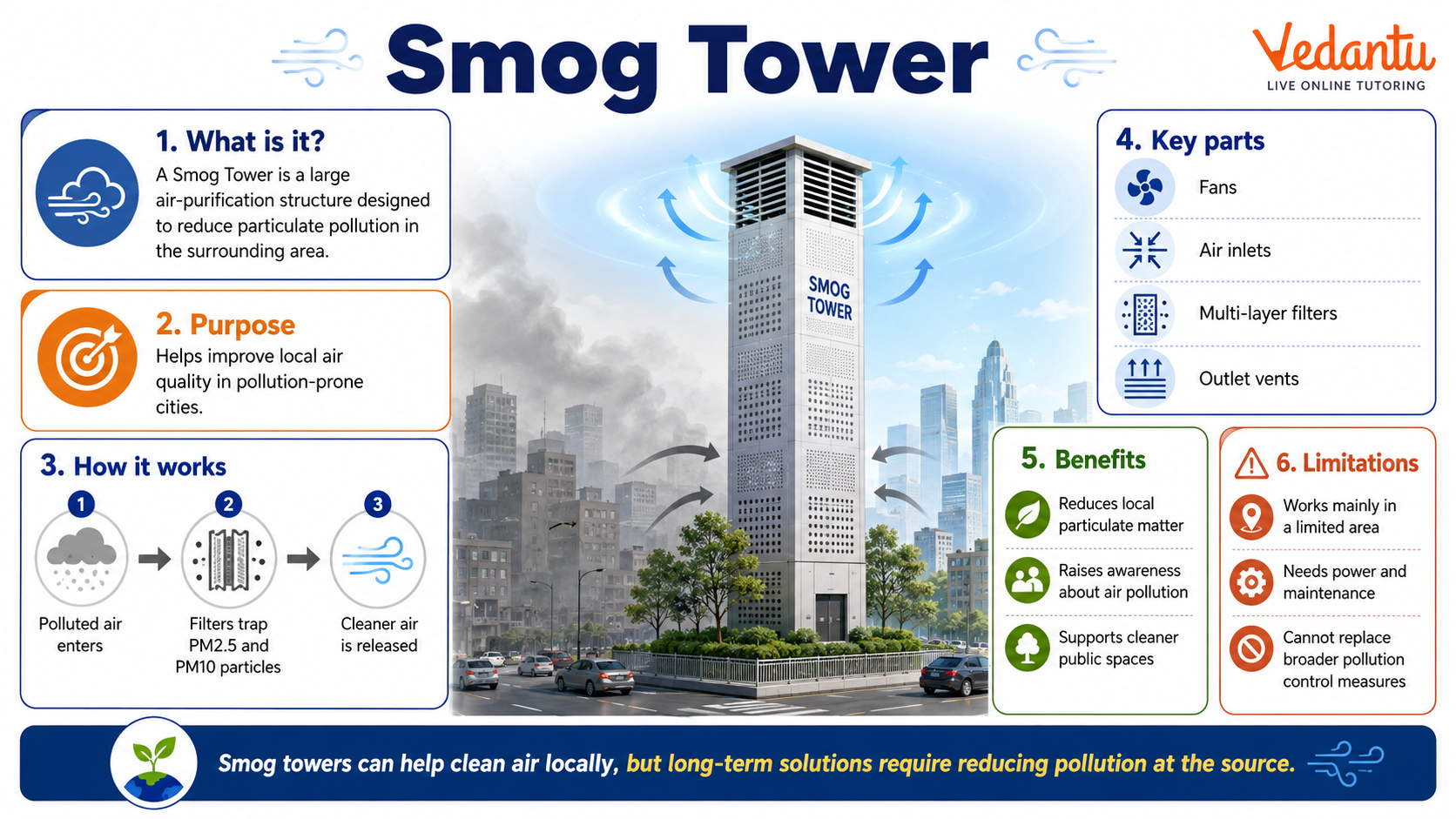
What is a Smog Tower?
A Smog Tower is a large-scale air purifier installed outdoors to remove particulate matter such as PM2.5 and PM10 from the surrounding air. The tower uses high-efficiency filters and fans to suck in polluted air, trap contaminants, and release purified air. It is often powered by electricity and sometimes supported by renewable energy sources such as solar panels.
- Designed to reduce urban air pollution
- Targets harmful particulate matter like PM2.5 and PM10
- Installed in pollution hotspots
- Improves local air quality
How Does a Smog Tower Work?
A Smog Tower operates using filtration technology similar to indoor air purifiers but on a much larger scale. The tower draws polluted air from the surrounding environment, passes it through multiple layers of filters, and then releases cleaner air.
- Polluted air is sucked into the tower using large fans.
- The air passes through pre-filters that trap larger dust particles.
- High-efficiency particulate air filters remove fine particles like PM2.5.
- Cleaned air is released back into the surroundings.
Major Components of a Smog Tower
1. Air Inlet System
The air inlet system consists of large fans that pull polluted air into the tower for filtration.
2. Filtration Unit
The filtration unit contains multiple layers of filters, including HEPA filters, which trap fine particulate matter and other pollutants.
3. Clean Air Outlet
After purification, the clean air outlet releases filtered air back into the environment.
4. Power Supply
Most smog towers are powered by electricity. Some advanced models use solar panels to reduce energy consumption.
Comparison of Smog Tower Features
| Feature | Description | Purpose |
|---|---|---|
| Air Filtration | HEPA and multi-layer filters | Remove PM2.5 and PM10 particles |
| Fan System | High-capacity industrial fans | Draw polluted air into the tower |
| Energy Source | Electricity or solar power | Operate the purification system |
The above features highlight how smog towers function as large outdoor air purifiers. Their efficiency depends on design, capacity, and environmental conditions.
Advantages of Smog Towers
- Improve air quality in localized areas
- Reduce health risks related to air pollution
- Provide technological support in pollution control
- Create awareness about environmental protection
Limitations of Smog Towers
While smog towers help in reducing air pollution, they are not a complete solution. Their impact is usually limited to a small area around the tower.
- Limited coverage area
- High installation and maintenance costs
- Require continuous power supply
- Do not address root causes of pollution
Smog Towers in the World
Several countries have installed smog towers to combat urban pollution. Cities with high pollution levels have experimented with these structures to test their effectiveness in improving air quality.
- China has installed large smog towers in polluted cities.
- India has set up smog towers in major urban areas.
- Some European cities have experimented with similar air purification systems.
Importance of Smog Towers
Smog towers represent an innovative approach to tackling air pollution in cities. Although they cannot replace long-term pollution control measures such as reducing emissions and promoting clean energy, they can provide temporary relief in high pollution zones. They also encourage technological advancements in environmental engineering and highlight the urgency of addressing air quality issues.
In conclusion, a Smog Tower is a modern environmental solution designed to purify polluted urban air. While it has advantages and limitations, it plays an important role in raising awareness and providing localized air quality improvement in heavily polluted areas.
FAQs on Smog Tower: Understanding How This Air-Purifying Structure Works
1. What is a Smog Tower?
A Smog Tower is a large air-purifying structure designed to reduce air pollution in urban areas. It works like a giant air purifier by filtering harmful pollutants from the atmosphere.
• Removes PM2.5 and PM10 particles
• Uses HEPA filters and air purification technology
• Installed in highly polluted cities like Delhi
• Also known as an air purification tower or anti-smog tower
2. Why was the Smog Tower installed in Delhi?
The Smog Tower in Delhi was installed to combat rising air pollution levels and severe smog conditions. Delhi often records hazardous Air Quality Index (AQI) levels.
• Reduces concentration of toxic pollutants
• Improves breathing conditions
• Supports environmental protection efforts
• Addresses winter smog crisis in North India
3. How does a Smog Tower work?
A Smog Tower works by drawing polluted air, filtering it, and releasing cleaner air back into the environment.
• Large fans suck in polluted air
• Multi-layer filtration systems trap dust and harmful particles
• Clean air is released at higher levels
• Helps lower local PM levels in surrounding areas
4. What are PM2.5 and PM10 particles?
PM2.5 and PM10 are tiny particulate matter present in polluted air that can harm human health. They are major causes of respiratory and heart diseases.
• PM2.5: Fine particles smaller than 2.5 micrometers
• PM10: Particles smaller than 10 micrometers
• Can enter lungs and bloodstream
• Measured under the Air Quality Index (AQI)
5. What are the benefits of a Smog Tower?
The benefits of a Smog Tower include localized air purification and public awareness about environmental protection.
• Reduces harmful air pollutants
• Improves nearby air quality
• Supports anti-pollution initiatives
• Promotes awareness about climate change and environmental conservation
6. What are the limitations of a Smog Tower?
Although useful, a Smog Tower has certain limitations in solving large-scale pollution problems.
• Covers only a limited area
• High installation and maintenance cost
• Cannot replace long-term pollution control policies
• Requires continuous electricity supply
7. Who developed the Smog Tower project in India?
The Smog Tower project in Delhi was developed under the supervision of the Supreme Court of India and environmental bodies.
• Implemented by the Central Pollution Control Board (CPCB)
• Supported by the Delhi Government
• Inspired by similar towers in countries like China
8. How is Air Quality Index (AQI) related to Smog Towers?
The Air Quality Index (AQI) measures air pollution levels, and Smog Towers aim to reduce high AQI readings.
• AQI indicates pollution severity
• Categories include Good, Moderate, Poor, and Hazardous
• Smog Towers help lower local AQI levels
• Important for public health monitoring
9. Are Smog Towers a permanent solution to air pollution?
No, Smog Towers are not a permanent solution but a temporary measure to reduce pollution in specific areas.
• Cannot eliminate pollution sources
• Need support from strict environmental laws
• Must be combined with vehicle emission control and industrial regulation
• Encourage sustainable development practices
10. Why is the Smog Tower topic important for students and competitive exams?
The Smog Tower topic is important for understanding environmental issues and is frequently asked in General Knowledge (GK) and competitive exams.
• Related to environment and ecology syllabus
• Important for UPSC, SSC, and state exams
• Highlights current environmental challenges
• Connects with topics like air pollution, climate change, and sustainability
