






Why the Night-Flowering Parijat Plant Is Important in India
The Parijat Tree, scientifically known as Nyctanthes arbor-tristis, is a small ornamental and medicinal tree widely known for its fragrant white flowers with bright orange centers. It holds great cultural, mythological, and medicinal significance in India and other South Asian countries. Commonly called Night-flowering Jasmine or Harsingar, the Parijat Tree blooms at night and sheds its flowers by morning, creating a beautiful carpet of blossoms on the ground. Due to its religious importance and therapeutic properties, it is frequently included in general knowledge topics, competitive exams, and environmental studies.
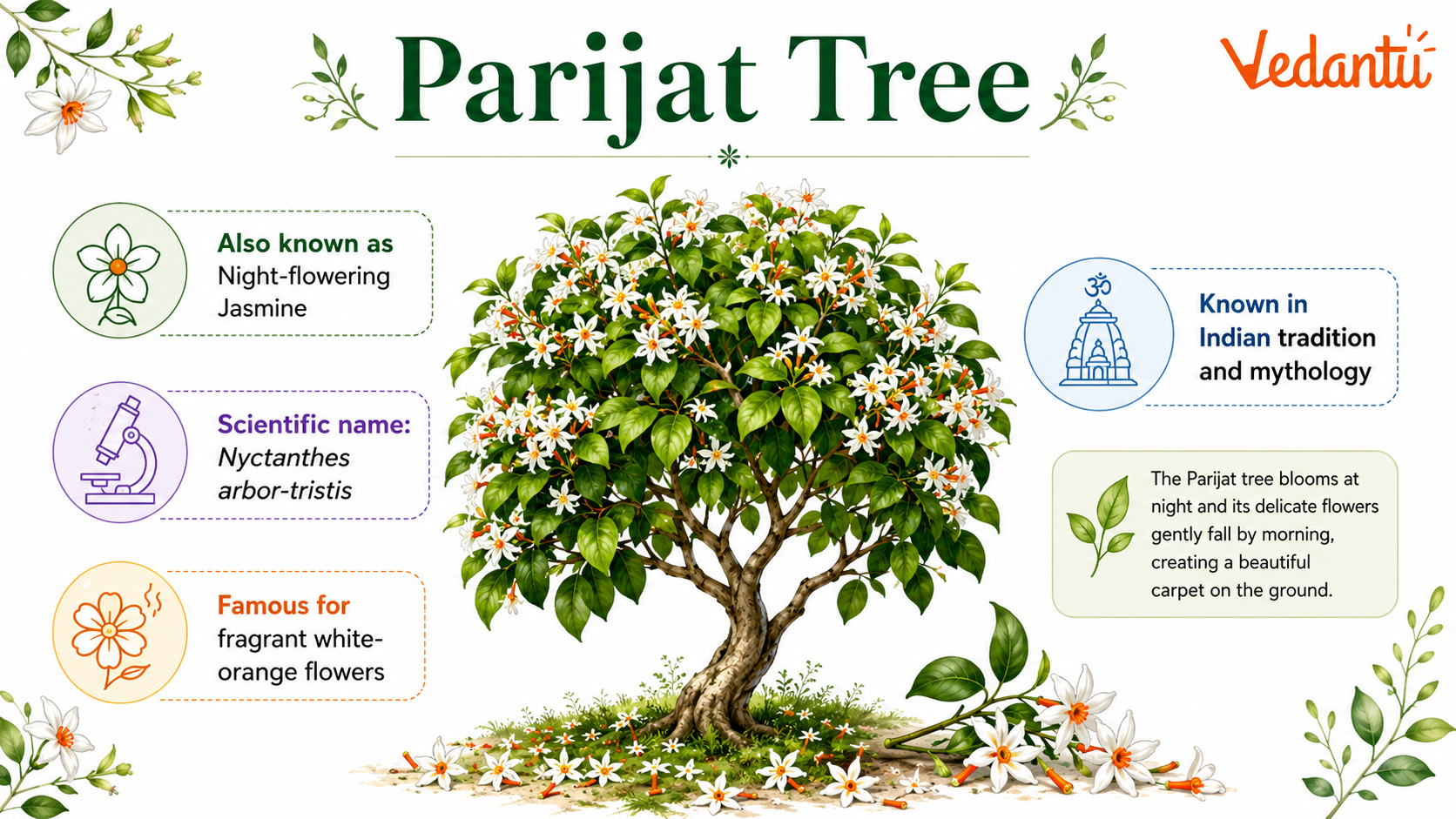
Scientific Classification of Parijat Tree
| Category | Classification | Details |
|---|---|---|
| Kingdom | Plantae | Flowering Plant |
| Family | Oleaceae | Olive Family |
| Scientific Name | Nyctanthes arbor-tristis | Night-flowering Jasmine |
The Parijat Tree belongs to the Oleaceae family, which also includes olive and jasmine plants. Its botanical name Nyctanthes arbor-tristis means sad tree that blooms at night, referring to its unique flowering habit.
Physical Characteristics
- Medium-sized shrub or small tree reaching about 10 meters in height.
- Leaves are rough, simple, and arranged opposite each other.
- Flowers are white with an orange tubular center.
- Flowers bloom at night and fall off by early morning.
- Fruit is a flat, heart-shaped capsule containing two seeds.
Habitat and Distribution
The Parijat Tree is native to South Asia and Southeast Asia. It is widely grown in India, Nepal, Bangladesh, Thailand, and Indonesia. It prefers tropical and subtropical climates and grows well in well-drained soil with moderate sunlight. The tree is commonly found in gardens, temple premises, and roadside plantations due to its decorative and religious importance.
Mythological and Cultural Significance
The Parijat Tree holds an important place in Hindu mythology. It is believed to have emerged during the Samudra Manthan - the churning of the ocean. According to legends, Lord Krishna brought the Parijat tree from heaven to Earth. The flowers are often offered in temples and are associated with devotion and purity. The tree is also mentioned in ancient scriptures and folklore, making it culturally significant.
Medicinal Uses of Parijat Tree
Parijat is widely used in traditional Ayurvedic medicine. Almost every part of the plant - leaves, flowers, seeds, and bark - has therapeutic value.
- Leaves are used to treat fever, arthritis, and joint pain.
- Flowers are used to prepare herbal tea for cough and cold.
- Bark extracts help in managing malaria symptoms.
- Seeds are sometimes used for skin-related treatments.
Modern research has also shown that Parijat possesses anti-inflammatory, anti-bacterial, and anti-oxidant properties.
Environmental Importance
- Improves air quality by absorbing pollutants.
- Provides nectar for pollinators like bees and butterflies.
- Enhances biodiversity in gardens and urban spaces.
- Used in landscaping due to its aesthetic appeal.
Interesting Facts about Parijat Tree
- It is called Night-flowering Jasmine because it blooms at night.
- The flowers lose their fragrance after sunrise.
- The orange center of the flower is used as a natural dye.
- It is the state flower of West Bengal.
Importance in General Knowledge and Competitive Exams
The Parijat Tree is frequently asked about in school exams, state public service exams, and other competitive tests. Questions may relate to its scientific name, family, medicinal uses, or mythological background. Students preparing for exams should remember its botanical name Nyctanthes arbor-tristis and its association with Hindu mythology and Ayurveda.
Conclusion
The Parijat Tree is not only admired for its beauty and fragrance but also respected for its medicinal and cultural value. Its unique night-blooming nature, mythological importance, and health benefits make it a significant topic in general knowledge. Understanding its scientific classification, uses, and environmental role helps students build a strong foundation in botany and cultural studies. The Parijat Tree truly represents the blend of nature, tradition, and science.
FAQs on Parijat Tree: History, Importance, and Key Facts for Students
1. What is the Parijat Tree?
The Parijat Tree is a sacred flowering tree known for its mythological, medicinal, and cultural importance in India. • Scientifically called Nyctanthes arbor-tristis • Commonly known as Night-flowering Jasmine or Harsingar • Produces fragrant white flowers with orange stems • Blooms at night and sheds flowers in the morning • Frequently mentioned in Hindu mythology, literature, and GK exams.
2. Why is the Parijat Tree important in Hindu mythology?
The Parijat Tree holds great mythological significance as it is believed to have emerged during the Samudra Manthan (churning of the ocean). • Associated with Lord Krishna and Indra • Considered a heavenly or celestial tree • Symbol of love, devotion, and divine blessings • Often referred to as the Kalpavriksha (wish-fulfilling tree) in legends.
3. Where is the famous Parijat Tree located in India?
The most famous Parijat Tree is located in Kintoor village, Barabanki district, Uttar Pradesh. • Believed to be thousands of years old • Considered a sacred pilgrimage site • Associated with the Mahabharata era • Attracts devotees and tourists throughout the year.
4. What are the medicinal uses of the Parijat Tree?
The Parijat Tree is widely used in Ayurveda for its healing properties. • Leaves help treat fever and arthritis • Flowers are used for skin and digestive disorders • Bark has anti-inflammatory benefits • Known for its antioxidant and antibacterial properties • Common in traditional and herbal medicine practices.
5. Why is the Parijat Tree called the Night-flowering Jasmine?
The Parijat Tree is called Night-flowering Jasmine because its fragrant flowers bloom at night and fall by morning. • Emits a sweet aroma after sunset • White petals with a bright orange center • Symbolizes beauty and transience • Also known as Queen of the Night in some regions.
6. What is the scientific classification of the Parijat Tree?
The scientific name of the Parijat Tree is Nyctanthes arbor-tristis, belonging to the Oleaceae family. • Kingdom: Plantae • Family: Oleaceae • Genus: Nyctanthes • Species: arbor-tristis • The term "arbor-tristis" means sad tree, referring to its falling flowers.
7. What does the Parijat Tree symbolize?
The Parijat Tree symbolizes love, devotion, purity, and spiritual awakening. • Represents eternal love in Krishna legends • Signifies divine blessings • Associated with heaven and immortality • Often used in religious rituals and temple offerings.
8. How is the Parijat Tree described in literature and English lessons?
In English literature and lessons, the Parijat Tree is described as a symbol of beauty and mythology. • Often portrayed as a mystical and sacred tree • Highlights themes of nature, devotion, and cultural heritage • Used in poems and stories to depict fragrance and grace • Important for school exams and General Knowledge preparation.
9. What are the physical characteristics of the Parijat Tree?
The Parijat Tree is a small ornamental tree known for its distinctive flowers and fragrance. • Grows up to 10–15 feet tall • Rough, flaky bark • Dark green, broad leaves • Small white flowers with orange tubular centers • Blooms mainly during the monsoon and autumn seasons.
10. Why is the Parijat Tree important for competitive exams and GK?
The Parijat Tree is important for GK and competitive exams due to its mythological, scientific, and cultural relevance. • Frequently asked in SSC, UPSC, and state exams • Linked to Samudra Manthan and Lord Krishna • Scientific name: Nyctanthes arbor-tristis • Known as Night-flowering Jasmine • Important for questions on Indian heritage, botany, and mythology.
