






Ramakrishna Paramahansa's Spiritual Philosophy and Influence on Modern India
Ramakrishna Paramahansa was one of the most influential spiritual leaders of 19th century India. He played a significant role in the revival of Hindu spirituality during a time of social and religious change. Known for his deep devotion, simple teachings, and emphasis on the unity of religions, he inspired many followers, including Swami Vivekananda. His life and message continue to influence spiritual thought and Indian philosophy. For students and competitive exam aspirants, understanding Ramakrishna Paramahansa is important in topics related to modern Indian history, religious reform movements, and spiritual leaders of India.
Early Life of Ramakrishna Paramahansa
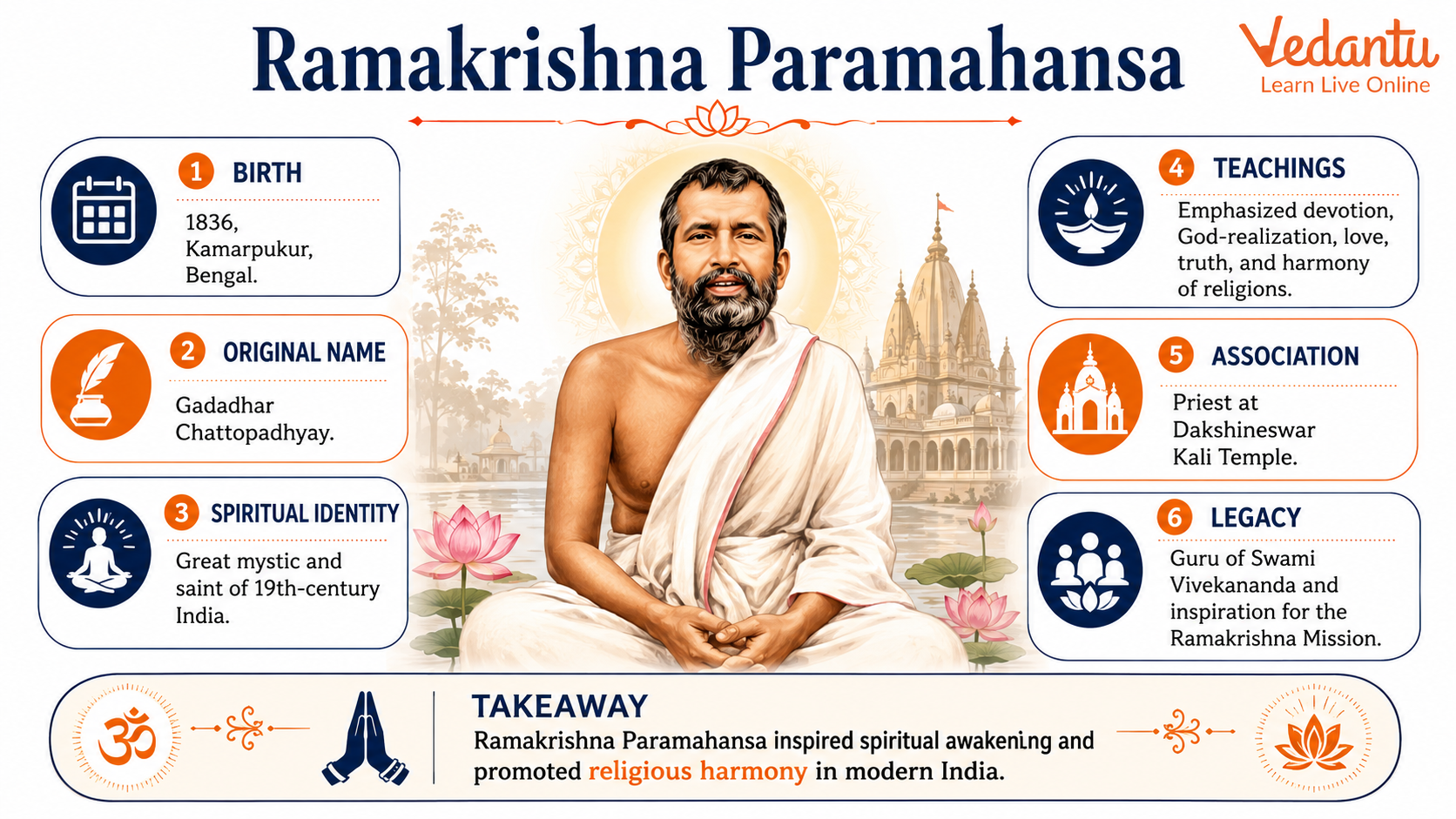
Ramakrishna Paramahansa was born as Gadadhar Chattopadhyay on 18 February 1836 in Kamarpukur, a village in the Hooghly district of West Bengal. He was born into a poor but religious Brahmin family. From childhood, he showed deep interest in spiritual matters and often experienced spiritual ecstasies.
- Birth Name - Gadadhar Chattopadhyay
- Date of Birth - 18 February 1836
- Birthplace - Kamarpukur, West Bengal
- Parents - Khudiram Chattopadhyay and Chandramani Devi
In 1855, he became a priest at the Dakshineswar Kali Temple near Kolkata. His intense devotion to Goddess Kali shaped his spiritual journey.
Spiritual Practices and Beliefs
Ramakrishna Paramahansa believed that all religions lead to the same ultimate truth. He practiced various religious paths including Hinduism, Islam, and Christianity to experience their spiritual essence. His teachings emphasized devotion, purity of heart, and direct experience of God.
Key Teachings
- All religions are true and lead to the same goal.
- God can be realized through sincere devotion and faith.
- Service to humanity is service to God.
- Renunciation of ego and worldly desires is essential for spiritual growth.
He did not promote complex rituals. Instead, he focused on love, devotion, and inner realization.
Ramakrishna and Swami Vivekananda
One of the most important disciples of Ramakrishna Paramahansa was Swami Vivekananda. Initially skeptical, Vivekananda was deeply influenced by Ramakrishna's spiritual experiences and teachings. After Ramakrishna's death in 1886, Vivekananda spread his master's message across India and the world.
- Ramakrishna inspired Vivekananda to serve humanity.
- The Ramakrishna Mission was founded by Swami Vivekananda in 1897.
- The mission works in education, healthcare, and social service.
Quick Facts about Ramakrishna Paramahansa
| Aspect | Details | Significance |
|---|---|---|
| Birth | 18 February 1836 | Born during British rule in India |
| Main Worship | Goddess Kali | Priest at Dakshineswar Temple |
| Famous Disciple | Swami Vivekananda | Spread his teachings worldwide |
These facts are frequently asked in competitive exams and general knowledge quizzes. Students should remember the dates and associations clearly.
Role in Religious Reform Movement
Ramakrishna Paramahansa lived during a period when Indian society was undergoing reform due to Western influence and internal challenges. Unlike other reformers, he did not directly criticize rituals or traditions. Instead, he strengthened faith in traditional spirituality while promoting religious harmony.
- Promoted unity of religions.
- Encouraged spiritual experience over theoretical debates.
- Inspired a generation of nationalist thinkers through Vivekananda.
Death and Legacy
Ramakrishna Paramahansa passed away on 16 August 1886 due to throat cancer. Despite his short life, his teachings left a lasting impact on Indian spirituality. His disciples preserved his teachings in texts such as The Gospel of Sri Ramakrishna.
His legacy continues through the Ramakrishna Math and Ramakrishna Mission, which operate worldwide. He is remembered as a symbol of religious tolerance, devotion, and spiritual unity.
Importance for Competitive Exams
Questions about Ramakrishna Paramahansa are commonly asked in exams like UPSC, SSC, State PSC, and other competitive tests under modern Indian history and religious reform movements.
Important Points to Remember
- Born in 1836 in Kamarpukur, West Bengal.
- Priest at Dakshineswar Kali Temple.
- Believed in unity of all religions.
- Guru of Swami Vivekananda.
- Died in 1886.
Ramakrishna Paramahansa remains a central figure in Indian spiritual history. His life teaches simplicity, devotion, and respect for all faiths. A clear understanding of his contributions helps students strengthen their preparation for general knowledge and history related examinations.
FAQs on Ramakrishna Paramahansa: Life, Teachings, and Legacy
1. Who was Ramakrishna Paramahansa?
Ramakrishna Paramahansa was a 19th-century Indian saint and spiritual leader who emphasized devotion and religious harmony.
• Born in 1836 in Kamarpukur, West Bengal
• Priest at the Dakshineswar Kali Temple
• Preached the unity of all religions and direct God-realization
• Guru of Swami Vivekananda
He is regarded as a key figure in the Bengal Renaissance and modern Hindu spirituality.
2. When and where was Ramakrishna Paramahansa born?
Ramakrishna Paramahansa was born on 18 February 1836 in Kamarpukur, Bengal Presidency (now in West Bengal, India).
• Birth name: Gadadhar Chattopadhyay
• Born into a poor Brahmin family
• Showed spiritual tendencies from childhood
This question is common in GK and competitive exams related to Indian saints and reformers.
3. What were the main teachings of Ramakrishna Paramahansa?
The main teachings of Ramakrishna Paramahansa focused on devotion, unity of religions, and direct experience of God.
• All religions lead to the same God (religious harmony)
• Importance of bhakti (devotion)
• God can be realized through sincere prayer and meditation
• Renunciation of ego and material desires
His philosophy influenced modern Hindu thought and spiritual movements worldwide.
4. Who was the famous disciple of Ramakrishna Paramahansa?
Swami Vivekananda was the most famous disciple of Ramakrishna Paramahansa.
• Original name: Narendranath Datta
• Spread Ramakrishna’s teachings globally
• Represented Hinduism at the Parliament of Religions, Chicago (1893)
• Founded the Ramakrishna Mission
Vivekananda played a key role in popularizing Vedanta and Indian spirituality in the West.
5. What is the Ramakrishna Mission?
The Ramakrishna Mission is a spiritual and philanthropic organization founded by Swami Vivekananda in 1897.
• Based on the teachings of Ramakrishna Paramahansa
• Headquarters at Belur Math, West Bengal
• Works in education, healthcare, and social service
• Promotes Vedanta and interfaith harmony
It is an important institution in modern Indian religious and social reform movements.
6. Why is Ramakrishna Paramahansa important in Indian history?
Ramakrishna Paramahansa is important for promoting spiritual revival and religious tolerance in 19th-century India.
• Inspired leaders of the Indian Renaissance
• Advocated unity among Hinduism, Islam, and Christianity
• Influenced nationalist thinkers through Swami Vivekananda
• Strengthened the foundation of modern spiritual movements
His life and message remain relevant in discussions on Indian philosophy and reformers.
7. What was the original name of Ramakrishna Paramahansa?
The original name of Ramakrishna Paramahansa was Gadadhar Chattopadhyay.
• Born into a traditional Brahmin family
• Later became known as Ramakrishna after spiritual initiation
• Earned the title Paramahansa meaning “supreme swan” (a spiritually enlightened person)
This fact is frequently asked in school exams and GK quizzes.
8. Where did Ramakrishna Paramahansa attain samadhi?
Ramakrishna Paramahansa attained mahasamadhi on 16 August 1886 in Cossipore, Kolkata.
• Passed away due to throat cancer
• Surrounded by his disciples
• His teachings continued through the Ramakrishna Order
His death marked the beginning of an organized spiritual movement led by his followers.
9. What is meant by religious harmony in Ramakrishna’s teachings?
Religious harmony in Ramakrishna’s teachings means that all religions are different paths leading to the same ultimate truth.
• Practiced Hindu, Islamic, and Christian spiritual disciplines
• Experienced God through multiple faiths
• Taught “Yato mat, tato path” (As many faiths, so many paths)
This idea is central to discussions on interfaith dialogue and universal spirituality.
10. How did Ramakrishna Paramahansa influence modern Hinduism?
Ramakrishna Paramahansa influenced modern Hinduism by reviving devotion and promoting Vedanta philosophy globally.
• Inspired Swami Vivekananda to spread Vedanta worldwide
• Encouraged practical spirituality and service to humanity
• Strengthened faith during British colonial rule
• Contributed to the growth of neo-Hinduism and spiritual reform movements
His legacy continues through the Ramakrishna Mission and global Vedanta societies.
