






Why Eye Protection Is Essential During a Solar Eclipse
A solar eclipse is a fascinating astronomical event that occurs when the Moon passes between the Earth and the Sun, blocking sunlight either partially or completely. While it is an exciting natural phenomenon, observing a solar eclipse without proper precautions can cause serious and permanent eye damage. Understanding the precautions taken during a solar eclipse is essential for students, general readers, and competitive exam aspirants. This page explains the safety measures, scientific reasons, and common guidelines to follow during a solar eclipse.
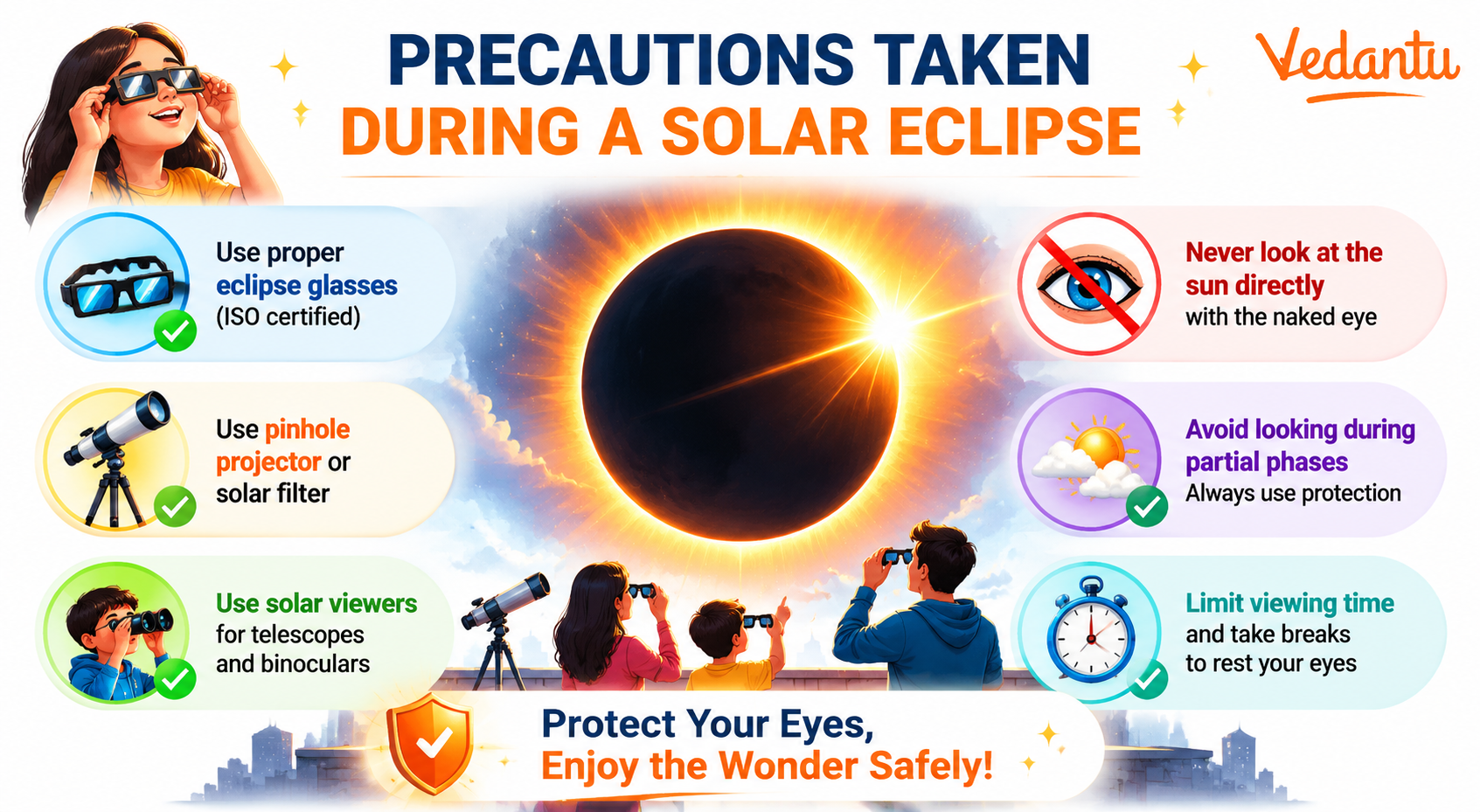
Why Precautions Are Necessary During a Solar Eclipse
During a solar eclipse, the Sun is partially or fully covered by the Moon, but its harmful ultraviolet and infrared rays continue to reach the Earth. Looking directly at the Sun without proper protection can damage the retina, leading to a condition called solar retinopathy. This damage may be painless but can result in blurred vision or even permanent blindness. Therefore, strict precautions must be followed while observing a solar eclipse.
Major Precautions to Take During a Solar Eclipse
1. Use Certified Solar Viewing Glasses
- Wear ISO certified solar eclipse glasses that meet international safety standards.
- Ensure the glasses are not scratched, torn, or damaged before use.
- Do not use regular sunglasses as they do not provide adequate protection.
2. Avoid Direct Viewing Without Protection
- Never look directly at the Sun with naked eyes during any phase of the eclipse.
- Avoid using binoculars, telescopes, or cameras without proper solar filters.
- Unfiltered optical devices can concentrate sunlight and cause instant eye damage.
3. Use Indirect Viewing Methods
- Use a pinhole projector to safely observe the eclipse indirectly.
- Watch live broadcasts on television or online platforms.
- Observe the Sun’s image projected onto a flat surface instead of looking directly at it.
4. Supervise Children Carefully
- Ensure children wear proper eclipse glasses at all times.
- Explain the risks of looking at the Sun without protection.
- Monitor them closely during the eclipse event.
Safe and Unsafe Viewing Methods During a Solar Eclipse
| Method | Safe or Unsafe | Reason |
|---|---|---|
| ISO certified eclipse glasses | Safe | Blocks harmful UV and infrared rays |
| Regular sunglasses | Unsafe | Do not filter intense solar radiation |
| Pinhole projector | Safe | Indirect viewing prevents eye exposure |
The table above clearly differentiates between safe and unsafe viewing methods. Always choose scientifically approved methods to protect your eyesight during a solar eclipse.
Scientific Reason Behind Eye Damage
The retina is a light sensitive layer at the back of the eye. During a solar eclipse, people may feel safe looking at the Sun because it appears dimmer. However, harmful solar radiation continues to enter the eye and can burn retinal cells. Since the retina does not have pain receptors, damage can occur without immediate discomfort. This condition is known as solar retinopathy and may cause permanent vision loss.
Common Myths and Facts
Myths
- Eating food during a solar eclipse is harmful.
- Pregnant women must stay indoors to avoid harm.
- Water becomes impure during the eclipse.
Facts
- A solar eclipse is a natural astronomical event with no harmful radiation effects on food or water.
- The only scientifically proven risk is eye damage due to direct viewing.
- Following proper viewing precautions ensures complete safety.
Precautions for Photography During a Solar Eclipse
Capturing a solar eclipse requires special care. Cameras, telescopes, and binoculars must be fitted with proper solar filters. Without filters, the camera sensor can be damaged and reflected sunlight can harm the eyes. Never look through the camera viewfinder without a certified solar filter attached to the lens.
Key Points for Competitive Exams
- A solar eclipse occurs when the Moon comes between the Earth and the Sun.
- Direct viewing can cause solar retinopathy.
- ISO certified solar glasses are essential for safe viewing.
- Indirect methods such as pinhole projection are safe alternatives.
Conclusion
A solar eclipse is an extraordinary celestial event that offers a valuable learning experience in astronomy. However, safety must always come first. By using certified protective glasses, avoiding direct exposure, and following scientifically recommended guidelines, we can safely observe and enjoy this rare phenomenon. Understanding the precautions taken during a solar eclipse not only protects eyesight but also promotes scientific awareness and responsible observation.
FAQs on Precautions During a Solar Eclipse for Students
1. What precautions should be taken during a solar eclipse?
The most important precaution during a solar eclipse is protecting your eyes from harmful solar radiation.
• Never look directly at the Sun without certified solar eclipse glasses.
• Use ISO 12312-2 approved solar filters for safe viewing.
• Avoid using regular sunglasses, X-ray films, or colored glass.
• Supervise children while observing the eclipse.
• Use indirect viewing methods like a pinhole projector for safety.
This helps prevent eye damage such as retinal burns or solar retinopathy.
2. Why is it dangerous to look at a solar eclipse with naked eyes?
Looking at a solar eclipse with naked eyes can cause permanent eye damage due to intense ultraviolet (UV) and infrared rays.
• The Sun’s rays can burn the retina without causing immediate pain.
• This may lead to solar retinopathy or partial blindness.
• Even during a partial eclipse, harmful radiation remains strong.
Therefore, proper eye protection during solar eclipse is essential.
3. What are safe ways to watch a solar eclipse?
Safe viewing of a solar eclipse requires certified protective equipment or indirect methods.
• Wear eclipse glasses with ISO certification.
• Use a solar viewer or solar filter on telescopes and binoculars.
• Observe through a pinhole camera projection method.
• Watch live broadcasts by space agencies like NASA.
These methods ensure safe solar eclipse viewing without risking eyesight.
4. Can regular sunglasses protect eyes during a solar eclipse?
No, regular sunglasses cannot protect your eyes during a solar eclipse because they do not block harmful solar radiation completely.
• Sunglasses reduce brightness but not UV and infrared rays.
• They are not designed for direct Sun viewing.
• Only ISO-certified eclipse glasses provide proper protection.
Using normal sunglasses may result in serious eye injury.
5. What precautions should be taken while using a telescope or binoculars during a solar eclipse?
Special care is required when using optical devices during a solar eclipse to prevent severe eye damage.
• Attach a proper solar filter to the front of the telescope or binoculars.
• Never look through lenses without certified filters.
• Do not use handheld solar viewers with magnifying devices.
• Seek guidance from astronomy experts if unsure.
Improper use can instantly damage the retina.
6. Should children take extra precautions during a solar eclipse?
Yes, children require special supervision during a solar eclipse to ensure eye safety.
• Always provide certified eclipse glasses.
• Monitor them to prevent direct Sun viewing.
• Teach them about solar eclipse safety rules.
• Encourage indirect viewing methods.
Proper guidance prevents accidental eye damage and promotes safe learning.
7. Is it safe to eat or go outside during a solar eclipse?
Scientifically, it is safe to eat and go outside during a solar eclipse if proper eye precautions are taken.
• There is no medical restriction on eating food.
• Outdoor activities are safe with eye protection.
• Cultural beliefs about fasting are traditional, not scientific.
The only proven risk is eye exposure to the Sun.
8. What is a pinhole projector and how does it help during a solar eclipse?
A pinhole projector is a simple device that allows indirect and safe viewing of a solar eclipse.
• It uses a small hole in a card to project the Sun’s image onto a surface.
• No direct eye contact with the Sun is required.
• It is easy to make at home.
This method is recommended for safe eclipse observation without special glasses.
9. What happens if proper precautions are not taken during a solar eclipse?
Failure to follow solar eclipse precautions can result in permanent vision problems.
• Damage to the retina due to intense sunlight.
• Development of solar retinopathy.
• Blurred vision or blind spots.
• In severe cases, permanent partial blindness.
Preventive safety measures are essential to protect eyesight.
10. Are there any scientific guidelines issued for solar eclipse safety?
Yes, organizations like NASA and the American Astronomical Society (AAS) provide official solar eclipse safety guidelines.
• Use ISO 12312-2 certified eclipse glasses.
• Avoid unfiltered optical devices.
• Follow expert instructions for safe observation.
• Prefer indirect viewing methods.
These scientific recommendations ensure safe and responsible eclipse viewing.
