






How to Apply for a Permanent Resident Certificate as a Student
A Permanent Residency Certificate, commonly known as PRC, is an official government document that certifies that a person is a permanent resident of a particular state, union territory, or country. It serves as proof of long-term residence and is often required to avail government benefits, apply for jobs, seek admission in educational institutions, and access welfare schemes reserved for residents. The certificate plays a crucial role in administrative, legal, and social contexts, making it an important document for citizens and long-term residents.
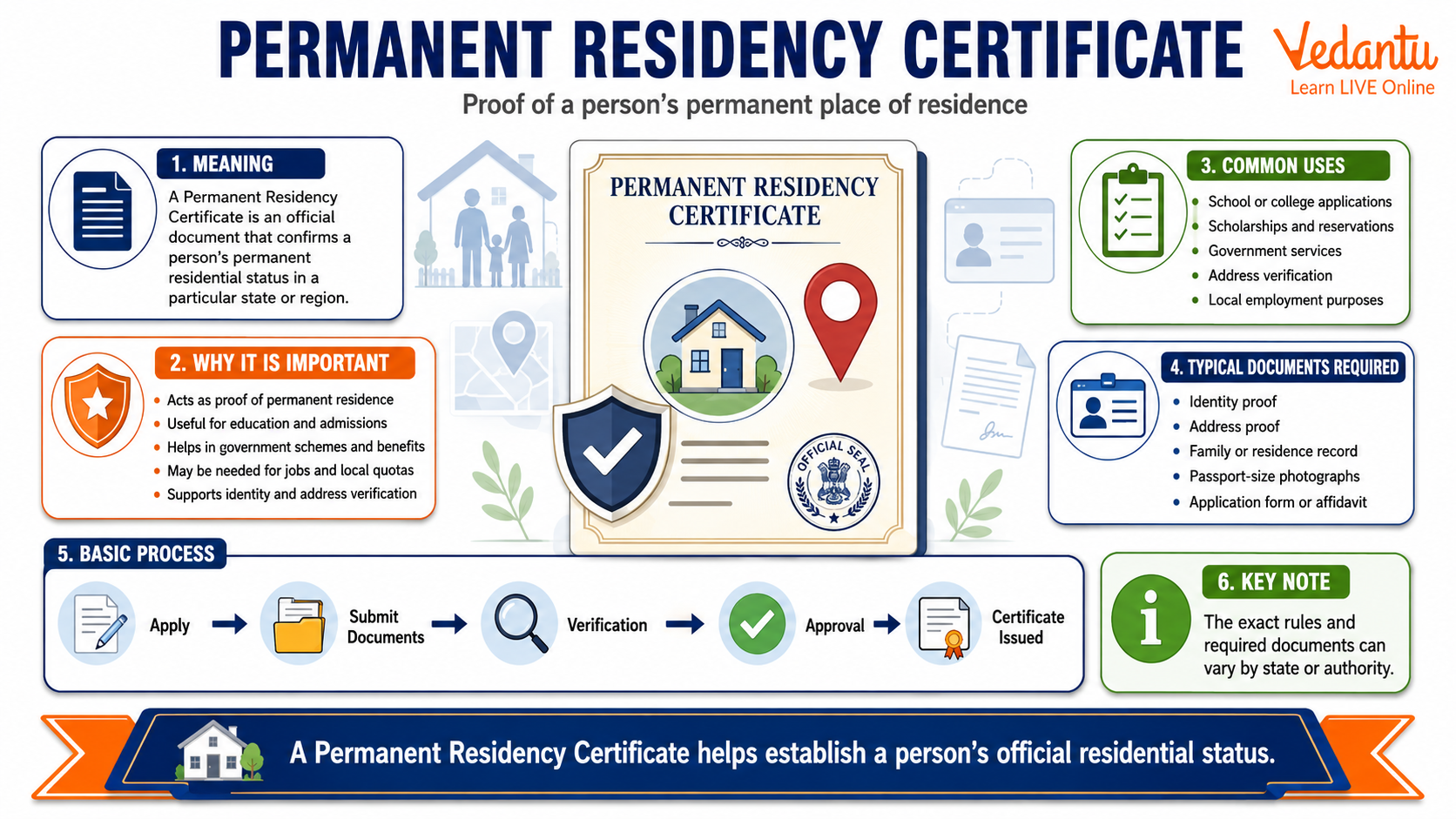
What is a Permanent Residency Certificate?
A Permanent Residency Certificate is a legal document issued by a competent government authority such as a District Magistrate, Tehsildar, or Revenue Department. It confirms that an individual has been residing in a particular region for a specified period and is recognized as a permanent resident under the rules of that region.
The eligibility criteria and issuing authority may vary depending on the state or country. However, the primary objective remains the same - to officially establish a person’s residential status.
Purpose of Permanent Residency Certificate
- To claim benefits under state government welfare schemes.
- To apply for reserved category seats in educational institutions.
- To secure state government employment opportunities.
- To obtain domicile-based scholarships and financial aid.
- To prove long-term residence for legal and administrative purposes.
Eligibility Criteria
The eligibility conditions for obtaining a Permanent Residency Certificate differ across regions. However, the common requirements include:
- The applicant must have resided in the state or region for a specified number of years.
- The applicant should possess valid identity and address proof.
- The applicant must not hold permanent residency status in another state if restricted by law.
- Supporting documents such as birth certificate, school records, or property records may be required.
Documents Required
To apply for a Permanent Residency Certificate, applicants generally need to submit the following documents:
- Proof of identity such as Aadhaar card, voter ID, or passport.
- Proof of residence such as electricity bill, ration card, or rental agreement.
- Birth certificate or school leaving certificate.
- Affidavit declaring permanent residence status.
- Passport-sized photographs.
Application Process
The process of applying for a Permanent Residency Certificate may be online or offline depending on the state. The general steps are as follows:
- Visit the official government portal or local revenue office.
- Fill out the application form with accurate details.
- Attach or upload the required documents.
- Pay the prescribed application fee if applicable.
- Submit the form and note the reference number for tracking.
- Receive the certificate after verification by authorities.
Key Details About Permanent Residency Certificate
| Aspect | Description | Authority Involved |
|---|---|---|
| Purpose | Proof of permanent residence | State Government |
| Issuing Body | Revenue Department | District Administration |
| Validity | Usually lifetime | As per state rules |
The above table summarizes the essential aspects of a Permanent Residency Certificate. While the core purpose remains consistent, procedural details may differ slightly across regions.
Difference Between Permanent Residency Certificate and Domicile Certificate
Although often used interchangeably, a Permanent Residency Certificate and a Domicile Certificate may have slight differences depending on local laws. A domicile certificate generally proves that a person resides in a state, while a PRC may specifically confirm permanent resident status with additional rights and privileges.
- PRC may grant eligibility for reserved quotas.
- Domicile certificate mainly establishes residence.
- Issuing authorities can be similar but legal implications may differ.
Importance in Education and Employment
The Permanent Residency Certificate holds significant importance in education and employment sectors. Many state universities reserve seats for permanent residents. Similarly, state government jobs may require proof of permanent residence. Scholarships and financial assistance programs also rely on this certificate to ensure benefits reach eligible residents.
Legal and Administrative Significance
From a legal perspective, the Permanent Residency Certificate acts as official recognition of an individual’s residential status. It helps maintain accurate population records, supports fair distribution of state resources, and ensures that government schemes are accessed by rightful beneficiaries.
Conclusion
A Permanent Residency Certificate is an essential legal document that confirms an individual’s permanent residential status within a specific region. It is crucial for accessing educational opportunities, employment benefits, and welfare schemes. Understanding its purpose, eligibility criteria, and application process helps individuals secure their rights and benefits effectively. As residency laws may vary by state or country, applicants should always verify the latest guidelines issued by the concerned authorities.
FAQs on Permanent Residency Certificate: Meaning, Eligibility, and Student Benefits
1. What is a Permanent Residency Certificate (PRC)?
A Permanent Residency Certificate (PRC) is an official government document that proves a person is a permanent resident of a particular state or region.
• Issued by: State Government/UT Administration
• Purpose: Establishes domicile status and legal residence
• Used for: government jobs, education admissions, welfare schemes
• Also known as: Domicile Certificate, Residence Certificate (People also search: proof of residence, state residency proof).
2. Why is a Permanent Residency Certificate important?
A Permanent Residency Certificate is important because it grants access to state-specific rights and benefits.
• Eligibility for state government jobs
• Admission in state-run educational institutions
• Access to scholarships and welfare schemes
• Legal proof of permanent domicile (People also ask: Why is domicile certificate required?).
3. Who is eligible to apply for a Permanent Residency Certificate?
Eligibility for a PRC depends on state laws, but generally applicants must fulfill residency conditions.
• Continuous stay in the state for a specified number of years
• Birth in the state or parents being permanent residents
• Possession of valid residential proof documents
• Compliance with state domicile rules (People also search: PRC eligibility criteria, domicile requirements).
4. What documents are required for obtaining a PRC?
To obtain a Permanent Residency Certificate, applicants must submit valid supporting documents.
• Aadhaar Card or identity proof
• Birth Certificate or school certificate
• Address proof (electricity bill, ration card)
• Affidavit or parental domicile proof
• Passport-size photographs (People also ask: Documents needed for domicile certificate).
5. How can one apply for a Permanent Residency Certificate?
A PRC application can be submitted either online or offline through government authorities.
• Visit the official state portal or local Tehsil office
• Fill out the application form
• Upload or attach required documents
• Pay applicable fees (if any)
• Track application status online (People also search: How to apply for domicile certificate online?).
6. What is the difference between a PRC and a Domicile Certificate?
A PRC and a Domicile Certificate are often similar but may differ based on state regulations.
• PRC: Confirms permanent resident status in specific regions
• Domicile Certificate: Proves legal residence in a state
• Usage varies by state laws and administrative rules
• Both serve as residency proof documents (People also ask: Is PRC same as domicile certificate?).
7. Is a Permanent Residency Certificate mandatory for government jobs?
Yes, a Permanent Residency Certificate is often mandatory for applying to state government jobs.
• Required for reserved state posts
• Needed for local quotas
• Mandatory for certain competitive exams
• Ensures preference to local residents (People also search: PRC requirement for state jobs).
8. What is the validity period of a Permanent Residency Certificate?
A Permanent Residency Certificate is generally valid for a lifetime unless specified otherwise by state authorities.
• Usually no expiry date
• Valid as long as residency conditions remain unchanged
• Re-issuance required if details are modified
• State-specific rules may apply (People also ask: Does domicile certificate expire?).
9. Can a PRC be cancelled or revoked?
Yes, a Permanent Residency Certificate can be cancelled if obtained fraudulently or if eligibility conditions are violated.
• Submission of false documents
• Providing incorrect information
• Violation of state domicile laws
• Legal action may follow cancellation (People also search: Cancellation of domicile certificate rules).
10. How long does it take to get a Permanent Residency Certificate?
The processing time for a PRC usually ranges from a few days to a few weeks, depending on verification procedures.
• Average time: 7–30 working days
• Depends on document verification
• Online applications may be processed faster
• Delays possible due to administrative checks (People also ask: PRC processing time in India?).
