






How Patent Rights Work and Who Can Apply for a Patent
A patent is a legal right granted by the government to an inventor for a new invention. It gives the inventor exclusive rights to make, use, sell, or distribute the invention for a specific period of time. Patents encourage innovation by protecting inventors from unauthorized copying of their work. They play a crucial role in technological advancement, economic growth, and industrial development. Understanding patents is important for students, competitive exam aspirants, and anyone interested in science, law, or business.
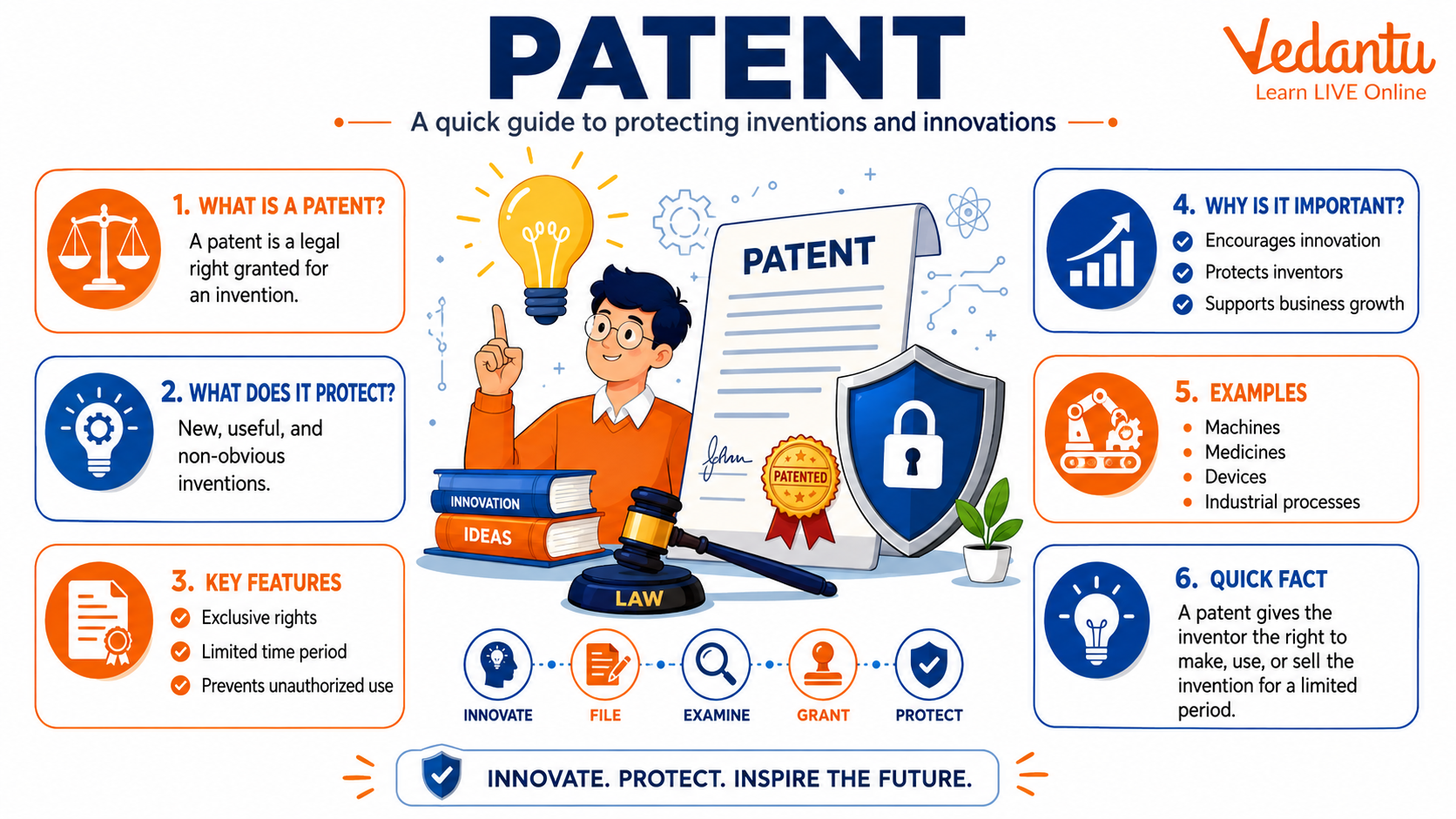
What is a Patent?
A patent is an exclusive right granted for an invention that is new, useful, and non-obvious. In exchange for this protection, the inventor must publicly disclose details of the invention. This ensures that knowledge is shared with society while rewarding innovation.
- Provides exclusive rights to the inventor.
- Prevents others from making or selling the invention without permission.
- Valid only for a limited time period.
- Territorial in nature, valid only in the country where granted.
Types of Patents
Different types of patents protect different kinds of inventions. The classification may vary slightly by country, but generally includes the following:
- Utility Patent - Granted for new and useful processes, machines, articles of manufacture, or compositions of matter.
- Design Patent - Protects the ornamental design or appearance of an object.
- Plant Patent - Granted for new varieties of plants that are asexually reproduced.
Criteria for Granting a Patent
Not every invention qualifies for a patent. It must meet certain legal requirements:
- Novelty - The invention must be new and not previously disclosed.
- Inventive Step - It should not be obvious to someone skilled in the field.
- Industrial Applicability - The invention must be useful and capable of practical application.
Duration of a Patent
In most countries, including India and the United States, the duration of a patent is 20 years from the date of filing the application. After this period, the invention enters the public domain and can be freely used by anyone.
Patent Application Process
The process of obtaining a patent involves several steps. It requires detailed documentation and examination by the patent office.
- Filing of patent application with complete specifications.
- Publication of the application after a specified period.
- Examination by the patent authority.
- Grant of patent if all requirements are satisfied.
Key Features of a Patent
| Feature | Description | Importance |
|---|---|---|
| Exclusive Right | Only the inventor can use or license it | Prevents unauthorized use |
| Limited Duration | Generally 20 years | Balances innovation and public access |
| Public Disclosure | Details of invention made public | Promotes knowledge sharing |
The above features ensure that inventors are rewarded while society benefits from technological progress and shared knowledge.
Importance of Patents
Patents are essential for economic and technological development. They motivate individuals and companies to invest in research and innovation.
- Encourage innovation and research.
- Provide legal protection to inventors.
- Promote industrial growth.
- Attract investment and commercialization opportunities.
Patent vs Copyright vs Trademark
Patents are part of intellectual property rights. They differ from other forms such as copyright and trademark.
Comparison of Intellectual Property Rights
| Basis | Patent | Copyright / Trademark |
|---|---|---|
| Protects | Inventions | Creative works / Brand names |
| Duration | 20 years | Longer duration depending on type |
| Requirement | Registration mandatory | Registration required for trademark |
Understanding these differences helps clarify the role of patents within the broader framework of intellectual property rights.
Conclusion
A patent is a powerful legal tool that protects inventions and promotes innovation. By granting exclusive rights for a limited period, it balances the interests of inventors and society. Knowledge about patents is important for students, entrepreneurs, scientists, and competitive exam aspirants. A clear understanding of the concept, features, types, and application process helps in building awareness about intellectual property and its role in modern development.
FAQs on Patent Protection Explained for Students
1. What is a Patent?
A patent is a legal right granted by the government that gives an inventor exclusive rights over their invention for a limited period.
• It protects new inventions, processes, machines, or products.
• It prevents others from making, using, selling, or distributing the invention without permission.
• In most countries, patent protection lasts for 20 years from the filing date.
• It falls under Intellectual Property Rights (IPR) along with trademarks and copyrights.
2. What are the types of Patents?
There are different types of patents based on the nature of the invention being protected.
• Utility Patent: Protects new processes, machines, or compositions of matter.
• Design Patent: Protects the unique appearance or design of a product.
• Plant Patent: Protects new varieties of plants.
• These categories ensure protection for innovation, industrial design, and agricultural inventions.
3. What are the requirements to obtain a Patent?
To obtain a patent, an invention must meet specific legal requirements.
• Novelty: The invention must be new and not previously disclosed.
• Inventive Step (Non-obviousness): It should not be obvious to a skilled person in the field.
• Industrial Applicability: It must be useful and capable of practical application.
• These criteria are essential under Patent Law and international agreements like TRIPS.
4. What is the duration of a Patent?
The standard duration of a patent is 20 years from the date of filing the application.
• The 20-year term applies to most utility patents worldwide.
• Annual maintenance fees must be paid to keep it valid.
• After expiry, the invention enters the public domain, allowing anyone to use it freely.
5. What is the Patent application process?
The patent application process involves several legal and technical steps before approval.
• Filing a provisional or complete specification with the Patent Office.
• Publication of the application after a specified period.
• Examination by a patent examiner for novelty and compliance.
• Grant of patent if all legal requirements are satisfied.
6. What is the difference between Patent, Copyright, and Trademark?
A patent, copyright, and trademark protect different forms of intellectual property.
• Patent: Protects inventions and technological innovations.
• Copyright: Protects literary, artistic, and creative works.
• Trademark: Protects brand names, logos, and symbols.
• All are part of Intellectual Property Rights (IPR) but serve different purposes.
7. What is a Patent infringement?
Patent infringement occurs when someone uses or sells a patented invention without permission from the patent holder.
• Unauthorized manufacturing, selling, or importing of a patented product is illegal.
• The patent owner can file a legal lawsuit for damages.
• Courts may grant injunctions, compensation, or penalties against the infringer.
8. What is a Compulsory License in Patent law?
A compulsory license allows a government to permit others to produce a patented product without the owner’s consent under special conditions.
• Issued in cases of public health emergencies or national interest.
• Ensures access to essential products like life-saving medicines.
• Recognized under international agreements such as TRIPS Agreement.
9. Who grants Patents in India?
In India, patents are granted by the Indian Patent Office under the Patents Act, 1970.
• It operates under the Controller General of Patents, Designs and Trade Marks (CGPDTM).
• Offices are located in Mumbai, Delhi, Chennai, and Kolkata.
• The system ensures protection of innovation and industrial development in India.
10. Why are Patents important for innovation and economic growth?
Patents are important because they encourage innovation by rewarding inventors with exclusive rights.
• Provide financial incentives for research and development (R&D).
• Promote technological advancement and industrial growth.
• Attract foreign investment and entrepreneurship.
• Balance public interest by eventually placing inventions in the public domain.
