






What Does Nota Mean in English Grammar and School Context?
NOTA stands for None Of The Above. It is an option provided to voters in elections that allows them to reject all the candidates contesting in a particular constituency. Introduced to strengthen democratic values, NOTA empowers citizens to express dissatisfaction with the available choices without abstaining from voting. In India, the NOTA option was implemented following a Supreme Court judgment in 2013, making the electoral process more transparent and participatory.
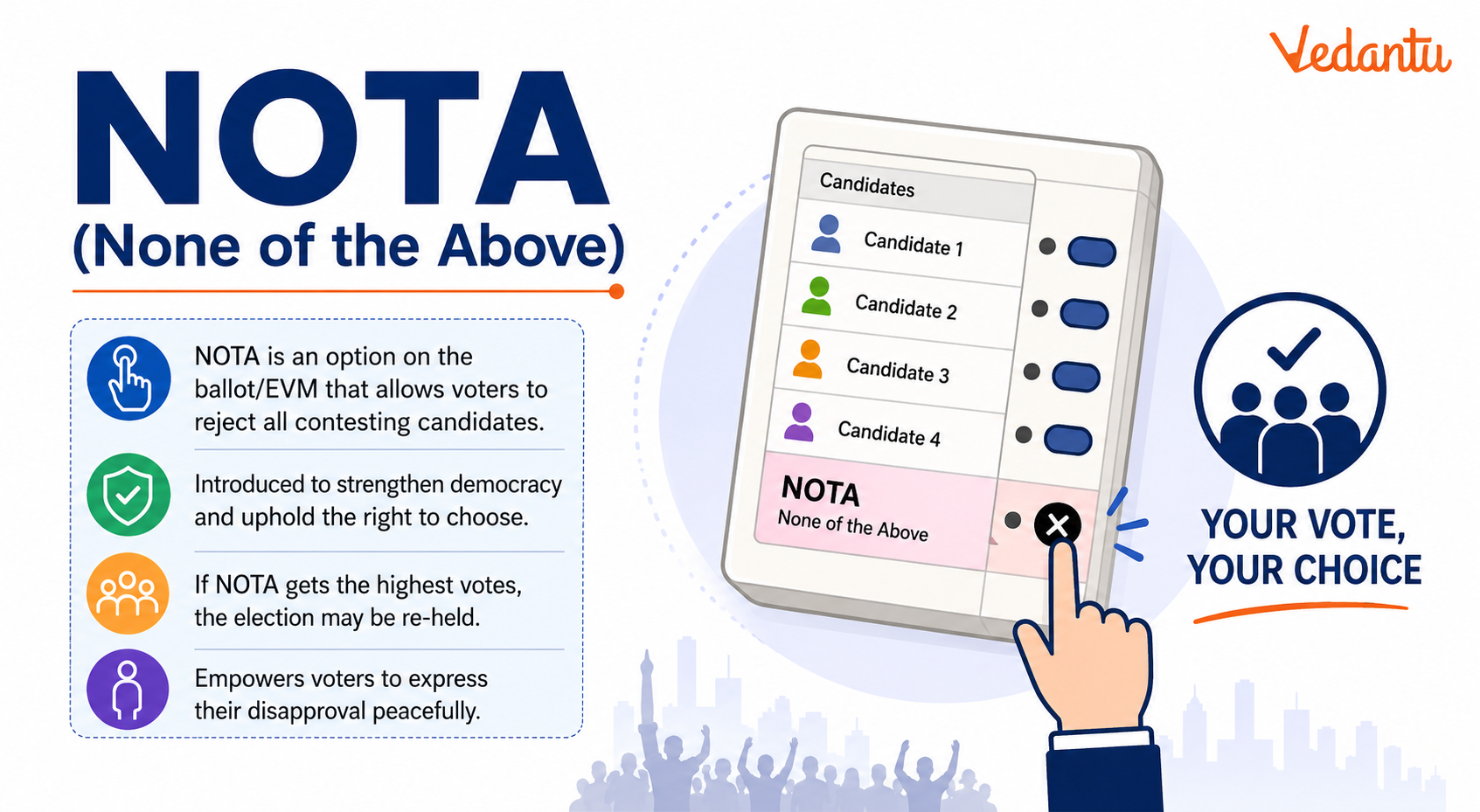
What is NOTA?
NOTA is a voting option that enables voters to choose none of the candidates listed on the Electronic Voting Machine (EVM). When a voter presses the NOTA button, it indicates that they do not support any of the contesting candidates. However, even if NOTA receives the highest number of votes, the candidate with the highest votes among the remaining candidates is declared the winner.
Background and Introduction of NOTA in India
The concept of NOTA was introduced in India after the Supreme Court verdict in the case of People’s Union for Civil Liberties vs Union of India in 2013. The Court directed the Election Commission of India to provide a NOTA option in EVMs to protect the secrecy of voters who wished to reject all candidates.
- Implemented in India in September 2013.
- First used in the 2013 State Assembly elections.
- Available in Lok Sabha, State Assembly, and local body elections.
Objectives of NOTA
The introduction of NOTA serves several democratic purposes. It provides voters with the freedom to reject unsuitable candidates and encourages political parties to nominate better representatives.
- Promotes voter freedom and expression.
- Ensures secrecy of voters who reject candidates.
- Encourages political accountability.
- Strengthens democratic participation.
Key Features of NOTA
- Appears as the last option on the Electronic Voting Machine.
- Represented by a ballot paper symbol with a cross mark.
- Does not affect the final result directly.
- Votes are counted and recorded separately.
NOTA at a Glance
| Aspect | Details | Year Introduced |
|---|---|---|
| Full Form | None Of The Above | 2013 |
| Implemented By | Election Commission of India | 2013 |
The table above summarizes the essential facts about NOTA, including its full form, implementing authority, and year of introduction in India.
Impact of NOTA in Elections
Since its introduction, NOTA has been used by a significant number of voters in various elections. Although it does not lead to re-elections if it secures the highest votes, it sends a strong message to political parties about voter dissatisfaction. In some constituencies, NOTA has received more votes than individual candidates.
Advantages and Limitations of NOTA
Advantages
- Enhances democratic rights.
- Encourages responsible candidate selection.
- Provides an alternative to abstaining from voting.
Limitations
- Does not cancel the election if it receives maximum votes.
- Has no direct legal consequence on candidates.
- Functions mainly as a symbolic option.
Why NOTA is Important for Students
Understanding NOTA is important for General Knowledge, Civics, and competitive examinations. Questions related to its full form, year of introduction, constitutional basis, and significance frequently appear in exams. For NEET aspirants, awareness of democratic processes enhances overall knowledge and helps in developing informed citizenship, which is essential for responsible professionals in society.
Conclusion
NOTA is an important reform in the Indian electoral system that strengthens democracy by giving voters the right to reject all candidates. While it does not directly change election outcomes, it plays a significant role in expressing public opinion and promoting accountability. A clear understanding of NOTA helps students grasp key democratic principles and prepares them effectively for competitive examinations.
FAQs on Nota in English Explained: Definition and Usage Guide
1. What is NOTA in elections?
The NOTA (None of the Above) option allows voters to reject all contesting candidates in an election.
• Introduced by the Election Commission of India (ECI) in 2013 after a Supreme Court judgment.
• Available on Electronic Voting Machines (EVMs).
• Ensures voter secrecy while expressing dissatisfaction.
• Also known as the Right to Reject or negative voting option.
2. When was NOTA introduced in India?
The NOTA option was introduced in India in 2013 following a landmark Supreme Court ruling.
• Based on the PUCL vs Union of India (2013) case.
• First used in the 2013 Assembly Elections.
• Aimed to strengthen democracy, electoral reforms, and voter rights.
3. What is the purpose of NOTA?
The main purpose of NOTA is to give voters the right to reject all candidates if they are dissatisfied.
• Promotes free and fair elections.
• Encourages political parties to nominate better candidates.
• Strengthens democratic participation.
• Reflects public dissatisfaction in voting results.
4. Does NOTA affect election results in India?
In India, NOTA does not affect the final election result even if it gets the highest votes.
• The candidate with the highest valid votes still wins.
• NOTA votes are counted but treated as non-transferable.
• Unlike some countries, re-elections are not held due to high NOTA votes.
5. Who introduced the concept of NOTA in India?
The Supreme Court of India directed the introduction of NOTA in 2013.
• Petition filed by People’s Union for Civil Liberties (PUCL).
• Implemented by the Election Commission of India.
• Recognized as part of the voter’s fundamental right to freedom of expression.
6. What symbol represents NOTA on the ballot paper or EVM?
The NOTA option is represented by a ballot paper with a black cross mark symbol.
• Appears as the last option on the EVM.
• Designed for easy identification by voters.
• Ensures clarity in the voting process during elections.
7. Is NOTA available in all elections in India?
Yes, NOTA is available in Lok Sabha, State Assembly, and local body elections in India.
• Applicable in Parliamentary elections.
• Used in State legislative elections.
• Included in most municipal and panchayat elections.
8. What are the advantages of NOTA?
The advantages of NOTA include promoting voter freedom and political accountability.
• Strengthens democratic values.
• Provides a legal way to express dissatisfaction.
• Encourages political reforms and cleaner candidates.
• Increases voter awareness and participation.
9. What are the criticisms of NOTA?
The main criticism is that NOTA has no direct impact on election outcomes.
• Does not lead to re-election even if it gets majority votes.
• Considered symbolic rather than powerful.
• Some experts argue it needs stronger electoral reforms.
10. How is NOTA important for competitive exams and GK?
NOTA is an important topic for General Knowledge (GK) and competitive exams like UPSC, SSC, and State PSC.
• Frequently asked under Indian Polity and Constitution.
• Related to electoral reforms and Supreme Court judgments.
• Important for understanding democracy and voter rights in India.
