






Key Differences Between Beca Lemoa and Comcasa Scholarships
Beca and COMCASA are two important agreements signed between India and the United States to strengthen defense cooperation. These agreements are often discussed in competitive exams, general knowledge sections, and current affairs due to their strategic importance. While both aim to enhance military collaboration, they differ in purpose, scope, and type of information shared. Understanding the difference between BECA and COMCASA is essential for students preparing for competitive exams and for anyone interested in international relations and defense studies.
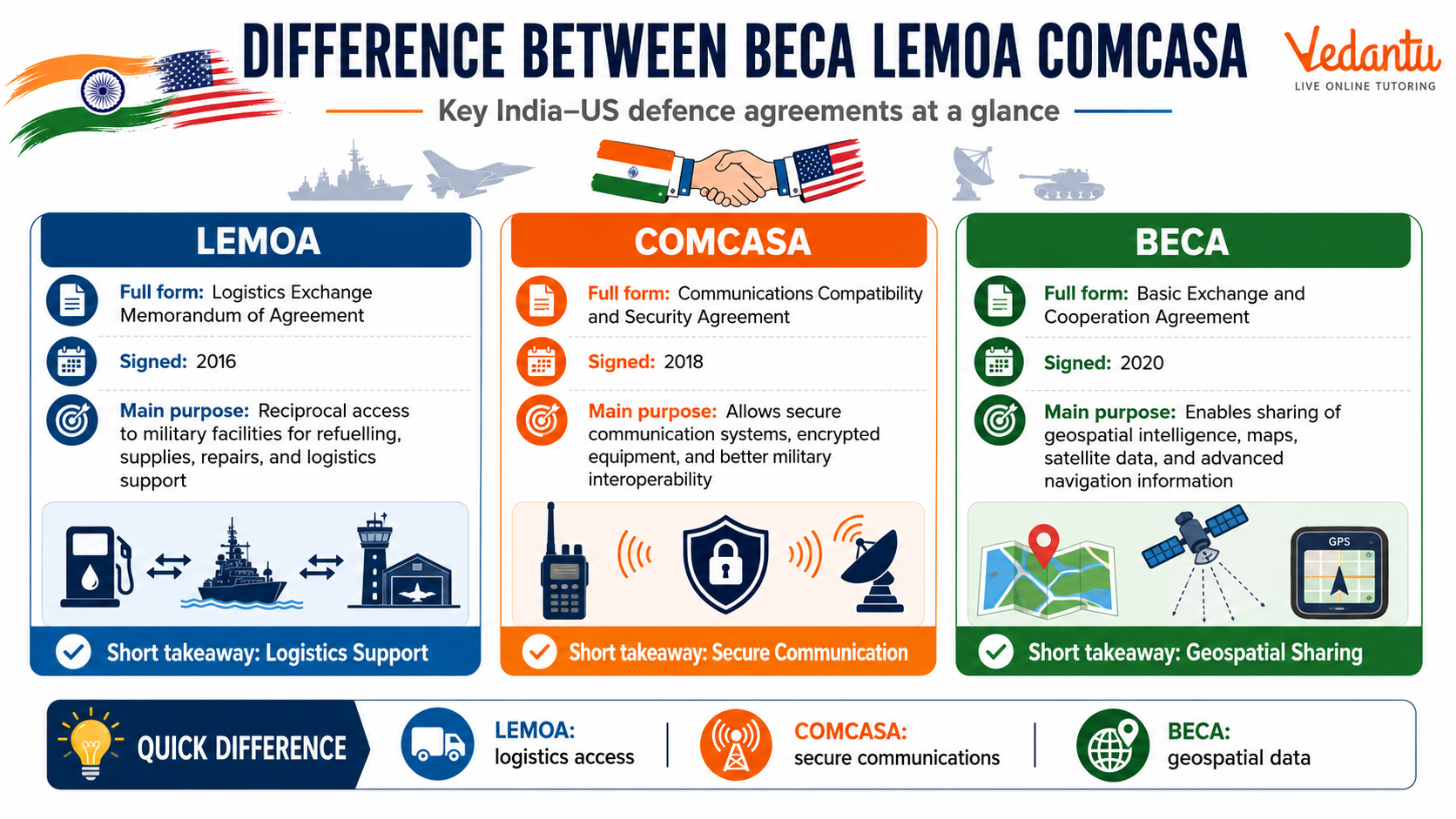
What is BECA?
BECA stands for Basic Exchange and Cooperation Agreement for Geo-Spatial Cooperation. It was signed between India and the United States in October 2020. This agreement allows both countries to share geospatial intelligence, including satellite data, maps, and advanced navigation information for defense purposes.
Key Features of BECA
- Sharing of high-end geospatial intelligence and satellite imagery.
- Improves accuracy of missiles and armed drones.
- Enhances navigation systems of aircraft and warships.
- Strengthens real-time intelligence sharing between armed forces.
What is COMCASA?
COMCASA stands for Communications Compatibility and Security Agreement. It was signed between India and the United States in September 2018. This agreement enables secure communication between the military forces of both countries by allowing India to obtain and use encrypted communication equipment from the US.
Key Features of COMCASA
- Provides access to secure and encrypted communication systems.
- Ensures real-time communication during joint military operations.
- Improves interoperability between Indian and US armed forces.
- Allows installation of advanced communication equipment on US-origin defense platforms.
Difference Between BECA and COMCASA
| Basis of Comparison | BECA | COMCASA |
|---|---|---|
| Full Form | Basic Exchange and Cooperation Agreement | Communications Compatibility and Security Agreement |
| Year Signed | 2020 | 2018 |
| Main Purpose | Sharing geospatial intelligence | Providing secure communication systems |
| Type of Data Shared | Satellite data and maps | Encrypted communication data |
| Strategic Benefit | Improves targeting and navigation accuracy | Enhances secure military communication |
In simple terms, BECA focuses on sharing geospatial and mapping intelligence, while COMCASA focuses on secure communication systems. Both agreements enhance India’s defense capabilities but in different operational areas.
Strategic Importance of BECA and COMCASA
Both agreements are part of the foundational defense agreements between India and the United States. They significantly improve military coordination and operational efficiency.
- Strengthen India-US strategic partnership.
- Enhance joint military exercises and operations.
- Improve India’s defense preparedness and surveillance capabilities.
- Support regional security in the Indo-Pacific region.
Conclusion
The difference between BECA and COMCASA lies mainly in their purpose and scope. BECA deals with geospatial intelligence sharing, while COMCASA ensures secure communication between the armed forces of India and the United States. Together, these agreements strengthen defense cooperation, improve military efficiency, and enhance strategic capabilities. For students and competitive exam aspirants, understanding these agreements is important as they are frequently asked in general knowledge and current affairs sections.
FAQs on Difference Between Beca Lemoa and Comcasa for Students
1. What is the difference between BECA, LEMOA, and COMCASA?
The difference between BECA, LEMOA, and COMCASA lies in their purpose within India–US defense cooperation agreements.
• LEMOA (Logistics Exchange Memorandum of Agreement) – Signed in 2016, allows mutual access to military bases for logistics support like fuel and supplies.
• COMCASA (Communications Compatibility and Security Agreement) – Signed in 2018, enables secure communication and sharing of encrypted military data.
• BECA (Basic Exchange and Cooperation Agreement) – Signed in 2020, facilitates sharing of geospatial intelligence and satellite data.
These three are known as foundational defense agreements that strengthen India–US strategic partnership.
2. What is LEMOA and why is it important?
The LEMOA agreement allows India and the United States to use each other’s military facilities for logistics support.
• Full form: Logistics Exchange Memorandum of Agreement
• Signed in: 2016
• Covers: Refueling, repair, food supplies, and port access
• Enhances: naval cooperation, joint exercises, and maritime security
LEMOA improves operational efficiency without establishing permanent military bases.
3. What is COMCASA and how does it benefit India?
The COMCASA agreement enables secure and encrypted communication between Indian and US armed forces.
• Full form: Communications Compatibility and Security Agreement
• Signed in: 2018
• Allows access to advanced US defense technology
• Ensures real-time secure communication during joint operations
COMCASA enhances interoperability, defense technology transfer, and military coordination.
4. What is BECA and what does it include?
The BECA agreement allows sharing of geospatial intelligence and satellite data between India and the US.
• Full form: Basic Exchange and Cooperation Agreement
• Signed in: 2020
• Provides: Topographical maps, satellite imagery, and targeting data
• Improves: missile accuracy, drone operations, and navigation systems
BECA strengthens India’s defense preparedness and border security.
5. Why are BECA, LEMOA, and COMCASA called foundational agreements?
BECA, LEMOA, and COMCASA are called foundational defense agreements because they form the base of India–US military cooperation.
• Enable logistics sharing (LEMOA)
• Ensure secure communication (COMCASA)
• Provide geospatial intelligence (BECA)
• Enhance joint military exercises and interoperability
These agreements deepen the strategic partnership and Indo-Pacific security cooperation.
6. When were BECA, LEMOA, and COMCASA signed?
The three India–US defense agreements were signed in different years to strengthen bilateral ties.
• LEMOA – 2016
• COMCASA – 2018
• BECA – 2020
These agreements reflect the growing India–US strategic alliance and defense collaboration.
7. How do BECA, LEMOA, and COMCASA enhance India’s security?
The three agreements collectively enhance India’s national security and military capability.
• Faster logistics support during operations (LEMOA)
• Secure communication in warfare (COMCASA)
• Accurate targeting and navigation data (BECA)
• Improved joint exercises like Malabar Naval Exercise
Together, they boost India’s defense readiness and Indo-Pacific presence.
8. Do BECA, LEMOA, and COMCASA allow US military bases in India?
No, these agreements do not allow permanent US military bases in India.
• LEMOA only permits temporary logistics access
• No sovereignty compromise for India
• Access is granted on a case-by-case basis
• Ensures mutual consent and strategic autonomy
India maintains full control over its territorial integrity and defense policy.
9. How are BECA, LEMOA, and COMCASA relevant for competitive exams?
These agreements are important for UPSC, SSC, CDS, NDA, and other competitive exams under international relations and defense topics.
• Frequently asked in current affairs and GK sections
• Related to India–US relations
• Important for Indo-Pacific strategy questions
• Linked with defense modernization and geopolitics
Understanding their differences helps in objective and descriptive answers.
10. How do BECA, LEMOA, and COMCASA impact Indo-Pacific strategy?
The agreements strengthen India’s role in the Indo-Pacific region by improving military cooperation with the US.
• Support freedom of navigation operations
• Enhance maritime domain awareness
• Strengthen Quad cooperation (India, US, Japan, Australia)
• Improve regional stability and deterrence
They contribute significantly to the Indo-Pacific security framework and strategic balance.
