






How the Dutch East India Company Established Control in India
The Establishment of Dutch Dominion in India marks an important phase in the history of European expansion in Asia. The Dutch, through the Dutch East India Company, entered India primarily for trade but gradually established their political and commercial influence in several coastal regions. Their activities were mainly focused on controlling the spice trade and other profitable commodities. Understanding the rise and decline of Dutch power in India is important for students preparing for competitive examinations and for gaining insight into the broader context of colonial history in India.
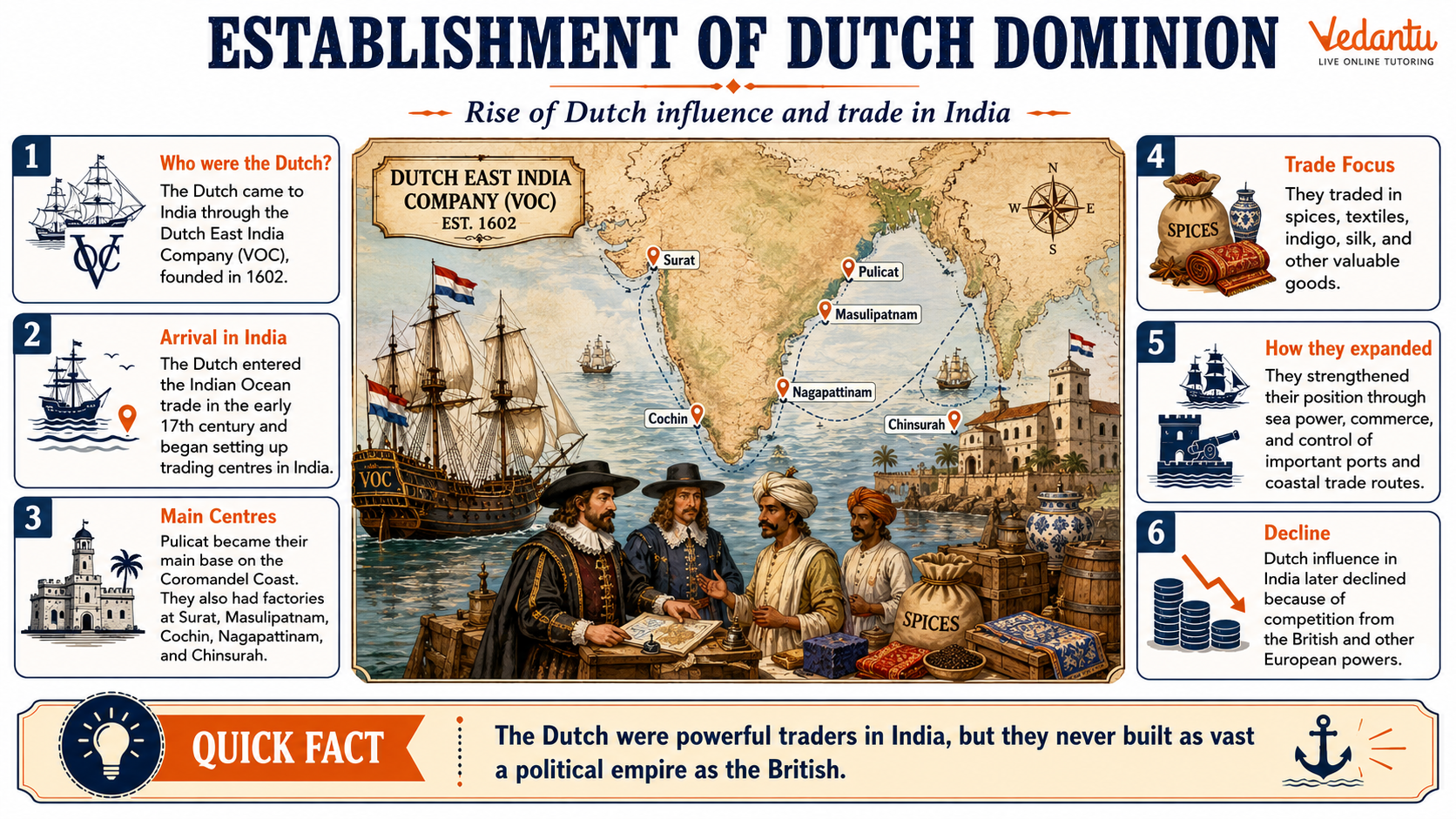
Background of Dutch Arrival in India
During the 16th and 17th centuries, European nations competed fiercely to control the lucrative spice trade of the East Indies. The Portuguese were the first to establish their presence in India, followed by the Dutch, the English, and the French. The Dutch formed the Verenigde Oostindische Compagnie, popularly known as the Dutch East India Company, in 1602.
The main objective of the Dutch was to eliminate Portuguese dominance and secure direct access to spices and other valuable goods. Unlike the English, the Dutch were more interested in trade rather than territorial expansion in India.
Establishment of Dutch Trading Centers
The Dutch established several trading posts and settlements along the Indian coastline to facilitate commerce. These settlements became the foundation of Dutch dominion in India.
Major Dutch Settlements in India
Important Dutch Settlements in India
| Settlement | Year of Establishment | Present Location |
|---|---|---|
| Masulipatnam | 1605 | Andhra Pradesh |
| Pulicat | 1610 | Tamil Nadu |
| Surat | 1616 | Gujarat |
| Chinsurah | 1656 | West Bengal |
Pulicat became the headquarters of the Dutch in India for many years. These trading centers helped the Dutch control important trade routes and export goods such as spices, indigo, silk, cotton textiles, and saltpetre.
Nature of Dutch Dominion
The Dutch dominion in India was primarily commercial in nature. They focused on monopolizing trade rather than acquiring large territories. Their main aim was profit through trade and not political rule.
- They captured Portuguese forts and trading posts in coastal regions.
- They established strong naval power in the Indian Ocean.
- They maintained good trade relations with local rulers.
- They concentrated more on Indonesia and the Spice Islands than on mainland India.
Anglo-Dutch Rivalry
The Dutch faced stiff competition from the British East India Company. Over time, the English emerged as stronger competitors due to better political strategies and naval strength.
The rivalry between the English and the Dutch resulted in several conflicts. The most significant event in India was the Battle of Bedara in 1759, where the British defeated the Dutch forces near Chinsurah in Bengal. This defeat marked the decline of Dutch power in India.
Reasons for the Decline of Dutch Power in India
Although the Dutch were initially successful in trade, several factors led to the decline of their dominion in India.
- Greater focus on the Indonesian archipelago rather than India.
- Lack of interest in territorial expansion in India.
- Strong competition from the British East India Company.
- Defeat in the Battle of Bedara in 1759.
- Financial difficulties and administrative issues within the Dutch East India Company.
Significance of Dutch Dominion in Indian History
Though the Dutch did not establish a vast empire in India, their presence had lasting effects on Indian trade and European competition in Asia. They weakened Portuguese dominance and contributed to the rise of competitive European trade in India.
- Introduced new commercial practices and trade networks.
- Strengthened maritime trade in the Indian Ocean.
- Played a role in shaping colonial rivalry in India.
Quick Revision Points
- Dutch East India Company was established in 1602.
- First Dutch factory in India was set up at Masulipatnam in 1605.
- Pulicat served as the Dutch headquarters in India.
- Main objective was trade monopoly, especially in spices.
- Defeated by the British at the Battle of Bedara in 1759.
Conclusion
The Establishment of Dutch Dominion in India represents a significant chapter in the history of European trade and colonial competition. Although the Dutch did not establish extensive political control, they played a crucial role in shaping maritime commerce and weakening Portuguese supremacy. Their eventual decline paved the way for British dominance in India. For students and competitive exam aspirants, this topic is important for understanding the sequence of European settlements and the dynamics of colonial rivalry in India.
FAQs on Establishment of Dutch Rule in India: Key Events and Impact
1. What was the Establishment of Dutch Dominion in India?
The Establishment of Dutch Dominion in India refers to the period when the Dutch East India Company (VOC) set up trading settlements and controlled parts of Indian trade during the 17th century.
• The Dutch arrived in India in 1605.
• They aimed to dominate the spice trade and maritime commerce.
• Key centers included Masulipatnam, Pulicat, Nagapattinam, Cochin, and Chinsurah.
• Their power declined after conflicts with the British East India Company.
This period is also known as the rise of Dutch colonial trade in India and European commercial expansion.
2. When did the Dutch East India Company come to India?
The Dutch East India Company (VOC) arrived in India in 1605 to establish trade relations.
• First factory established at Masulipatnam (Andhra Pradesh).
• Main objective was to capture the Indian Ocean spice trade.
• Followed the Portuguese in entering Indian markets.
This marked the beginning of Dutch commercial settlements in India and European competition in Asia.
3. What were the main trading centers of the Dutch in India?
The Dutch established several important trading factories and settlements in India.
• Masulipatnam – First Dutch factory.
• Pulicat – Main headquarters in South India.
• Nagapattinam – Important port on the Coromandel Coast.
• Cochin – Captured from the Portuguese in 1663.
• Chinsurah (Bengal) – Major center in eastern India.
These centers helped the Dutch dominate the textile, spice, and maritime trade.
4. What were the objectives of the Dutch in India?
The main objective of the Dutch in India was to control the profitable spice trade and expand their commercial empire.
• Establish monopoly over pepper, cloves, and nutmeg.
• Set up secure trading posts (factories).
• Compete with the Portuguese and British.
• Strengthen Dutch dominance in the Indian Ocean trade network.
Their focus was mainly on trade rather than territorial conquest.
5. How did the Dutch defeat the Portuguese in India?
The Dutch weakened Portuguese power by capturing their key ports and challenging their naval supremacy.
• Defeated the Portuguese in naval battles.
• Captured Cochin in 1663.
• Reduced Portuguese influence on the Malabar Coast.
• Established control over spice-producing regions.
This shift marked the decline of Portuguese dominance and the rise of Dutch colonial power in India.
6. Why did the Dutch fail to establish a strong empire in India?
The Dutch failed to build a strong empire in India mainly due to British competition and limited political ambition.
• Focused only on trade, not territorial expansion.
• Defeated by the British in the Battle of Bedara (1759).
• Faced financial problems in the Dutch East India Company.
• Lost settlements to the British East India Company.
These factors led to the decline of Dutch influence in India.
7. What was the Battle of Bedara (1759)?
The Battle of Bedara (1759) was a decisive conflict between the Dutch and the British in Bengal.
• Fought near Chinsurah in Bengal.
• British forces defeated the Dutch troops.
• Marked the end of serious Dutch political ambitions in India.
• Strengthened British dominance in eastern India.
This battle is a key event in the decline of Dutch colonial power in India.
8. What goods did the Dutch trade in India?
The Dutch traded mainly in spices, textiles, and other valuable commodities.
• Pepper, cloves, nutmeg – Major spice items.
• Indian textiles from Bengal and Coromandel Coast.
• Silk, indigo, saltpetre.
• Precious goods for European markets.
This trade network connected India with the global spice trade and European markets.
9. How was the Dutch administration different from the British in India?
The Dutch administration in India was primarily commercial, unlike the British who later established political rule.
• Governed by the Dutch East India Company (VOC).
• Focused on trade profits rather than governance.
• Did not expand large territorial control.
• Limited involvement in Indian politics.
In contrast, the British gradually built a vast colonial empire in India.
10. What was the impact of Dutch Dominion on Indian history?
The Dutch Dominion significantly influenced India’s maritime trade and European rivalry in Asia.
• Increased competition among European trading companies.
• Boosted international demand for Indian textiles and spices.
• Weakened Portuguese control in coastal regions.
• Paved the way for British supremacy in India.
Although short-lived, the Dutch presence shaped the course of colonial trade and economic history in India.
