






Limits and Conditions of the President’s Ordinance Power in India
The Ordinance Making Power of the Indian President is an important legislative power provided under the Constitution of India. This power enables the President to promulgate ordinances when Parliament is not in session and immediate action is necessary. It ensures that urgent matters of national importance can be addressed without waiting for Parliament to reconvene. This topic is highly relevant for students, competitive exam aspirants, and anyone interested in understanding the functioning of the Indian political system.
Constitutional Provision
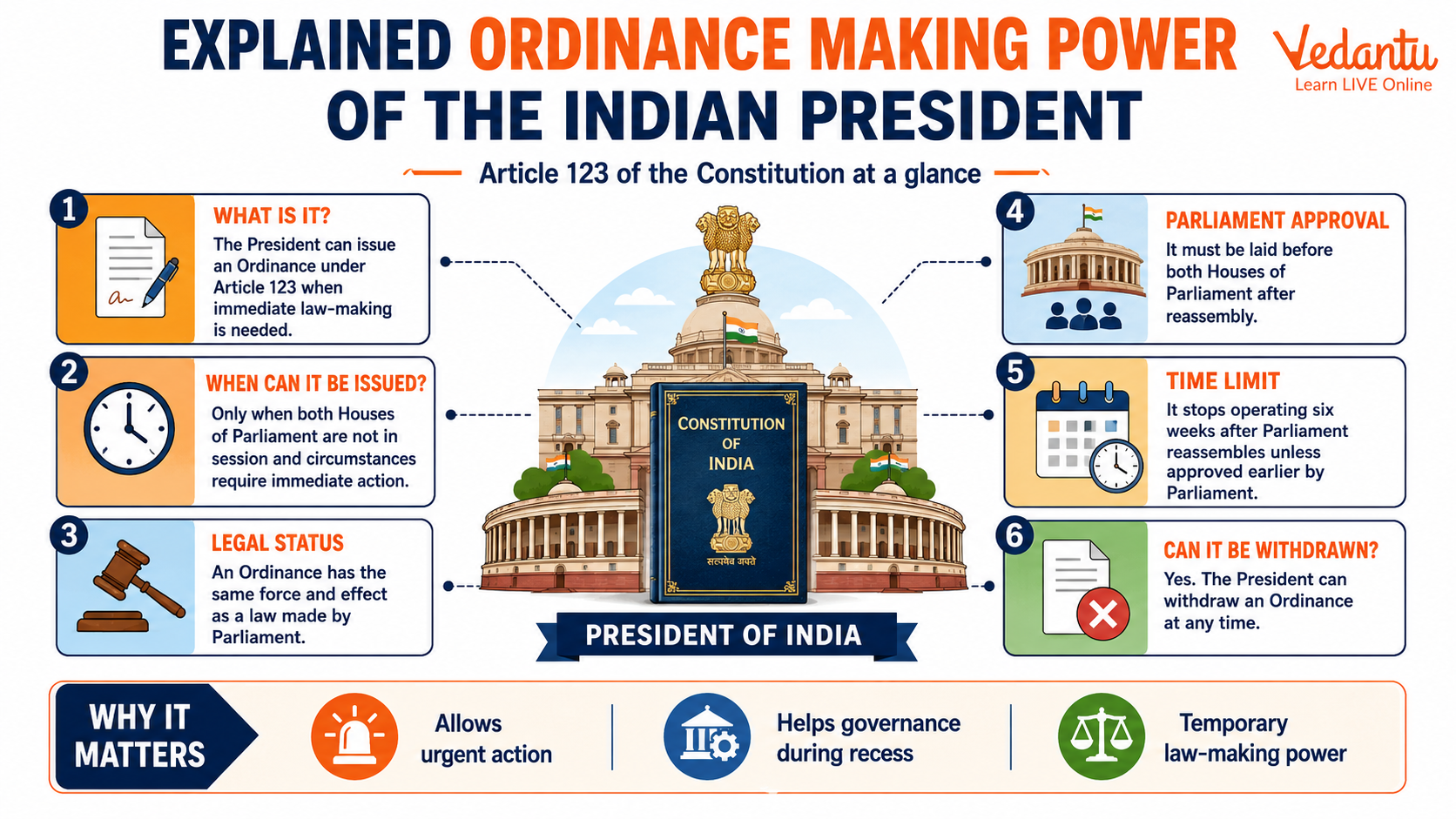
The ordinance making power of the President is mentioned under Article 123 of the Indian Constitution. It empowers the President to issue ordinances when both Houses of Parliament are not in session and circumstances require immediate legislative action.
- Provided under Article 123 of the Constitution of India.
- Can be exercised only when Parliament is not in session.
- Requires satisfaction of the President regarding immediate necessity.
- Has the same force and effect as an Act of Parliament.
Conditions for Issuing an Ordinance
The President cannot issue an ordinance arbitrarily. Certain constitutional conditions must be fulfilled before exercising this power.
- Both Houses of Parliament must not be in session.
- The President must be satisfied that immediate action is required.
- The ordinance must be laid before Parliament when it reassembles.
Duration and Approval of Ordinance
An ordinance is a temporary law. It must be approved by Parliament within a specified period to remain in force.
- It remains valid for six weeks from the date Parliament reassembles.
- If both Houses pass a resolution disapproving it, the ordinance ceases to operate.
- The President can withdraw the ordinance at any time.
- If not approved within six weeks, it automatically lapses.
Scope and Limitations
Although the ordinance has the same force as a law passed by Parliament, it is subject to certain limitations.
- It can be issued only on matters on which Parliament has the power to legislate.
- It cannot amend the Constitution directly under Article 368.
- It is subject to judicial review by the Supreme Court and High Courts.
- The satisfaction of the President can be questioned in court if mala fide intent is alleged.
Judicial Interpretation
The Supreme Court of India has clarified the scope of ordinance making power in several landmark cases. The Court has emphasized that this power should not be used as a substitute for regular legislation.
- D.C. Wadhwa v. State of Bihar - Re-promulgation of ordinances without parliamentary approval was held unconstitutional.
- Krishna Kumar Singh v. State of Bihar - Re-promulgation of ordinances is a fraud on the Constitution.
Comparison Between Ordinance and Act of Parliament
| Basis | Ordinance | Act of Parliament |
|---|---|---|
| Authority | Issued by President | Passed by Parliament |
| Duration | Temporary - 6 weeks after reassembly | Permanent until amended or repealed |
| Session Requirement | When Parliament not in session | Requires parliamentary session |
The table above highlights that while both have the same legal force, an ordinance is temporary and subject to parliamentary approval, whereas an Act of Parliament is a regular and permanent law.
Importance of Ordinance Making Power
The ordinance making power plays a crucial role in maintaining legislative continuity. It allows the government to respond quickly to emergencies, economic crises, or urgent administrative needs. However, its misuse can undermine parliamentary democracy. Therefore, it is considered an extraordinary power meant for exceptional circumstances.
- Ensures swift action in urgent situations.
- Maintains continuity in governance.
- Acts as a temporary legislative mechanism.
- Subject to constitutional checks and balances.
Key Points for Competitive Exams
- Article 123 deals with ordinance making power of the President.
- Ordinance has the same force as an Act of Parliament.
- Valid for six weeks after Parliament reassembles.
- Subject to judicial review.
- Re-promulgation without approval is unconstitutional.
Understanding the ordinance making power of the Indian President is essential for grasping how emergency legislative powers function in India. It reflects the balance between executive efficiency and parliamentary supremacy within the constitutional framework.
FAQs on Ordinance Making Power of the Indian President in the Indian Constitution
1. What is the Ordinance Making Power of the Indian President?
The Ordinance Making Power of the Indian President allows the President to issue temporary laws when Parliament is not in session.
• It is provided under Article 123 of the Indian Constitution.
• An Ordinance has the same force as an Act of Parliament.
• It can be issued only when immediate action is necessary.
• It must be approved by Parliament within six weeks of reassembly.
This power ensures legislative continuity during emergencies and urgent situations.
2. Under which Article of the Constitution is the Ordinance Making Power mentioned?
The Ordinance Making Power is mentioned under Article 123 of the Indian Constitution.
• It empowers the President of India to promulgate ordinances.
• It applies when Lok Sabha and Rajya Sabha are not in session.
• Similar power is given to Governors under Article 213.
Article 123 is frequently asked in competitive exams like UPSC, SSC, and State PSC.
3. When can the President issue an Ordinance?
The President can issue an Ordinance only when immediate legislative action is required and Parliament is not in session.
• Both Houses of Parliament must not be sitting.
• The situation must require urgent action.
• The decision is based on the advice of the Union Council of Ministers.
This provision prevents delays in law-making during emergencies or unforeseen circumstances.
4. How long does a Presidential Ordinance remain in force?
A Presidential Ordinance remains valid for a maximum of six weeks after Parliament reassembles.
• It ceases to operate if not approved within 6 weeks of reassembly.
• It can be withdrawn earlier by the President.
• If both Houses disapprove it, the Ordinance lapses immediately.
Thus, an Ordinance is a temporary law and not a permanent substitute for parliamentary legislation.
5. Does an Ordinance have the same power as an Act of Parliament?
Yes, an Ordinance has the same force and effect as an Act passed by Parliament.
• It is legally binding across India.
• It can amend or repeal existing laws.
• It is subject to judicial review by the Supreme Court and High Courts.
However, it must receive parliamentary approval to continue beyond the prescribed time limit.
6. Can the Ordinance Making Power be misused?
Yes, the Ordinance Making Power can be misused if issued repeatedly without genuine urgency.
• Re-promulgation without parliamentary approval has been criticized.
• The Supreme Court in D.C. Wadhwa case (1987) ruled against misuse.
• Ordinances cannot replace regular legislative processes.
This ensures checks and balances in India’s parliamentary democracy.
7. What is the difference between an Ordinance and a Bill?
The main difference is that an Ordinance is issued by the President, while a Bill is passed by Parliament.
• Ordinance: Issued when Parliament is not in session.
• Bill: Introduced and debated in Parliament.
• Ordinance requires later approval by Parliament.
• A Bill becomes law only after parliamentary approval and Presidential assent.
This distinction is important in understanding India’s legislative process.
8. Can the President refuse to issue an Ordinance?
The President generally acts on the advice of the Council of Ministers regarding Ordinances.
• Under Article 74, the President must follow ministerial advice.
• The President may seek clarification or reconsideration.
• Final decision is based on constitutional provisions.
Thus, the power is executive in nature but exercised within constitutional limits.
9. Can an Ordinance amend the Constitution?
No, an Ordinance cannot be used to amend the Constitution of India.
• Constitutional amendments require a special procedure under Article 368.
• Ordinances deal only with matters Parliament can legislate on.
• They are subject to constitutional limitations.
This ensures that the basic structure and amendment process remain protected.
10. Why is the Ordinance Making Power important in India?
The Ordinance Making Power is important because it enables quick law-making during urgent situations.
• Ensures continuity of governance.
• Addresses emergencies when Parliament is not in session.
• Maintains administrative efficiency.
• Strengthens the executive’s ability to respond swiftly.
Overall, it balances flexibility with parliamentary control in the Indian constitutional framework.
