






How the National Population Registry Works in India and Why It Matters
The National Population Register (NPR) is a comprehensive database of usual residents of India. It is prepared at the local, state, and national level to collect demographic as well as biometric details of residents. The NPR is an important administrative tool that helps the government in planning welfare schemes, improving service delivery, and strengthening internal security. It is closely associated with the Census and is conducted under the provisions of the Citizenship Act, 1955 and the Citizenship Rules, 2003.
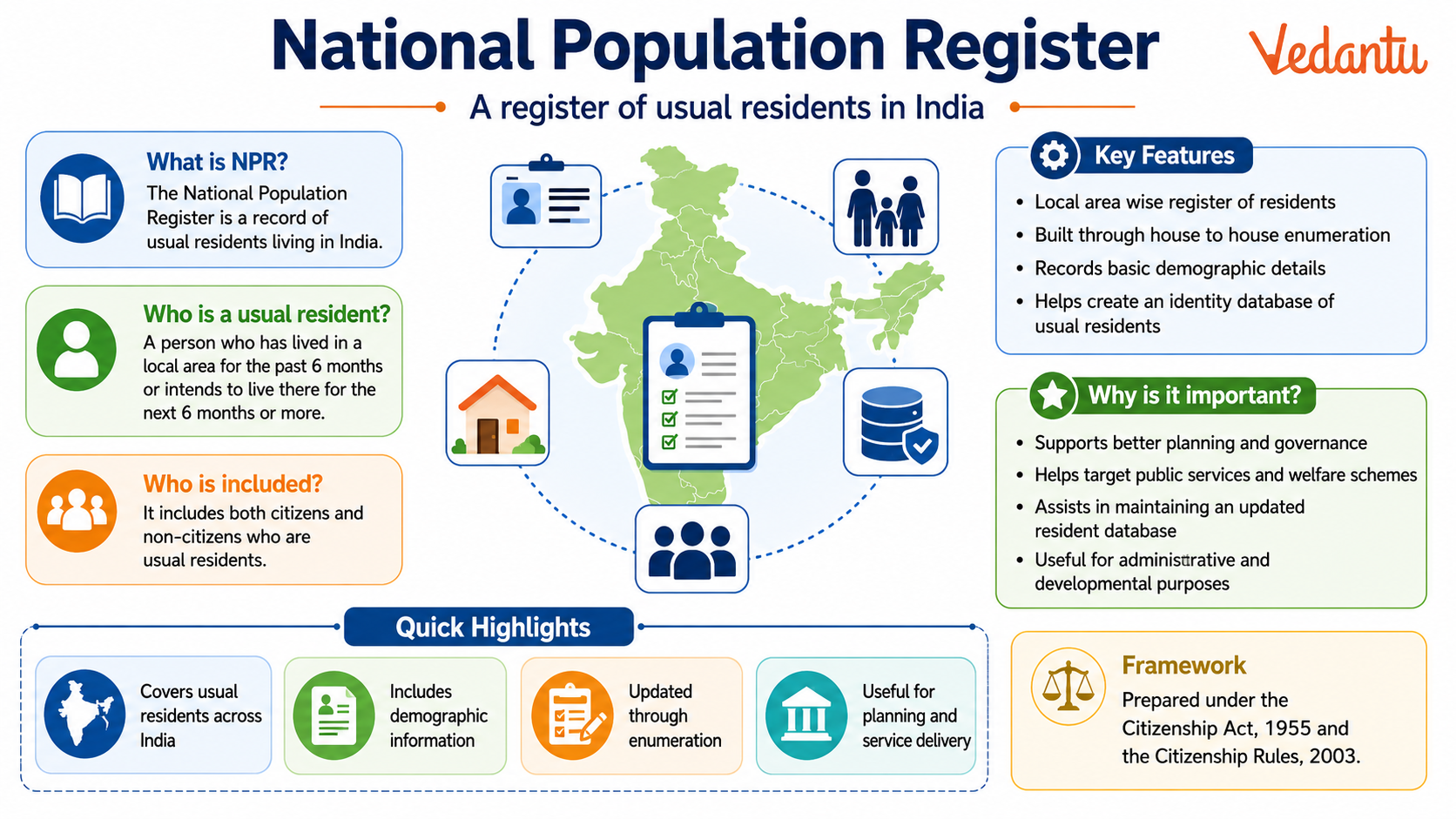
What is the National Population Register?
The National Population Register is a register containing details of all usual residents of India. A usual resident is a person who has resided in a local area for the past six months or intends to reside there for the next six months. The NPR includes both Indian citizens and foreign nationals residing in India.
- It is conducted by the Office of the Registrar General and Census Commissioner, India.
- It was first prepared in 2010.
- It was updated in 2015 through door-to-door verification.
- It is different from the Census but is often conducted alongside it.
Legal Basis of NPR
The NPR is prepared under the legal framework of the Citizenship Act, 1955 and the Citizenship Registration of Citizens and Issue of National Identity Cards Rules, 2003. These rules mandate the preparation of a National Register of Indian Citizens, for which the NPR serves as the first step.
Objectives of the National Population Register
- To create a comprehensive identity database of usual residents.
- To assist in better targeting of government welfare schemes.
- To improve planning and resource allocation.
- To strengthen internal security mechanisms.
- To serve as a basis for preparing the National Register of Indian Citizens.
Information Collected Under NPR
The NPR collects various demographic and identification details of residents. The information is gathered through house-to-house enumeration.
- Name of the individual
- Relationship to head of household
- Date and place of birth
- Marital status
- Educational qualification
- Occupation
- Nationality as declared
- Residential address
National Population Register vs Census vs NRC
| Basis | NPR | Census |
|---|---|---|
| Purpose | Identity database of residents | Statistical data collection |
| Legal Framework | Citizenship Act 1955 | Census Act 1948 |
| Coverage | Usual residents including foreigners | Entire population |
The NPR is different from the National Register of Citizens (NRC). While NPR includes all usual residents, the NRC aims to identify only Indian citizens. The NPR acts as a foundational database from which the NRC can be prepared if required.
Process of NPR Data Collection
- House-to-house enumeration by trained officials.
- Collection of demographic details from residents.
- Verification and updating of previously collected data.
- Preparation of a digital database at local and national levels.
Significance of the National Population Register
The NPR plays a vital role in governance and public administration. It provides accurate data for policymaking and ensures efficient implementation of welfare programs. By maintaining an updated register of residents, the government can better manage resources and address security concerns.
- Improves delivery of subsidies and benefits.
- Helps eliminate duplication in beneficiary databases.
- Supports demographic and socio-economic planning.
- Enhances internal security monitoring.
Concerns and Debates
The NPR has been the subject of public debate in India. Some concerns relate to data privacy, possible linkage with NRC, and the collection of sensitive information. The government has clarified that NPR is meant only to create a resident database and improve governance mechanisms.
Key Points for Competitive Exams
- Conducted under Citizenship Act, 1955 and Citizenship Rules, 2003.
- Covers all usual residents, not only citizens.
- First prepared in 2010 and updated in 2015.
- Different from Census and NRC in purpose and scope.
- Important topic for UPSC, SSC, State PSC, and other government exams.
Conclusion
The National Population Register is an important administrative initiative aimed at creating a reliable database of usual residents of India. It supports governance, welfare planning, and security management. Understanding the NPR, its objectives, legal basis, and differences from Census and NRC is essential for students and competitive exam aspirants. A clear conceptual understanding helps in answering both objective and descriptive questions related to Indian polity and governance.
FAQs on National Population Registry (NPR): Complete Guide for Students
1. What is the National Population Register (NPR)?
The National Population Register (NPR) is a comprehensive database of all usual residents of India prepared by the Government of India.
• It includes both Indian citizens and foreign nationals who have lived in a local area for at least 6 months.
• It is maintained under the Citizenship Act, 1955 and the Citizenship Rules, 2003.
• The objective is to create a reliable identity database for better governance and security.
People also ask: Is NPR compulsory? What is population register? Difference between NPR and Census.
2. What is the objective of the National Population Register?
The main objective of the NPR is to create a comprehensive identity database of residents to improve governance and national security.
• Strengthen internal security.
• Prevent identity fraud and illegal migration.
• Improve delivery of welfare schemes and public services.
• Assist in policy planning and administrative reforms.
Related searches: Purpose of NPR, importance of population register, benefits of NPR.
3. Who is included in the National Population Register?
The NPR includes every usual resident of India, regardless of citizenship status.
• A usual resident is someone who has lived in an area for 6 months or more.
• It also includes individuals who intend to stay for the next 6 months.
• Both Indian citizens and foreign nationals are covered.
People also search: Who qualifies for NPR? Is NPR only for citizens?
4. What is the difference between NPR and Census?
The NPR and Census differ in purpose and legal backing, although both collect population data.
• Census: Conducted under the Census Act, 1948 to collect demographic data every 10 years.
• NPR: Conducted under the Citizenship Act, 1955 to create a resident identity database.
• Census data is confidential, while NPR data may be used for identity verification.
Related queries: NPR vs Census difference, Is NPR part of Census?
5. What is the difference between NPR and NRC?
The NPR is a list of residents, while the National Register of Citizens (NRC) is a list of Indian citizens.
• NPR includes all usual residents.
• NRC includes only verified Indian citizens.
• NRC aims to identify illegal immigrants, whereas NPR collects demographic details.
People also ask: Is NPR linked to NRC? Does NPR lead to NRC?
6. When was the National Population Register first conducted?
The first National Population Register (NPR) was prepared in 2010 alongside the House Listing phase of the Census.
• Updated in 2015 through door-to-door surveys.
• Conducted under the supervision of the Registrar General of India (RGI).
• Linked with biometric data collection in coordination with Aadhaar.
Related searches: NPR 2010, NPR update 2015, history of NPR.
7. What information is collected under NPR?
The NPR collects basic demographic and identification details of residents.
• Name, gender, date of birth, and place of birth.
• Marital status and educational qualification.
• Residential address and duration of stay.
• Aadhaar number (optional), voter ID, passport details (if available).
People also ask: What documents are required for NPR? What data does NPR collect?
8. Is providing information for NPR mandatory?
Yes, providing information for the National Population Register is mandatory under the Citizenship Rules, 2003.
• Residents are legally required to furnish accurate details.
• False information may attract penalties under relevant laws.
• The process is conducted through door-to-door enumeration.
Related queries: Is NPR compulsory? Can we refuse NPR?
9. Which authority conducts the National Population Register?
The Registrar General and Census Commissioner of India under the Ministry of Home Affairs (MHA) conducts the NPR.
• Implemented by state and local government officials.
• Supervised by the Office of the Registrar General of India (RGI).
• Often carried out alongside Census operations.
People also search: Who manages NPR? NPR under which ministry?
10. Why has the National Population Register been controversial?
The NPR has been controversial due to concerns about its possible linkage with the NRC and issues of data privacy.
• Fear that NPR data may be used to identify doubtful citizens.
• Concerns about misuse of personal information.
• Debates over its connection with the Citizenship Amendment Act (CAA), 2019.
People also ask: Why is NPR opposed? NPR and CAA controversy explained.
