






Key Objectives and Benefits of India’s National Manufacturing Strategy
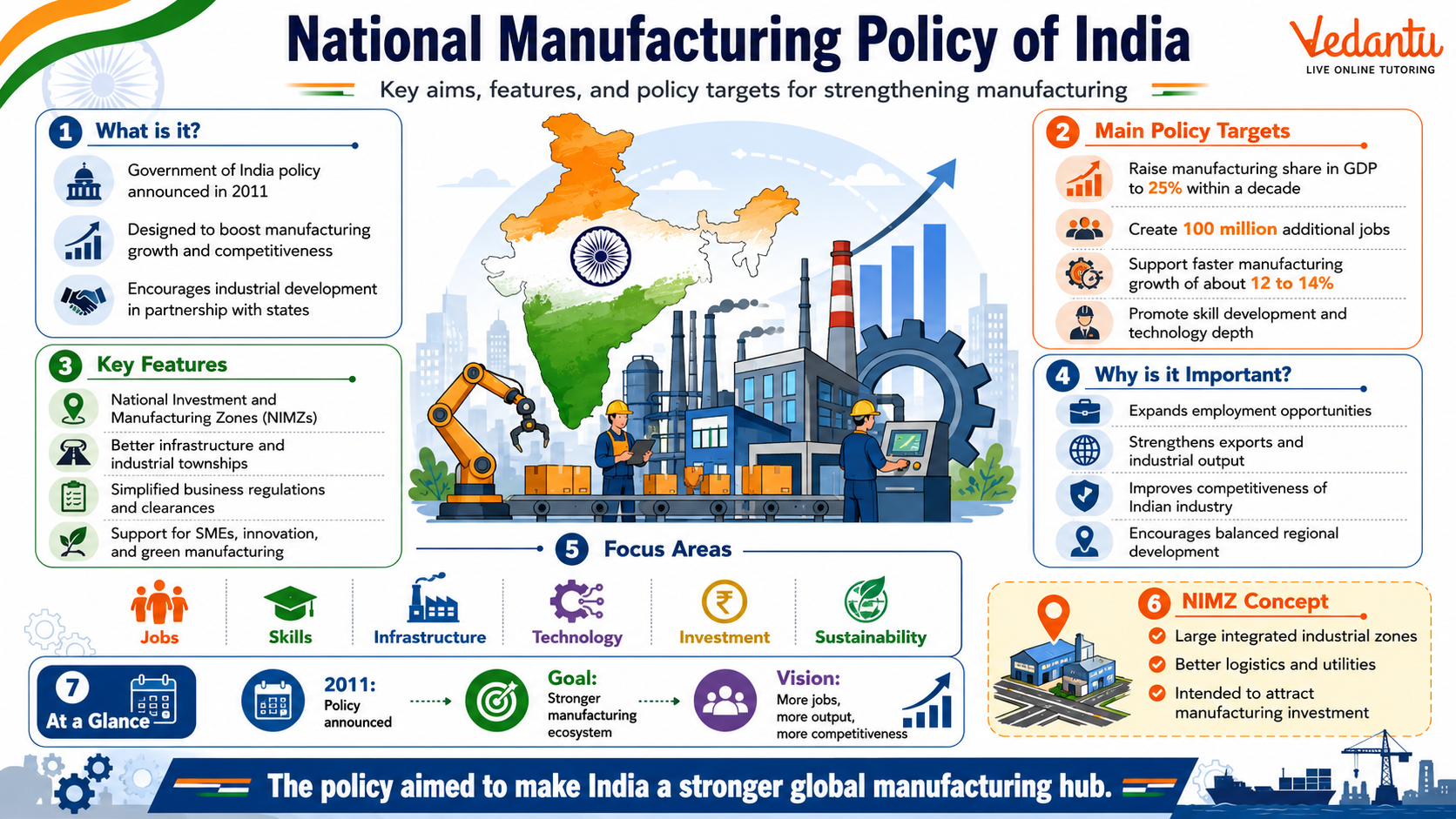
The National Manufacturing Policy (NMP) of India is a major initiative launched by the Government of India to boost the country’s manufacturing sector. Approved in 2011, the policy aims to increase the share of manufacturing in India’s Gross Domestic Product (GDP), generate large-scale employment, and enhance global competitiveness. The policy focuses on sustainable growth, technological innovation, skill development, and infrastructure improvement. It plays a crucial role in strengthening India’s economic foundation and is closely linked with initiatives like Make in India and Skill India.
Background of the National Manufacturing Policy
Before the introduction of the National Manufacturing Policy, India's manufacturing sector was growing at a slower pace compared to other emerging economies like China and South Korea. The contribution of manufacturing to GDP remained around 15 to 16 percent, which was considered low for a developing economy with a large workforce. To address structural bottlenecks such as poor infrastructure, complex regulations, and low technological adoption, the government introduced the National Manufacturing Policy in 2011.
Objectives of the National Manufacturing Policy
The National Manufacturing Policy sets clear and measurable goals to transform India into a global manufacturing hub.
- Increase the share of manufacturing in GDP to 25 percent by 2022.
- Create 100 million additional jobs in the manufacturing sector.
- Enhance global competitiveness of Indian industries.
- Ensure sustainable and environmentally friendly industrial growth.
- Improve skill development and technological depth in manufacturing.
Key Features of the National Manufacturing Policy
1. National Investment and Manufacturing Zones (NIMZs)
One of the most important features of the policy is the establishment of National Investment and Manufacturing Zones. These are large industrial townships with world-class infrastructure, efficient regulatory mechanisms, and simplified business processes. Each NIMZ is planned to have a minimum area of 5000 hectares to promote integrated industrial development.
2. Simplification of Business Regulations
The policy emphasizes ease of doing business by simplifying procedures, reducing compliance burdens, and promoting online clearances. Rationalization of business regulations aims to attract both domestic and foreign investment.
3. Skill Development and Employment
To support industrial growth, the policy focuses on creating a skilled workforce. Special emphasis is given to vocational training, technical education, and partnerships between industry and educational institutions.
4. Technology and Innovation
The policy encourages research and development, innovation, and the adoption of green technologies. Financial and institutional support is provided to promote advanced manufacturing practices.
5. Environmental Sustainability
The NMP promotes sustainable industrialization by encouraging energy efficiency, waste management, and the use of renewable resources. Environmental clearances are streamlined while ensuring ecological protection.
Key Targets and Provisions of National Manufacturing Policy
| Aspect | Target or Provision | Purpose |
|---|---|---|
| GDP Contribution | 25 percent share | Strengthen economic growth |
| Employment | 100 million jobs | Reduce unemployment |
| NIMZ Area | Minimum 5000 hectares | Integrated industrial development |
The above targets reflect the long-term vision of transforming India into a competitive manufacturing economy with improved infrastructure, employment opportunities, and technological advancement.
Significance of the National Manufacturing Policy
The National Manufacturing Policy is significant for India's economic transformation. Manufacturing creates multiplier effects across sectors such as transport, logistics, services, and trade. A strong manufacturing base reduces dependence on imports, improves export performance, and strengthens foreign exchange reserves. It also supports inclusive growth by generating employment for semi-skilled and skilled workers across urban and rural areas.
- Promotes balanced regional development.
- Enhances India’s position in global supply chains.
- Encourages private sector participation.
- Supports allied initiatives like Make in India.
Challenges in Implementation
Despite its ambitious goals, the implementation of the National Manufacturing Policy faces several challenges.
- Land acquisition issues and delays.
- Infrastructure gaps in power, transport, and logistics.
- Global competition and fluctuating demand.
- Skill mismatch in the workforce.
Conclusion
The National Manufacturing Policy of India represents a strategic effort to accelerate industrial growth and employment generation. By focusing on infrastructure development, ease of doing business, skill enhancement, and sustainable practices, the policy aims to transform India into a global manufacturing hub. Although challenges remain, the policy continues to shape India’s industrial landscape and supports long-term economic development. For competitive exam aspirants and general readers, understanding the objectives, features, and significance of the National Manufacturing Policy is essential for grasping India’s economic strategy.
FAQs on National Manufacturing Policy in India: Objectives, Features and Significance
1. What is the National Manufacturing Policy of India?
The National Manufacturing Policy (NMP) of India is a government initiative launched in 2011 to boost the manufacturing sector’s growth and increase its contribution to GDP.
• Announced in 2011 by the Ministry of Commerce and Industry
• Aims to raise manufacturing share in GDP to 25%
• Seeks to create 100 million jobs by 2022
• Focuses on industrial growth, skill development, and global competitiveness
It is closely related to initiatives like Make in India, industrial corridors, and economic reforms.
2. What are the main objectives of the National Manufacturing Policy?
The main objective of the National Manufacturing Policy is to strengthen India’s manufacturing sector and promote sustainable industrial growth.
• Increase manufacturing contribution to 25% of GDP
• Create 100 million additional jobs
• Enhance global competitiveness of Indian industries
• Promote green and sustainable manufacturing
• Develop world-class infrastructure
These goals support economic development, employment generation, and industrial expansion in India.
3. When was the National Manufacturing Policy launched?
The National Manufacturing Policy was launched in 2011 by the Government of India.
• Announced on 4th November 2011
• Introduced under the UPA Government
• Implemented by the Department for Promotion of Industry and Internal Trade (DPIIT)
It laid the foundation for later programs like Make in India (2014) and industrial corridor projects.
4. What are National Investment and Manufacturing Zones (NIMZs)?
National Investment and Manufacturing Zones (NIMZs) are large industrial townships established under the National Manufacturing Policy to promote industrial growth.
• Minimum area of 5,000 hectares
• At least 30% land reserved for manufacturing units
• Equipped with world-class infrastructure and utilities
• Designed as self-contained industrial cities
NIMZs aim to attract domestic and foreign investment and boost industrial production.
5. How does the National Manufacturing Policy promote employment?
The National Manufacturing Policy promotes employment by expanding industrial activities and encouraging skill development.
• Target of creating 100 million jobs
• Support for Micro, Small and Medium Enterprises (MSMEs)
• Focus on skill development programs
• Promotion of labor-intensive industries
This policy benefits youth, skilled workers, and job seekers across India.
6. How is the National Manufacturing Policy related to Make in India?
The National Manufacturing Policy provides the policy framework, while Make in India is a campaign to implement and promote manufacturing growth.
• NMP launched in 2011
• Make in India launched in 2014
• Both aim to increase manufacturing output and FDI
• Encourage ease of doing business and industrial investment
Together, they strengthen India’s position as a global manufacturing hub.
7. What role does the manufacturing sector play in India’s economy?
The manufacturing sector plays a crucial role in economic growth, employment generation, and export promotion in India.
• Contributes around 16–17% of GDP
• Generates large-scale employment
• Boosts exports and foreign exchange earnings
• Encourages technological innovation
Strengthening manufacturing supports sustainable economic development and industrialization.
8. What incentives are provided under the National Manufacturing Policy?
The National Manufacturing Policy offers incentives to attract investors and promote industrial development.
• Simplified business regulations
• Faster environmental clearances
• Financial incentives for MSMEs
• Infrastructure support in NIMZs
These incentives improve ease of doing business and attract both domestic and foreign direct investment (FDI).
9. What challenges does the National Manufacturing Policy address?
The National Manufacturing Policy addresses key challenges faced by India’s industrial sector.
• Poor infrastructure and logistics
• Complex regulatory framework
• Low technological advancement
• Limited access to finance for MSMEs
By tackling these issues, the policy aims to improve industrial productivity and global competitiveness.
10. Why is the National Manufacturing Policy important for competitive exams?
The National Manufacturing Policy is important for competitive exams because it is a key topic in Indian economy and government policies.
• Frequently asked in UPSC, SSC, Banking, and State PSC exams
• Related to economic reforms and industrial policy
• Connected with schemes like Make in India and Skill India
Understanding this policy helps students prepare for General Knowledge (GK) and current affairs sections.
