






Who Wrote India’s National Anthem and What Does It Mean?
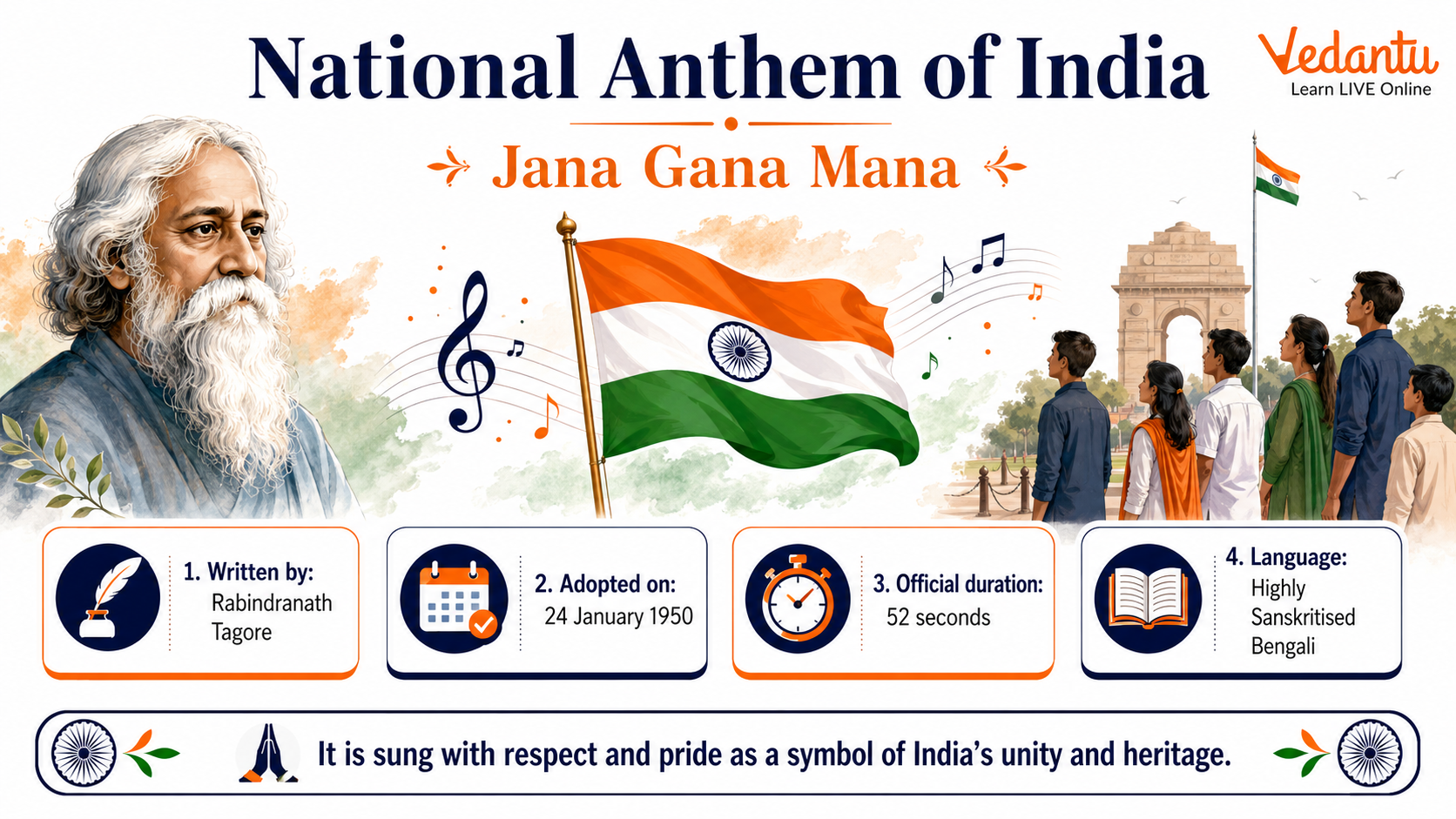
The National Anthem of India is a symbol of national pride, unity, and patriotism. It reflects the cultural diversity and collective spirit of the country. The anthem, titled Jana Gana Mana, was composed by Rabindranath Tagore and was officially adopted as the National Anthem of India on 24 January 1950. It is sung on important national occasions such as Independence Day, Republic Day, and other official ceremonies. Understanding the history, meaning, and significance of the National Anthem is important for students and competitive exam aspirants as it is a frequently asked topic in General Knowledge.
History of the National Anthem of India
The song Jana Gana Mana was originally composed in Bengali by Rabindranath Tagore. It was first sung publicly on 27 December 1911 at the Calcutta Session of the Indian National Congress. The song gained popularity during the freedom struggle and later became a symbol of national unity.
After India gained independence in 1947, there was a need to officially adopt a national anthem. On 24 January 1950, the Constituent Assembly of India formally adopted the first stanza of Jana Gana Mana as the National Anthem of India.
Author of the National Anthem
Rabindranath Tagore
Rabindranath Tagore was a renowned poet, philosopher, and Nobel Laureate. He became the first Asian to receive the Nobel Prize in Literature in 1913. Tagore composed Jana Gana Mana in highly Sanskritized Bengali. Interestingly, he also wrote the national anthem of Bangladesh, making him the only person to have written the national anthems of two countries.
- Full Name - Rabindranath Tagore
- Born - 7 May 1861
- Nobel Prize - Literature, 1913
- Also wrote - National Anthem of Bangladesh
Official Duration and Singing Rules
The official duration of the National Anthem of India is approximately 52 seconds when sung in its complete form. A shorter version consisting of the first and last lines takes about 20 seconds.
- Citizens must stand in attention position while the anthem is being played.
- It should be sung with dignity and respect.
- Any form of disrespect is punishable under the Prevention of Insults to National Honour Act, 1971.
Key Facts About the National Anthem of India
| Particular | Details | Year |
|---|---|---|
| Name | Jana Gana Mana | 1911 |
| Adopted As National Anthem | By Constituent Assembly | 1950 |
| Composer | Rabindranath Tagore | 1911 |
The table above summarizes the most important factual information related to the National Anthem of India. These details are frequently asked in school examinations and competitive exams.
Meaning and Significance
The National Anthem praises India and highlights the unity in diversity of the nation. It mentions various regions of India and celebrates the collective strength of its people. The song reflects the spirit of patriotism and devotion to the country.
The anthem plays a crucial role in promoting national integration. It reminds citizens of their responsibilities towards the nation and fosters a sense of belonging and respect for the country.
Important GK Points for Exams
- The National Anthem of India is Jana Gana Mana.
- It was written by Rabindranath Tagore.
- First sung on 27 December 1911 at the Calcutta Session of the Indian National Congress.
- Adopted on 24 January 1950.
- Official duration is 52 seconds.
- Disrespect is punishable under the Prevention of Insults to National Honour Act, 1971.
Conclusion
The National Anthem of India, Jana Gana Mana, is more than just a song. It represents the unity, sovereignty, and pride of the nation. Composed by Rabindranath Tagore and adopted in 1950, it continues to inspire millions of Indians. For students and competitive exam aspirants, understanding its history, composer, adoption date, and significance is essential for General Knowledge preparation. Respecting the National Anthem is a fundamental duty of every citizen of India.
FAQs on India’s National Anthem: History, Meaning and Importance
1. What is the National Anthem of India?
The National Anthem of India is “Jana Gana Mana”, which represents the unity and sovereignty of the nation.
• Written by Rabindranath Tagore
• Originally composed in Bengali (Brahmo style)
• Adopted as the National Anthem on 24 January 1950
• Reflects India’s diversity, unity, and patriotic spirit
It is a key symbol of national identity and is commonly asked in GK, UPSC, SSC, and school exams.
2. Who wrote the National Anthem of India?
The National Anthem of India was written by Rabindranath Tagore, a Nobel Prize-winning poet.
• Full name: Rabindranath Tagore
• Won the Nobel Prize in Literature (1913)
• Originally composed in 1911
• First sung at the Indian National Congress Session, Calcutta (1911)
Tagore is also known for writing the national anthems of India and Bangladesh.
3. When was Jana Gana Mana adopted as the National Anthem of India?
“Jana Gana Mana” was officially adopted as India’s National Anthem on 24 January 1950.
• Adopted by the Constituent Assembly of India
• Two days before India became a Republic (26 January 1950)
• Recognized as a symbol of sovereignty and unity
This date is important for competitive exams and GK preparation.
4. How long does it take to sing the National Anthem of India?
The full version of the Indian National Anthem takes approximately 52 seconds to sing.
• Full version duration: 52 seconds
• Short version duration: 20 seconds
• Must be sung with proper dignity and respect
This timing is officially prescribed by the Government of India.
5. In which language is the National Anthem of India written?
The National Anthem of India is written in Bengali, specifically in a highly Sanskritized form.
• Original language: Bengali (Brahmo dialect)
• Contains many Sanskrit words
• Easily understood across Indian languages
This linguistic style reflects India’s cultural and linguistic diversity.
6. What is the meaning of Jana Gana Mana?
The meaning of “Jana Gana Mana” is a tribute to the Supreme Spirit guiding the destiny of India.
• “Jana Gana Mana” means “Thou art the ruler of the minds of all people”
• Praises the unity of different states, rivers, and regions
• Highlights India’s diversity in unity
The anthem symbolizes national integration and patriotism.
7. Where was the National Anthem of India first sung?
The National Anthem of India was first sung at the Indian National Congress Session in Calcutta on 27 December 1911.
• Event: INC Session
• Location: Calcutta (now Kolkata)
• Year: 1911
This historical event marks the anthem’s first public performance.
8. What are the rules for respecting the National Anthem of India?
Respect for the Indian National Anthem is governed by official guidelines and constitutional values.
• Citizens must stand at attention when it is played
• Maintain silence and dignity
• No disrespectful behavior allowed under the Prevention of Insults to National Honour Act, 1971
Showing respect reflects patriotism and constitutional duty.
9. What is the difference between the National Anthem and National Song of India?
The National Anthem and National Song of India are different patriotic compositions.
• National Anthem: Jana Gana Mana by Rabindranath Tagore
• National Song: Vande Mataram by Bankim Chandra Chattopadhyay
• Anthem adopted in 1950
• National Song recognized for its historical importance in the freedom movement
Both hold great importance in India’s freedom struggle and national identity.
10. Why is the National Anthem of India important?
The National Anthem of India is important because it symbolizes the country’s unity, integrity, and sovereignty.
• Promotes national pride and patriotism
• Represents India’s cultural diversity
• Sung at national events, schools, and official ceremonies
• Encourages a sense of belonging and unity
It is a powerful symbol of India’s independence and democratic values.
