






Mural Wall Art Techniques and Famous Examples
Mural Painting is a form of visual art created directly on walls, ceilings, or other permanent surfaces. The word "mural" comes from the Latin word "murus" meaning wall. Mural paintings have been an important part of human culture since prehistoric times, when early humans painted scenes of daily life and animals on cave walls. Over centuries, mural painting has evolved into a powerful medium for artistic expression, storytelling, religious representation, and social awareness. Today, murals are found in temples, public buildings, streets, and modern urban spaces, reflecting both tradition and contemporary creativity.
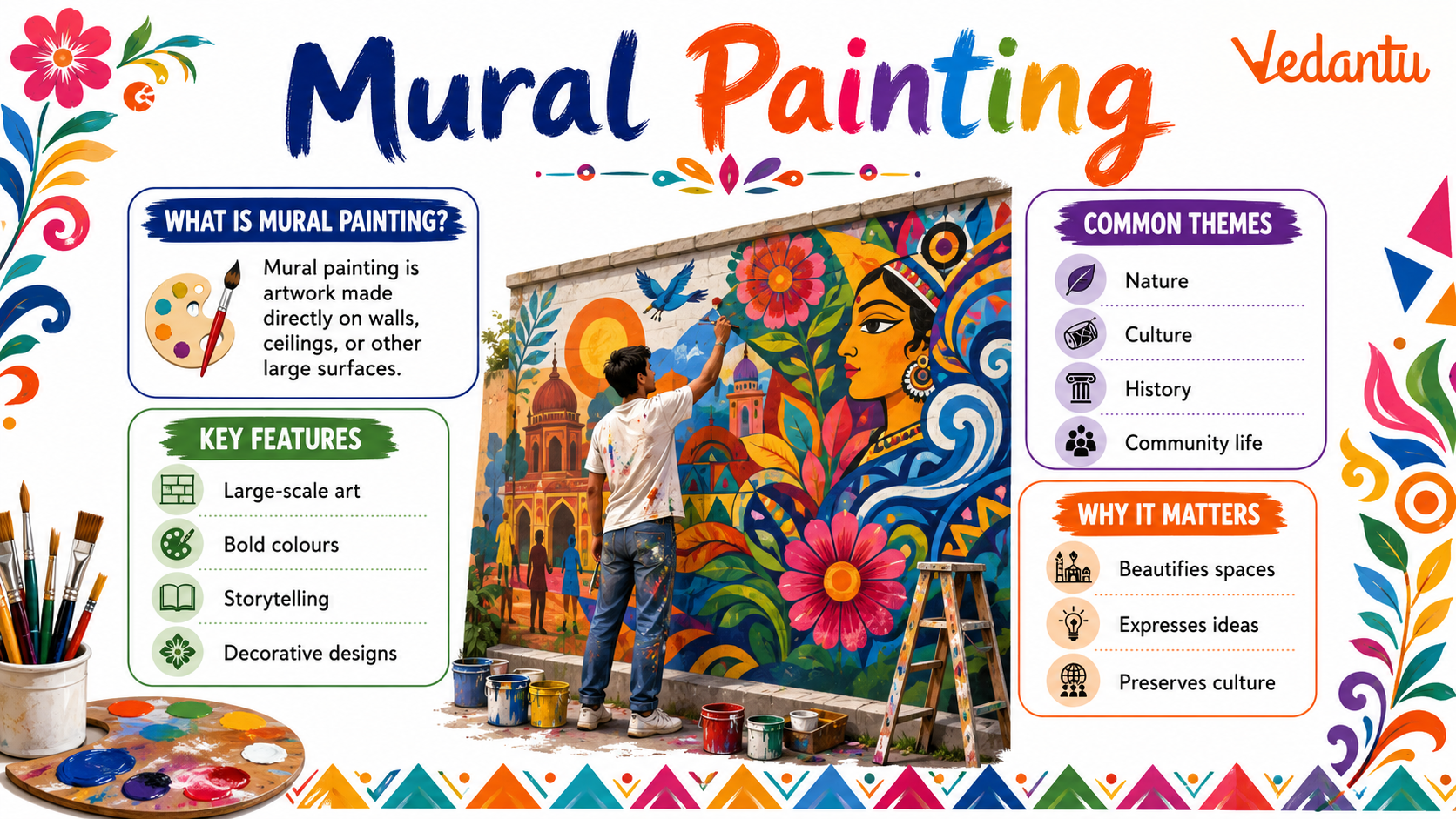
What is Mural Painting?
Mural painting refers to artwork painted or applied directly on a wall or large surface. Unlike canvas paintings, murals are integrated into the architecture of a space. They can be decorative, informative, religious, political, or cultural in nature. Murals are often large in size and designed to communicate messages to a wide audience.
- Created directly on walls or ceilings
- Often large in scale
- Reflect social, cultural, or religious themes
- Common in temples, public buildings, and streets
History of Mural Painting
The history of mural painting dates back to prehistoric times. Cave paintings such as those found in Lascaux in France and Bhimbetka in India are early examples of mural art. In ancient civilizations like Egypt, Greece, and Rome, murals decorated tombs, palaces, and temples. During the Renaissance period, mural painting flourished in Europe with artists like Michelangelo creating masterpieces on church ceilings.
In India, mural painting developed in various regions and styles. The Ajanta and Ellora caves are famous for their detailed murals depicting Buddhist themes. Kerala mural paintings and Rajasthan frescoes are other notable examples.
Types of Mural Painting
1. Fresco
Fresco is a technique where pigments are applied on freshly laid wet plaster. As the plaster dries, the painting becomes an integral part of the wall.
2. Tempera
Tempera murals use pigments mixed with a binding medium such as egg yolk. This technique allows detailed and vibrant artwork.
3. Mosaic Murals
Mosaic murals are created using small pieces of colored glass, stone, or tiles arranged to form images or patterns.
4. Modern Street Murals
These murals are painted on public walls and buildings. They often express social messages, political opinions, or urban culture.
Famous Mural Paintings in the World
| Name of Mural | Artist | Location |
|---|---|---|
| Sistine Chapel Ceiling | Michelangelo | Vatican City |
| Ajanta Cave Murals | Unknown Ancient Artists | India |
These murals are globally admired for their artistic excellence, historical importance, and cultural impact. They showcase religious stories, mythology, and human emotions with remarkable detail.
Characteristics of Mural Painting
- Large scale artwork integrated with architecture
- Use of natural and mineral pigments in traditional murals
- Themes include religion, mythology, history, and social issues
- Enhances aesthetic appeal of public and private spaces
Importance of Mural Painting
Mural painting plays a significant role in preserving history and culture. It serves as a visual record of traditions, beliefs, and events. Murals also promote community identity and awareness. In modern times, they are used for urban beautification and social campaigns.
- Preserves cultural heritage
- Educates people through visual storytelling
- Encourages artistic creativity
- Beautifies public spaces
Mural Painting in India
India has a rich tradition of mural painting. The Ajanta caves in Maharashtra are among the finest examples of ancient mural art. Kerala murals are known for their bright colors and depiction of Hindu mythology. Rajasthan and Madhya Pradesh also have distinct mural traditions. These paintings often use natural pigments and follow strict iconographic rules.
Conclusion
Mural Painting is one of the oldest and most expressive forms of art in human history. From ancient cave walls to modern city streets, murals continue to communicate powerful stories and ideas. They reflect the cultural, religious, and social life of different eras. Understanding mural painting helps students appreciate art history, cultural diversity, and the role of creativity in shaping societies.
FAQs on Mural Painting: Meaning, History and Importance
1. What is mural painting?
Mural painting is a large-scale artwork created directly on walls, ceilings, or permanent surfaces. It is a form of public art and wall painting that enhances architectural spaces.
• Derived from the Latin word "murus" meaning wall
• Painted on walls, ceilings, or other large surfaces
• Includes techniques like fresco, tempera, mosaic, and modern graffiti
• Often reflects culture, religion, history, and social themes
People also ask: What is the meaning of mural art? How is mural painting different from canvas painting?
2. What are the main types of mural painting?
The main types of mural painting are categorized based on technique and medium used. These styles have evolved from ancient to modern times.
• Fresco – Painting on freshly laid wet plaster (e.g., Ajanta murals)
• Secco – Painting on dry plaster
• Mosaic murals – Made using small pieces of glass or stone
• Tempera murals – Use of pigments mixed with binding agents
• Modern street murals – Spray paint and acrylic-based wall art
People also search: Types of fresco painting, difference between fresco and secco, mural techniques in art.
3. What is the history of mural painting?
The history of mural painting dates back to prehistoric times and reflects human civilization and cultural development.
• Prehistoric cave paintings at Lascaux (France)
• Ajanta and Ellora Caves in India (2nd century BCE)
• Renaissance murals by Michelangelo (Sistine Chapel)
• Mexican mural movement led by Diego Rivera
• Contemporary urban street art worldwide
People also ask: When did mural painting begin? Famous murals in history.
4. What materials are used in mural painting?
Mural painting materials vary depending on the technique and surface used. Artists select durable and weather-resistant materials.
• Plaster (for fresco technique)
• Natural or synthetic pigments
• Acrylic paints and spray paints
• Brushes, rollers, and spray guns
• Protective coatings and sealants
People also search: What paint is best for murals? Materials required for wall painting.
5. What is the difference between mural painting and fresco?
The key difference between mural painting and fresco lies in the technique and surface preparation. Fresco is a specific type of mural painting.
• Mural painting – Any large artwork painted on walls
• Fresco – Painting done on wet plaster
• Fresco becomes part of the wall surface as it dries
• All frescoes are murals, but not all murals are frescoes
People also ask: Is fresco a mural? What are examples of fresco paintings?
6. What are famous examples of mural paintings in India?
India has several famous mural paintings known for their religious and cultural significance.
• Ajanta Caves – Buddhist themes and Jataka tales
• Ellora Caves – Hindu, Buddhist, and Jain art
• Kerala temple murals – Mythological subjects
• Lepakshi murals – Vijayanagara style paintings
People also search: Ancient Indian mural paintings, Ajanta mural art features.
7. Why is mural painting important?
Mural painting is important because it preserves history, spreads social messages, and beautifies public spaces.
• Reflects cultural heritage and traditions
• Educates people about historical and religious themes
• Promotes social awareness through public art
• Enhances architecture and community identity
People also ask: What is the significance of mural art? Why are murals important in society?
8. How is mural painting different from graffiti?
Mural painting and graffiti differ mainly in purpose, permission, and artistic style. Both are forms of wall art but have different social perceptions.
• Mural painting – Usually planned and officially permitted
• Graffiti – Often informal or unauthorized street art
• Murals focus on detailed storytelling and themes
• Graffiti emphasizes stylized text and urban expression
People also search: Street art vs mural, Is graffiti considered mural art?
9. Who are some famous mural artists in the world?
Several famous mural artists have contributed significantly to world art history.
• Michelangelo – Sistine Chapel ceiling
• Diego Rivera – Mexican mural movement
• David Alfaro Siqueiros – Political murals
• José Clemente Orozco – Revolutionary themes
People also ask: Who is the father of mural art? Famous mural painters in history.
10. What themes are commonly depicted in mural paintings?
Mural paintings commonly depict religious, historical, social, and cultural themes depending on the time period and region.
• Religious stories and mythological scenes
• Historical events and freedom movements
• Social issues like peace, unity, and environment
• Cultural traditions and folklore
People also search: Themes of Ajanta murals, common subjects in wall painting.
