






Why the Minimum Reserve System Improves Currency Stability and Flexibility
The Minimum Reserve System is a method adopted by the Reserve Bank of India for issuing currency notes. Under this system, the central bank is required to keep a minimum reserve of gold and foreign securities while issuing currency. This system replaced the earlier proportional reserve system and was introduced in India in 1956. The main objective of the Minimum Reserve System is to provide flexibility in currency issuance while maintaining confidence in the monetary system. Understanding the advantages of the Minimum Reserve System is important for students preparing for competitive exams and for gaining clarity about how modern central banking works.
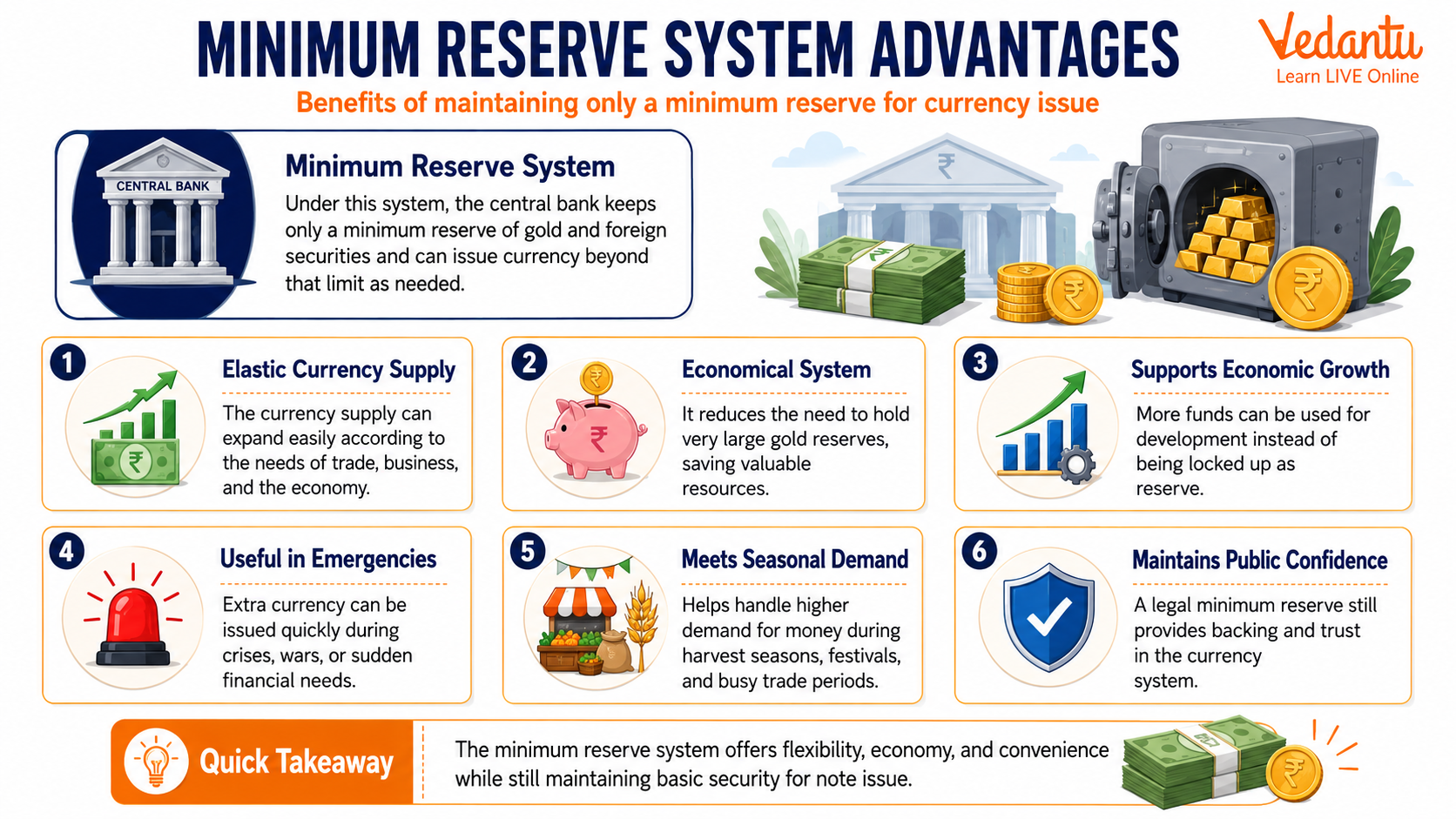
What is the Minimum Reserve System?
Under the Minimum Reserve System, the Reserve Bank of India is required to maintain a minimum reserve of Rs. 200 crore in the form of gold and foreign securities. Out of this, at least Rs. 115 crore must be kept in gold. The rest can be maintained in foreign securities. The RBI can issue currency notes beyond this reserve limit based on the needs of the economy.
Key Features of the Minimum Reserve System
- A fixed minimum reserve of gold and foreign securities must be maintained.
- Provides flexibility to issue currency beyond the reserve limit.
- Adopted in India in 1956 replacing the proportional reserve system.
- Ensures stability and public confidence in currency.
Advantages of Minimum Reserve System
1. Flexibility in Currency Issue
The system allows the central bank to issue currency according to the needs of the economy. It is not strictly bound by the amount of gold reserves, which helps in managing inflation, recession, and other economic conditions effectively.
2. Supports Economic Growth
Since the RBI can issue more currency beyond the minimum reserve requirement, it can meet the growing demands of trade, industry, and development activities. This promotes smooth economic growth.
3. Better Monetary Control
The system gives the central bank better control over money supply. It can increase or decrease currency circulation depending on inflationary or deflationary pressures in the economy.
4. Economical Use of Gold
Only a minimum amount of gold is required to be kept as reserve. This reduces the need to hold large quantities of gold, allowing the country to use its gold reserves more efficiently.
5. Stability and Public Confidence
Although the reserve requirement is minimal, it still ensures that currency issuance is backed by tangible assets. This maintains trust and confidence among the public in the monetary system.
6. Suitable for Developing Economies
Developing countries like India require expanding money supply to support development. The Minimum Reserve System is suitable because it provides elasticity in currency supply without compromising monetary discipline.
Comparison: Proportional Reserve System vs Minimum Reserve System
| Basis | Proportional Reserve System | Minimum Reserve System |
|---|---|---|
| Reserve Requirement | Fixed percentage of gold against currency | Fixed minimum amount of gold and securities |
| Flexibility | Limited flexibility | High flexibility in currency issue |
| Suitability | Suitable for stable economies | Suitable for growing economies |
The Minimum Reserve System is more practical and adaptable compared to the proportional reserve system. It ensures sufficient backing of currency while allowing the central bank to respond to economic needs efficiently.
Why the Minimum Reserve System Matters
The Minimum Reserve System plays a crucial role in maintaining monetary stability in India. It balances the need for economic growth with financial discipline. By allowing controlled expansion of currency, it helps manage inflation, supports development, and ensures trust in the banking system. For students preparing for competitive exams, understanding this system is important as it forms a key part of Indian monetary policy and central banking functions.
Conclusion
The Minimum Reserve System offers several advantages such as flexibility in currency issuance, economic growth support, efficient use of gold reserves, and better monetary control. Adopted in 1956, it remains a vital part of India's monetary framework. Its balanced approach between reserve backing and currency expansion makes it highly suitable for a developing economy like India. A clear understanding of its advantages helps students grasp how central banks maintain stability and promote growth in modern economies.
FAQs on Minimum Reserve System and Its Major Benefits for Students
1. What is the Minimum Reserve System in banking?
The Minimum Reserve System (MRS) is a monetary system under which a central bank maintains a minimum fixed reserve of gold and foreign securities to issue currency.
• Introduced in India in 1957 by the Reserve Bank of India (RBI)
• Requires a minimum reserve of ₹200 crore
• Out of this, at least ₹115 crore must be in gold
• The remaining can be in foreign exchange securities
This system provides flexibility in currency issuance and supports economic growth.
2. What are the main advantages of the Minimum Reserve System?
The Minimum Reserve System offers flexibility and stability in currency management.
• Allows expansion of money supply as per economic needs
• Reduces dependence on large gold reserves
• Supports economic development and trade
• Helps in managing inflation and deflation
• Ensures better monetary policy control
It is more practical compared to rigid systems like the Gold Standard.
3. Why did India adopt the Minimum Reserve System?
India adopted the Minimum Reserve System in 1957 to gain flexibility in issuing currency.
• To meet increasing demands of a growing economy
• To reduce pressure on maintaining large gold reserves
• To support planned economic development
• To ensure efficient monetary regulation by RBI
This system helped India manage its currency supply more effectively.
4. How does the Minimum Reserve System help in economic growth?
The Minimum Reserve System promotes economic growth by allowing controlled expansion of money supply.
• Enables funding for development projects
• Supports industrial and agricultural growth
• Facilitates smooth functioning of banking and financial systems
• Helps maintain liquidity in the economy
Thus, it plays a key role in modern monetary management.
5. What is the difference between Minimum Reserve System and Proportional Reserve System?
The key difference lies in the reserve requirement for issuing currency.
• Minimum Reserve System: Fixed minimum reserve (₹200 crore in India)
• Proportional Reserve System: Reserve is a fixed percentage of total currency issued
• MRS offers greater flexibility
• Proportional system is more rigid and restrictive
MRS is considered more suitable for developing economies.
6. How does the Minimum Reserve System control inflation?
The Minimum Reserve System helps control inflation through regulated currency supply.
• RBI can adjust money supply as needed
• Uses tools like repo rate, CRR, and open market operations
• Prevents excessive printing of money
• Maintains balance between demand and supply
This ensures better price stability in the economy.
7. What is the minimum reserve requirement under the Minimum Reserve System in India?
Under India’s Minimum Reserve System, RBI must maintain at least ₹200 crore as reserve.
• ₹115 crore must be in gold
• Remaining in foreign securities
• No upper limit on currency issuance
This fixed reserve ensures credibility while allowing flexibility in issuing banknotes.
8. Is the Minimum Reserve System better than the Gold Standard?
Yes, the Minimum Reserve System is more flexible than the traditional Gold Standard.
• Does not require 100% gold backing
• Allows expansion of paper currency
• Supports modern banking needs
• Suitable for developing economies
Hence, it is considered more practical in today’s financial system.
9. Who manages the Minimum Reserve System in India?
The Reserve Bank of India (RBI) manages the Minimum Reserve System in India.
• Controls issuance of currency notes
• Maintains required gold and foreign reserves
• Implements monetary policy
• Regulates inflation and liquidity
RBI ensures stability of the Indian financial system.
10. How is the Minimum Reserve System important for competitive exams?
The Minimum Reserve System is an important topic in General Knowledge and Economics for exams.
• Frequently asked in UPSC, SSC, Banking, and State PSC exams
• Related to RBI functions and monetary policy
• Important for understanding inflation and currency systems
• Common in GK and current affairs sections
Understanding MRS strengthens concepts in Indian Economy and banking awareness.
