






What Are the Key Roles and Functions of the RBI in India’s Economy?
The Reserve Bank of India (RBI) is the central bank of India and plays a vital role in managing the country’s financial and monetary system. Established on 1 April 1935 under the Reserve Bank of India Act, 1934, the RBI regulates banking operations, controls inflation, manages currency, and ensures financial stability in the economy. Understanding the main functions of the Reserve Bank of India is important for students, competitive exam aspirants, and general readers as it forms a key part of Indian Economy in General Knowledge.
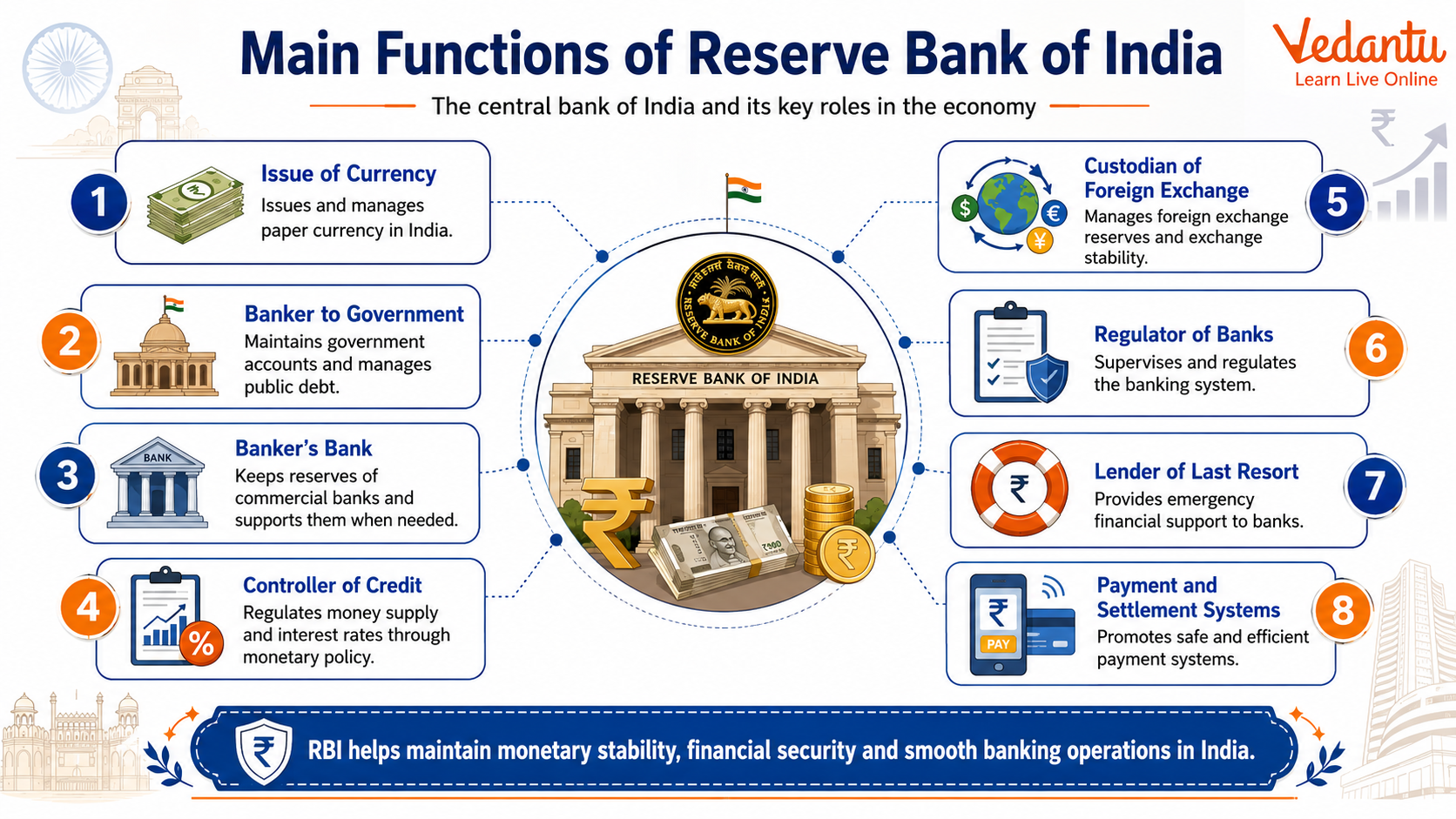
Introduction to the Reserve Bank of India
The Reserve Bank of India acts as the apex monetary authority of the country. It was nationalized in 1949 and is headquartered in Mumbai, Maharashtra. The RBI is responsible for framing and implementing monetary policy, supervising banks, managing foreign exchange, and acting as a banker to the government and commercial banks. Its primary objective is to maintain price stability while ensuring adequate flow of credit to productive sectors of the economy.
Main Functions of Reserve Bank of India
1. Issue of Currency
The RBI has the sole authority to issue currency notes in India except one rupee note and coins which are issued by the Government of India. This function ensures uniformity and control over the country’s money supply.
- Issues and circulates currency notes
- Maintains adequate supply of clean and genuine notes
- Withdraws damaged and counterfeit currency from circulation
2. Banker to the Government
The RBI acts as a banker, agent, and advisor to the Central and State Governments. It manages government accounts and handles public debt.
- Maintains government accounts
- Receives and makes payments on behalf of the government
- Manages public debt and treasury bills
3. Banker’s Bank
Commercial banks keep a portion of their reserves with the RBI. In times of need, banks can borrow funds from the RBI, making it the banker’s bank.
- Maintains cash reserves of commercial banks
- Provides financial assistance during emergencies
- Ensures stability of the banking system
4. Controller of Credit
The RBI controls credit in the economy to maintain price stability and prevent inflation or deflation. It uses various monetary policy tools to regulate money supply.
- Repo rate and reverse repo rate
- Cash Reserve Ratio (CRR)
- Statutory Liquidity Ratio (SLR)
- Open Market Operations (OMO)
5. Custodian of Foreign Exchange Reserves
The RBI manages India’s foreign exchange reserves and ensures stability in the foreign exchange market under the Foreign Exchange Management Act (FEMA), 1999.
- Maintains foreign currency reserves
- Regulates foreign exchange transactions
- Stabilizes exchange rate fluctuations
6. Clearing House Function
The RBI acts as a clearing house for banks by settling interbank payments and transfers. This reduces the need for physical movement of cash and promotes efficiency in the banking system.
7. Controller and Supervisor of Banks
The RBI supervises and regulates commercial banks and financial institutions to ensure their proper functioning and protect depositors’ interests.
- Issues banking licenses
- Conducts inspections and audits
- Implements banking regulations
Summary of Main Functions of RBI
| Function | Role | Purpose |
|---|---|---|
| Issue of Currency | Prints and circulates notes | Maintains uniform money supply |
| Controller of Credit | Uses monetary tools | Controls inflation and liquidity |
| Banker to Government | Manages accounts and debt | Ensures smooth government finance |
The table above highlights the core responsibilities of the Reserve Bank of India. Each function contributes to economic stability, financial security, and sustainable growth of the Indian economy.
Importance of RBI in the Indian Economy
The RBI plays a crucial role in maintaining economic stability and promoting growth. By regulating credit and controlling inflation, it safeguards the value of the Indian currency. Through supervision of banks and financial institutions, it protects depositors and strengthens the financial system. Its role in managing foreign exchange reserves ensures stability in international trade and payments.
Conclusion
The main functions of the Reserve Bank of India revolve around currency issuance, credit control, banking supervision, and financial regulation. As the central bank of the country, the RBI ensures stability, transparency, and efficiency in the Indian financial system. A clear understanding of these functions is essential for General Knowledge preparation and competitive examinations, as questions related to RBI frequently appear in exams.
FAQs on Main Functions of the Reserve Bank of India in Simple Words
1. What are the main functions of the Reserve Bank of India (RBI)?
The Reserve Bank of India (RBI) performs key roles to regulate and manage India’s financial system.
• Issuer of Currency – Issues and manages Indian currency notes.
• Banker to the Government – Manages accounts of Central and State Governments.
• Banker’s Bank – Provides financial support to commercial banks.
• Controller of Credit – Regulates money supply using monetary policy tools.
• Custodian of Foreign Exchange – Manages forex reserves under FEMA Act, 1999.
• Clearing House – Settles interbank payments.
These functions make RBI the central bank of India and the backbone of the Indian banking system.
2. When was the Reserve Bank of India established?
The Reserve Bank of India was established on 1 April 1935 under the RBI Act, 1934.
• Initially set up in Kolkata
• Nationalized on 1 January 1949
• Headquarters shifted to Mumbai
RBI was created to regulate currency, credit, and banking operations in India.
3. What is the role of RBI as the issuer of currency?
As the issuer of currency, RBI has the sole authority to print and circulate Indian banknotes.
• Issues notes from ₹2 to ₹2000 (except ₹1 note issued by Government of India)
• Maintains Minimum Reserve System
• Ensures security features to prevent counterfeiting
This function helps maintain trust and stability in the Indian monetary system.
4. How does RBI control credit in the economy?
The RBI controls credit using various monetary policy tools to maintain inflation and economic stability.
• Repo Rate and Reverse Repo Rate
• Cash Reserve Ratio (CRR)
• Statutory Liquidity Ratio (SLR)
• Open Market Operations (OMO)
Through these instruments, RBI regulates money supply, controls inflation, and stabilizes economic growth.
5. What does RBI do as the banker to the government?
As the banker to the government, RBI manages financial transactions of the Central and State Governments.
• Maintains government accounts
• Manages public debt and treasury bills
• Acts as financial advisor
• Facilitates payments and receipts
This function ensures smooth fiscal operations and public finance management.
6. Why is RBI called the banker’s bank?
RBI is called the banker’s bank because it provides financial assistance to commercial banks.
• Maintains banks’ reserves (CRR)
• Provides loans during emergencies
• Acts as Lender of Last Resort
• Supervises and regulates banks
This role strengthens the stability of the Indian banking system and prevents bank failures.
7. What is RBI’s role in foreign exchange management?
RBI acts as the custodian of foreign exchange reserves and regulates forex markets.
• Manages India’s foreign currency reserves
• Implements the Foreign Exchange Management Act (FEMA), 1999
• Stabilizes exchange rates
• Promotes international trade and payments
This function helps maintain balance of payments and currency stability.
8. What is meant by RBI as the clearing house?
As a clearing house, RBI settles interbank claims and payments.
• Facilitates cheque clearing
• Handles electronic fund transfers (NEFT, RTGS)
• Settles mutual claims among banks
This system reduces cash transactions and ensures smooth banking operations.
9. Who is the head of the Reserve Bank of India?
The head of the RBI is the Governor of the Reserve Bank of India.
• Appointed by the Government of India
• Heads the Monetary Policy Committee (MPC)
• Oversees banking regulation and monetary policy
The Governor plays a crucial role in controlling inflation, interest rates, and financial stability.
10. What is the importance of RBI in the Indian economy?
The Reserve Bank of India is vital for maintaining economic stability and growth.
• Controls inflation and money supply
• Regulates banks and financial institutions
• Ensures safe payment systems
• Maintains foreign exchange reserves
• Supports economic development
Through its core functions, RBI acts as the backbone of India’s financial and monetary system.
