






How Non-Cooperation, Civil Disobedience and Quit India Movements Led by Gandhi Changed India
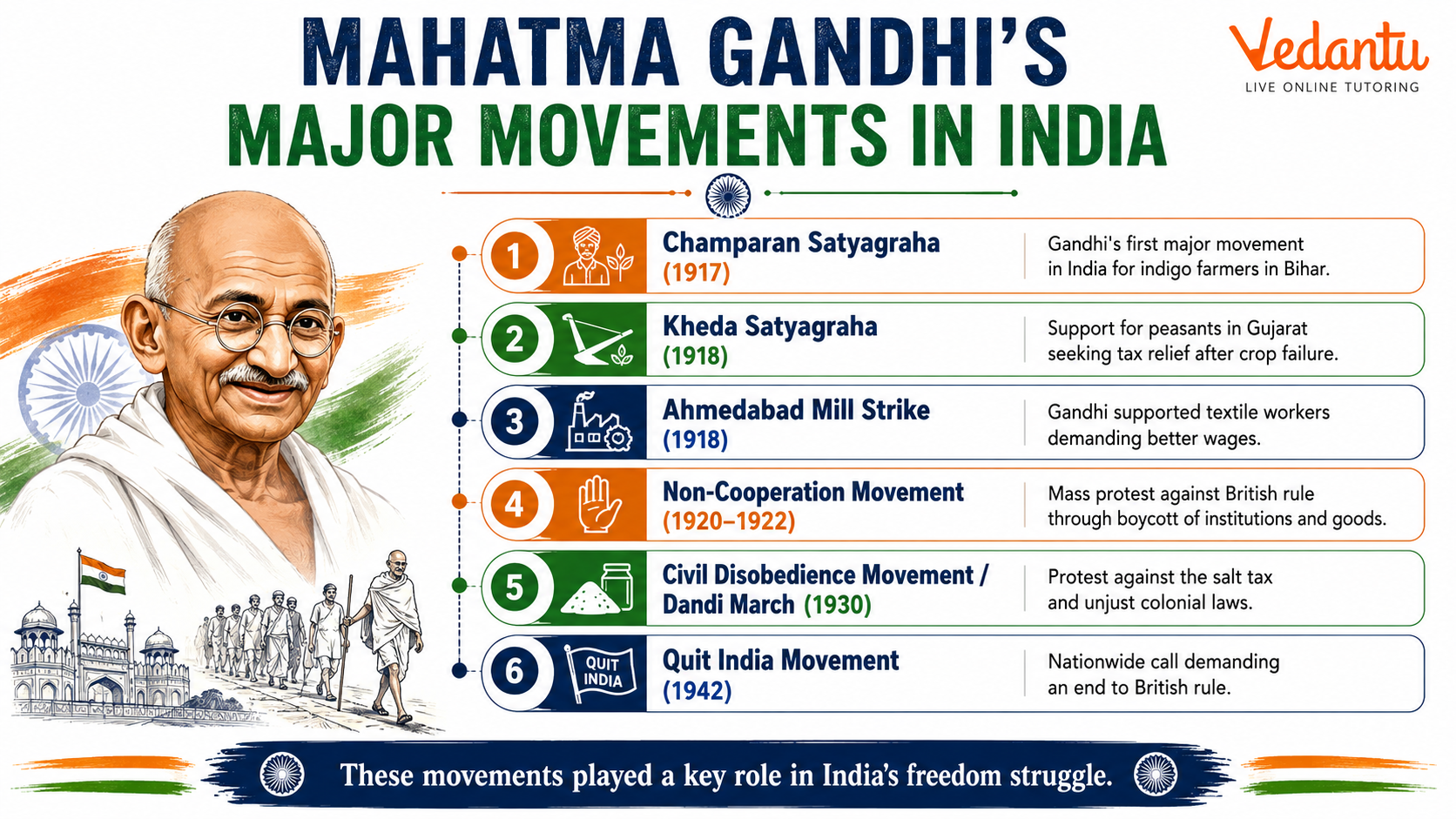
Mahatma Gandhi played a central role in India’s freedom struggle through a series of mass movements based on truth and non-violence. His leadership transformed the Indian National Congress into a powerful mass organization and united millions of Indians against British rule. The major movements led by Gandhi not only challenged colonial authority but also promoted values like self-reliance, unity, and civil disobedience. Understanding Mahatma Gandhi’s major movements is essential for students, competitive exam aspirants, and general readers interested in Indian history and General Knowledge.
Introduction to Gandhian Philosophy
Gandhi’s political methods were rooted in the principles of Satya - truth, and Ahimsa - non-violence. He believed in peaceful resistance and moral pressure rather than armed rebellion. His method of protest, known as Satyagraha, encouraged people to resist injustice through non-violent means while maintaining dignity and discipline.
- Satyagraha - insistence on truth and non-violent resistance.
- Civil Disobedience - refusal to obey unjust laws.
- Non-Cooperation - withdrawal of support from British institutions.
- Swadeshi - promotion of Indian goods and boycott of foreign products.
Major Movements Led by Mahatma Gandhi
1. Champaran Satyagraha (1917)
Champaran Satyagraha in Bihar was Gandhi’s first successful experiment with Satyagraha in India. It was launched to help indigo farmers who were forced by British planters to cultivate indigo under oppressive conditions.
- Year - 1917
- Issue - Exploitation of indigo farmers under the Tinkathia system.
- Outcome - British authorities agreed to reduce exploitation and refund money to farmers.
2. Kheda Satyagraha (1918)
The Kheda movement in Gujarat was organized to support peasants who were unable to pay land revenue due to crop failure. Gandhi demanded tax suspension and relief for farmers.
- Year - 1918
- Issue - Tax collection despite crop failure.
- Outcome - Government relaxed revenue collection.
3. Non-Cooperation Movement (1920-1922)
The Non-Cooperation Movement was launched in response to the Jallianwala Bagh massacre and the Rowlatt Act. Gandhi urged Indians to withdraw from British institutions and boycott foreign goods.
- Year - 1920 to 1922
- Methods - Boycott of schools, courts, titles, and foreign goods.
- End - Withdrawn after the Chauri Chaura incident in 1922.
4. Civil Disobedience Movement and Dandi March (1930)
The Civil Disobedience Movement began with the historic Dandi March in 1930. Gandhi marched from Sabarmati Ashram to Dandi to break the Salt Law, which symbolized British economic exploitation.
- Year - 1930
- Cause - Protest against the Salt Tax.
- Significance - Nationwide participation and international attention.
5. Quit India Movement (1942)
The Quit India Movement was launched during World War II demanding an immediate end to British rule in India. Gandhi gave the slogan "Do or Die" to inspire the nation.
- Year - 1942
- Objective - Immediate independence from British rule.
- Impact - Massive protests, arrests of leaders, and intensified freedom struggle.
Summary of Mahatma Gandhi’s Major Movements
| Movement | Year | Main Objective |
|---|---|---|
| Champaran Satyagraha | 1917 | Relief to indigo farmers |
| Kheda Satyagraha | 1918 | Tax relief for peasants |
| Non-Cooperation Movement | 1920-1922 | Boycott of British institutions |
| Civil Disobedience Movement | 1930 | Protest against Salt Law |
| Quit India Movement | 1942 | Demand for immediate independence |
These movements played a crucial role in weakening British authority and mobilizing people from all sections of society. Gandhi’s leadership ensured that the struggle for independence remained largely non-violent while still being powerful and effective.
Significance of Gandhi’s Major Movements
The major movements led by Mahatma Gandhi had long-lasting effects on India’s freedom struggle and global politics. They demonstrated the power of collective action and moral resistance.
- Transformed the freedom struggle into a mass movement.
- Promoted unity among different communities.
- Inspired civil rights movements across the world.
- Strengthened the demand for complete independence.
Key Facts for Exams
- Champaran was Gandhi’s first Satyagraha in India.
- Non-Cooperation Movement was withdrawn after the Chauri Chaura incident.
- Dandi March covered approximately 240 miles from Sabarmati to Dandi.
- Quit India Movement was launched on 8 August 1942.
Mahatma Gandhi’s major movements remain a cornerstone of Indian history and General Knowledge. They reflect the strength of non-violent resistance and the determination of the Indian people to achieve independence. A clear understanding of these movements helps students grasp the evolution of India’s national movement and prepares them effectively for competitive examinations.
FAQs on Mahatma Gandhi's Major Movements in India's Freedom Struggle
1. What were the major movements led by Mahatma Gandhi?
The major movements led by Mahatma Gandhi were mass national campaigns against British rule in India. Key movements include:
- Champaran Satyagraha (1917) – First successful satyagraha for indigo farmers
- Kheda Satyagraha (1918) – Tax relief movement for peasants
- Non-Cooperation Movement (1920–22)
- Civil Disobedience Movement (1930–34) including the Dandi Salt March
- Quit India Movement (1942)
2. What was the Non-Cooperation Movement?
The Non-Cooperation Movement (1920) was a mass protest urging Indians to withdraw support from British institutions. It aimed to achieve Swaraj (self-rule) through peaceful resistance. Major features include:
- Boycott of British schools, colleges, and courts
- Resignation from government jobs
- Boycott of foreign goods and promotion of Swadeshi
3. What was the Civil Disobedience Movement?
The Civil Disobedience Movement (1930) was a campaign to openly defy unjust British laws. It began with the famous Dandi Salt March. Key highlights:
- Violation of the Salt Law
- Refusal to pay taxes
- Boycott of British goods
4. What was the Quit India Movement?
The Quit India Movement (1942) was a decisive mass protest demanding immediate British withdrawal from India. Launched during World War II, it carried the slogan “Do or Die”. Key points include:
- Launched on 8 August 1942 at Bombay
- Led by Indian National Congress
- Mass arrests of Gandhi and other leaders
5. What was the Champaran Satyagraha?
The Champaran Satyagraha (1917) was Gandhi’s first successful movement in India. It aimed to protect indigo farmers from exploitation by British planters. Important aspects include:
- Protest against the Tinkathia system
- Use of non-violent resistance
- Government inquiry leading to reforms
6. What was the Kheda Satyagraha?
The Kheda Satyagraha (1918) was a peasant movement in Gujarat demanding tax suspension due to crop failure. Led by Mahatma Gandhi and Sardar Vallabhbhai Patel, it involved:
- Refusal to pay land revenue
- Peaceful protests against British authorities
7. What was the significance of the Dandi March?
The Dandi March (1930) symbolized resistance against British salt laws. Gandhi marched 240 miles from Sabarmati Ashram to Dandi. Its importance includes:
- Breaking the unjust Salt Act
- Mobilizing nationwide participation
- Drawing global attention to India’s freedom struggle
8. What is Satyagraha in Gandhi’s movements?
Satyagraha means “truth-force” or “soul-force” and was the foundation of Gandhi’s movements. It emphasized:
- Non-violence (Ahimsa)
- Peaceful protest and civil resistance
- Moral pressure instead of physical force
9. Why did Gandhi withdraw the Non-Cooperation Movement?
Gandhi withdrew the Non-Cooperation Movement in 1922 after the violent Chauri Chaura incident. The incident involved:
- Protesters burning a police station
- Death of 22 policemen
10. How did Gandhi’s movements contribute to Indian independence?
Gandhi’s movements united millions of Indians and weakened British authority through peaceful resistance. Their contributions include:
- Mass political awakening across villages and cities
- Promotion of Swadeshi and national unity
- International support for India’s cause
