






Regional and Traditional Names for Shifting Cultivation in Asia, Africa, and Latin America
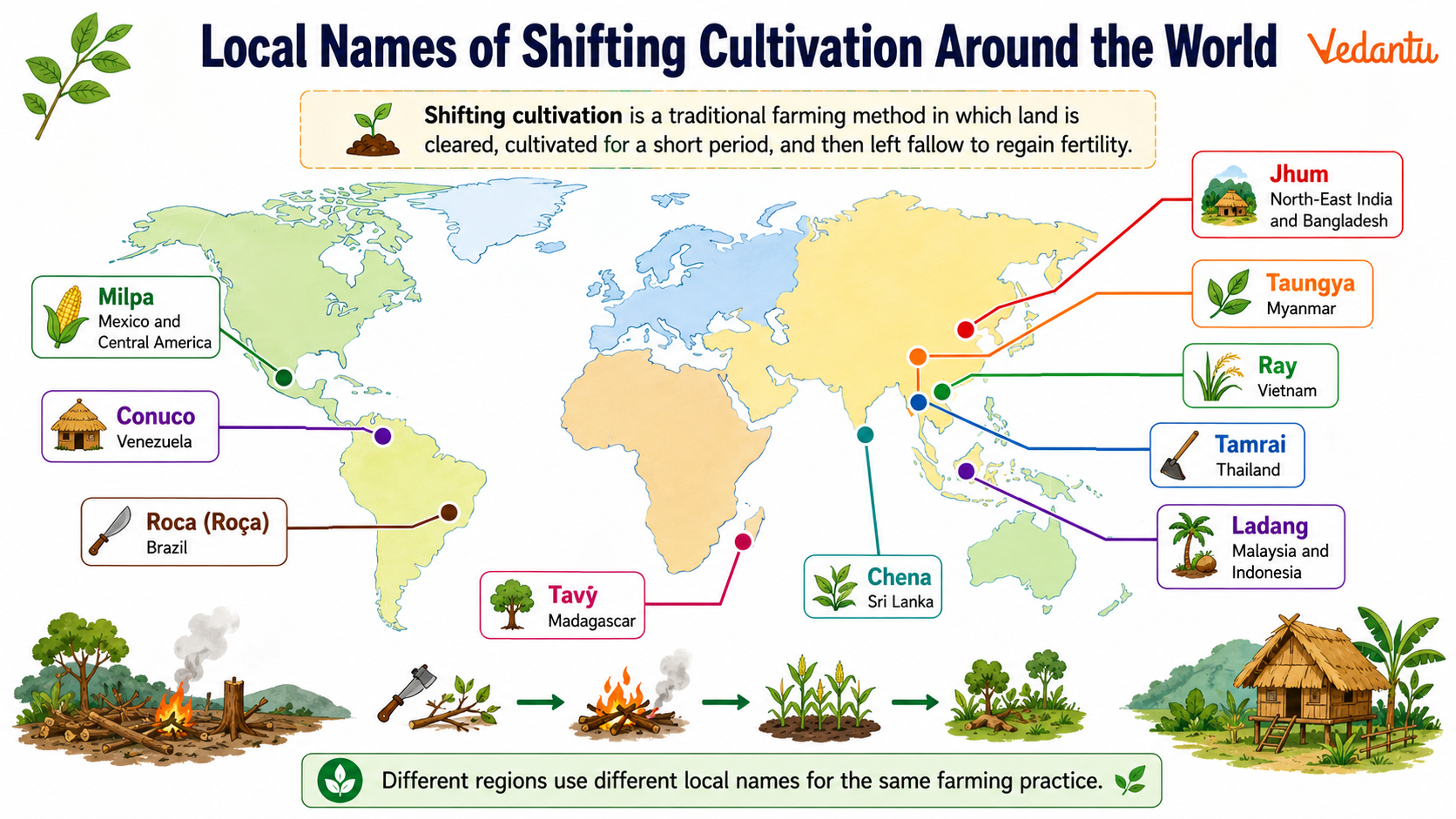
Shifting cultivation is one of the oldest agricultural practices in the world. It is a traditional farming system in which a piece of forest land is cleared, cultivated for a few years, and then left fallow to regain its natural fertility. This practice is commonly found in tropical regions of Asia, Africa, and South America. Different countries and communities have their own local names for shifting cultivation, reflecting cultural diversity and regional traditions. Understanding these local names is important for General Knowledge, Geography studies, and competitive examinations.
What Is Shifting Cultivation?
Shifting cultivation is also known as slash-and-burn agriculture. In this method, farmers cut down trees and vegetation, burn the biomass to clear the land, and use the ash as a natural fertilizer. Crops are grown for a few years until the soil loses fertility. Then the farmers move to a new area and repeat the process, allowing the previous land to regenerate naturally.
Key Features of Shifting Cultivation
- Practiced mainly in tropical forest regions
- Involves clearing and burning vegetation
- Land is cultivated temporarily and then abandoned
- Soil fertility is restored during the fallow period
- Generally practiced by tribal and indigenous communities
Local Names Of Shifting Cultivation Around The World
| Country or Region | Local Name | Continent |
|---|---|---|
| India (North-East) | Jhum | Asia |
| Central America and Mexico | Milpa | North America |
| Brazil | Roca | South America |
| Venezuela | Conuco | South America |
| Indonesia | Ladang | Asia |
| Philippines | Kaingin | Asia |
| Sri Lanka | Chena | Asia |
| Vietnam | Ray | Asia |
| Africa (Various regions) | Bush Fallow | Africa |
| Thailand | Tamrai | Asia |
The above table highlights the different local names used for shifting cultivation in various parts of the world. These names are frequently asked in Geography and General Knowledge examinations, especially in topics related to agriculture and tribal practices.
Shifting Cultivation In India
In India, shifting cultivation is mainly practiced in the North-Eastern states such as Assam, Meghalaya, Mizoram, Nagaland, and Manipur. It is locally called Jhum cultivation. Tribal communities depend on this practice for growing crops like rice, maize, millets, and vegetables.
Indian States Where Jhum Is Common
- Assam
- Meghalaya
- Mizoram
- Nagaland
- Tripura
- Manipur
Advantages And Disadvantages
Advantages
- Low cost farming method
- Uses natural fertilizers such as ash
- Suitable for hilly and forested regions
- Supports traditional lifestyles
Disadvantages
- Leads to deforestation
- Causes soil erosion
- Reduces biodiversity
- Less productive compared to modern farming
Importance For Competitive Exams
Local names of shifting cultivation are frequently asked in competitive examinations such as UPSC, SSC, State PSC, and other General Knowledge tests. Questions may appear in the form of match the following, multiple choice questions, or direct factual questions. Understanding the geographical distribution and regional terminology helps students score easily in static GK sections.
Quick Revision Points
- Shifting cultivation is also called slash-and-burn agriculture
- It is known as Jhum in North-East India
- Milpa is the local name in Central America
- Ladang is practiced in Indonesia
- Chena is the name used in Sri Lanka
- Roca and Conuco are names used in South America
Understanding the local names of shifting cultivation around the world enhances geographical awareness and strengthens static General Knowledge. Since it is a traditional agricultural system practiced across continents, learning these names helps students connect cultural practices with regional geography in a meaningful way.
FAQs on Local Names of Shifting Cultivation Across Different Countries
1. What are the local names of shifting cultivation around the world?
The local names of shifting cultivation vary across regions, reflecting cultural and geographical diversity.
Major local names include:
• Jhum – North-East India
• Slash and Burn – General term (Tropics)
• Milpa – Mexico and Central America
• Ladang – Indonesia and Malaysia
• Chena – Sri Lanka
• Tavy – Madagascar
• Taungya – Myanmar
• Conuco – Venezuela
• Roca – Brazil
These names are commonly asked in Geography GK, UPSC, SSC, and school exams under topics like primitive subsistence farming and slash-and-burn agriculture.
2. What is Jhum cultivation?
Jhum cultivation is the Indian form of shifting cultivation practiced mainly in the North-Eastern states.
Key features:
• Forest land is cleared and burned
• Crops are grown for 1–3 years
• Farmers move to a new plot after soil fertility declines
• Practiced in Assam, Meghalaya, Mizoram, and Nagaland
It is also known as slash-and-burn farming and is important in questions related to Indian agriculture and tribal farming practices.
3. Why is shifting cultivation called slash-and-burn agriculture?
Shifting cultivation is called slash-and-burn agriculture because vegetation is cut (slashed) and then burned before cultivation.
Process includes:
• Cutting down trees and shrubs
• Burning the biomass to add nutrients to the soil
• Growing crops temporarily
• Leaving land fallow after fertility decreases
This method is common in tropical rainforest regions and is frequently asked under primitive farming methods.
4. What is Milpa cultivation?
Milpa cultivation is the traditional form of shifting agriculture practiced in Mexico and Central America.
Main characteristics:
• Involves slash-and-burn technique
• Maize (corn) is the primary crop
• Often combined with beans and squash
• Practiced by indigenous communities
Milpa is a common term in questions about Latin American agriculture and traditional farming systems.
5. Where is Ladang cultivation practiced?
Ladang cultivation is a form of shifting cultivation practiced in Indonesia and Malaysia.
Important points:
• Forest land is cleared for farming
• Rice is the major crop
• Fields are abandoned after soil fertility declines
• Common in humid tropical climates
Ladang is often mentioned in South-East Asian agriculture and shifting cultivation examples worldwide.
6. What is Taungya system of cultivation?
The Taungya system is a type of shifting cultivation practiced mainly in Myanmar and parts of South-East Asia.
Key features:
• Farmers grow crops along with forest trees
• Cultivation continues until tree canopy develops
• Combines agriculture with forestry
• Helps in forest regeneration
Taungya is important in topics related to agroforestry and forest management systems.
7. What is Chena cultivation?
Chena cultivation is the local name for shifting cultivation in Sri Lanka.
Main characteristics:
• Slash-and-burn technique
• Temporary farming plots
• Cultivation of millets, maize, and vegetables
• Practiced in dry zones
Chena is frequently asked in world geography GK and types of subsistence farming.
8. What is Tavy cultivation?
Tavy cultivation is the traditional shifting agriculture practiced in Madagascar.
Key points:
• Forest areas are cleared and burned
• Rice is the primary crop
• Practiced in tropical forest regions
• Associated with deforestation concerns
Tavy is commonly included in questions about African agriculture and environmental impact of slash-and-burn farming.
9. What are the main features of shifting cultivation?
Shifting cultivation is a primitive subsistence farming method characterized by temporary land use.
Main features:
• Slash-and-burn technique
• Small land holdings
• Family labor-based farming
• Low productivity
• Long fallow period for soil recovery
It is widely practiced in tropical rainforests of Asia, Africa, and South America and is important for competitive exam geography preparation.
10. In which climatic regions is shifting cultivation commonly practiced?
Shifting cultivation is mainly practiced in tropical and equatorial climatic regions with heavy rainfall.
Common regions include:
• Amazon Basin (South America)
• Congo Basin (Africa)
• North-East India and South-East Asia
• Central America
These regions support dense forests suitable for slash-and-burn agriculture, making this topic important in climate and agriculture-based GK questions.
