






Major Solar Power Plants in India by State and Installed Capacity
Solar power plants in India play a crucial role in the country’s renewable energy development and sustainable growth. India is one of the fastest-growing solar energy markets in the world due to its high solar radiation and large geographical area. The Government of India has launched various initiatives such as the National Solar Mission to promote clean energy and reduce dependence on fossil fuels. This page provides a detailed list of major solar power plants in India, along with their locations, capacities, and importance for competitive exams and general knowledge preparation.
Overview of Solar Power in India
India ranks among the top countries in solar power generation. With more than 300 sunny days in a year in many regions, the country has immense potential for solar energy production. Solar power plants convert sunlight into electricity using photovoltaic panels or solar thermal technology.
- India launched the Jawaharlal Nehru National Solar Mission in 2010.
- Rajasthan, Gujarat, Karnataka, and Tamil Nadu are leading solar power producing states.
- India aims to achieve high renewable energy capacity targets in the coming years.
- Solar parks are developed to provide infrastructure for large scale solar projects.
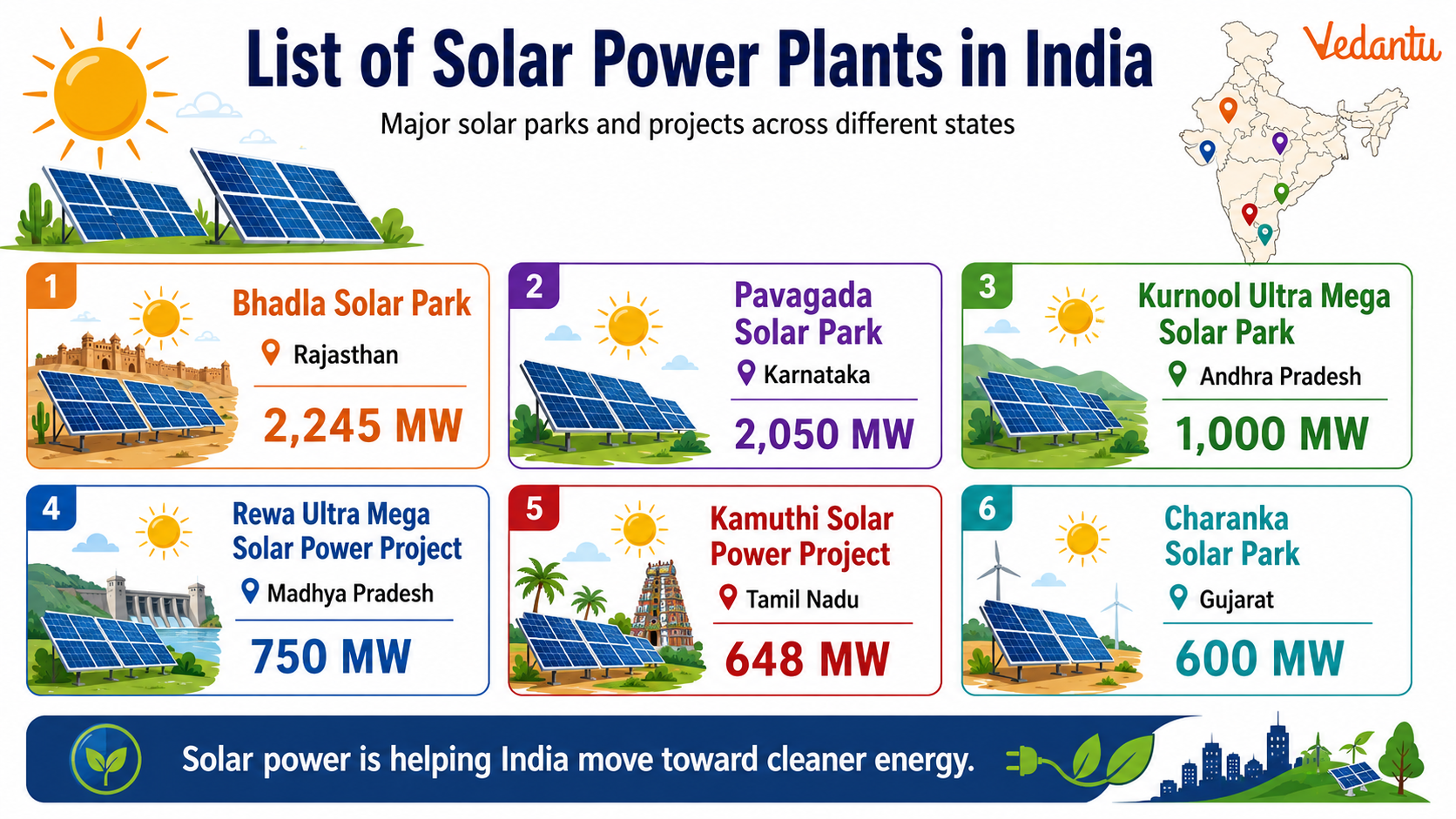
List of Major Solar Power Plants in India
| Solar Power Plant | Location | Capacity (MW) |
|---|---|---|
| Bhadla Solar Park | Rajasthan | 2245 |
| Pavagada Solar Park | Karnataka | 2050 |
| Kurnool Ultra Mega Solar Park | Andhra Pradesh | 1000 |
| Rewa Solar Park | Madhya Pradesh | 750 |
| Kamuthi Solar Power Project | Tamil Nadu | 648 |
Bhadla Solar Park in Rajasthan is currently one of the largest solar power plants in the world. These large scale projects significantly contribute to India’s renewable energy capacity and help reduce carbon emissions.
State Wise Distribution of Solar Plants
Solar power plants are unevenly distributed across India due to differences in sunlight availability, land area, and state policies. Western and southern states dominate in installed capacity.
Top Solar Producing States
- Rajasthan - Highest solar capacity due to desert climate and vast land.
- Gujarat - Early adopter of solar park development.
- Karnataka - Home to Pavagada Solar Park.
- Tamil Nadu - Major contributor to renewable energy including solar and wind.
- Andhra Pradesh - Known for Kurnool Ultra Mega Solar Park.
Importance of Solar Power Plants in India
Solar power plants are important for India’s economic and environmental development. They help in meeting rising electricity demand and reducing greenhouse gas emissions.
- Reduce dependence on coal and imported fossil fuels.
- Promote clean and sustainable energy production.
- Generate employment in solar panel manufacturing and installation.
- Support India’s commitment to climate change mitigation.
Government Initiatives Supporting Solar Power
The Government of India has implemented several schemes to boost solar energy production and infrastructure development.
- National Solar Mission - Aimed at promoting solar energy development across the country.
- Solar Park Scheme - Provides land and infrastructure for solar projects.
- PM Kusum Scheme - Encourages farmers to install solar pumps and grid connected solar plants.
- Rooftop Solar Programme - Promotes installation of solar panels on residential and commercial buildings.
Key Facts for Competitive Exams
- Bhadla Solar Park is one of the largest solar parks in the world.
- India is among the top countries in solar energy capacity.
- The National Solar Mission was launched in 2010.
- Rajasthan is the leading state in solar power generation.
Conclusion
The list of solar power plants in India highlights the country’s strong commitment to renewable energy and sustainable development. Large solar parks such as Bhadla, Pavagada, and Kurnool have positioned India as a global leader in solar energy production. Understanding the major solar power plants, their locations, and capacities is important for general knowledge and competitive exams. As India continues to expand its renewable energy infrastructure, solar power will remain a key pillar of its energy strategy.
FAQs on List of Solar Power Plants in India with Locations and Capacity Details
1. What are the major solar power plants in India?
The major solar power plants in India are large-scale renewable energy projects contributing significantly to India’s clean energy goals. Key plants include:
• Bhadla Solar Park (Rajasthan) – 2,245 MW (largest in India)
• Pavagada Solar Park (Karnataka) – 2,050 MW
• Kurnool Ultra Mega Solar Park (Andhra Pradesh) – 1,000 MW
• Rewa Solar Park (Madhya Pradesh) – 750 MW
• Kamuthi Solar Power Project (Tamil Nadu) – 648 MW
These projects support India’s target of expanding solar energy capacity under the National Solar Mission.
2. Which is the largest solar power plant in India?
The Bhadla Solar Park in Rajasthan is the largest solar power plant in India with a capacity of 2,245 megawatts (MW). It is located in the Jodhpur district and is one of the world’s biggest solar parks. The plant plays a vital role in boosting renewable energy production and reducing carbon emissions in India.
3. In which state is Bhadla Solar Park located?
The Bhadla Solar Park is located in Rajasthan, specifically in the Jodhpur district. Rajasthan is a leading state in solar power generation due to:
• High solar radiation levels
• Vast desert land availability
• Strong government support for renewable energy
This makes Rajasthan a hub for solar energy projects in India.
4. What is the capacity of Pavagada Solar Park?
The Pavagada Solar Park in Karnataka has a total installed capacity of 2,050 MW. Also known as the Shakti Sthala Solar Park, it is one of the largest solar parks in the world. It significantly contributes to Karnataka’s position as a leader in solar energy production in India.
5. What is the National Solar Mission?
The National Solar Mission (NSM) is a major initiative launched in 2010 under the National Action Plan on Climate Change (NAPCC). Its main objectives are:
• Promote large-scale solar power projects
• Reduce dependence on fossil fuels
• Achieve ambitious solar capacity targets
The mission aims to strengthen India’s position in renewable energy development and sustainable growth.
6. Which solar power plant is located in Madhya Pradesh?
The major solar plant in Madhya Pradesh is the Rewa Solar Park, with a capacity of 750 MW. It is notable because:
• It supplies power to the Delhi Metro
• It offers competitive solar tariffs
• It supports India’s clean energy transition
The Rewa project is often cited in GK questions about solar parks in India.
7. What is the capacity of Kamuthi Solar Power Project?
The Kamuthi Solar Power Project in Tamil Nadu has an installed capacity of 648 MW. Commissioned in 2016, it was once the largest single-location solar plant in the world. It plays an important role in Tamil Nadu’s renewable energy generation and solar infrastructure.
8. Why is Rajasthan a leader in solar power generation?
Rajasthan is a leader in solar power generation in India due to favorable natural and policy conditions. Key reasons include:
• Abundant sunlight throughout the year
• Large areas of unused desert land
• Government incentives for solar energy projects
Major plants like Bhadla Solar Park make Rajasthan a top state in installed solar capacity.
9. What is an Ultra Mega Solar Park in India?
An Ultra Mega Solar Park is a large-scale solar project with very high generation capacity, usually above 500 MW. Features include:
• Centralized infrastructure support
• Grid connectivity facilities
• Government-backed development
Examples include Kurnool Ultra Mega Solar Park and Pavagada Solar Park, which boost India’s renewable energy output.
10. How do solar power plants benefit India?
Solar power plants benefit India by promoting clean, sustainable, and affordable energy. Major advantages include:
• Reduction in carbon emissions
• Decreased dependence on coal and fossil fuels
• Energy security and job creation
• Support for India’s renewable energy targets
Large solar parks like Bhadla, Pavagada, and Rewa strengthen India’s position in global solar energy development.
