






Types and Directions of World Ocean Currents with Key Facts
Ocean currents are continuous, directed movements of seawater that flow through the world’s oceans. They play a vital role in regulating the Earth’s climate, influencing weather patterns, supporting marine life, and facilitating global trade routes. Ocean currents are broadly classified as warm and cold currents based on the temperature of the water they carry. Understanding the list of ocean currents of the world is essential for students preparing for competitive exams such as NEET, UPSC, SSC, and other geography-related tests, as it forms a key part of physical geography and climatology.
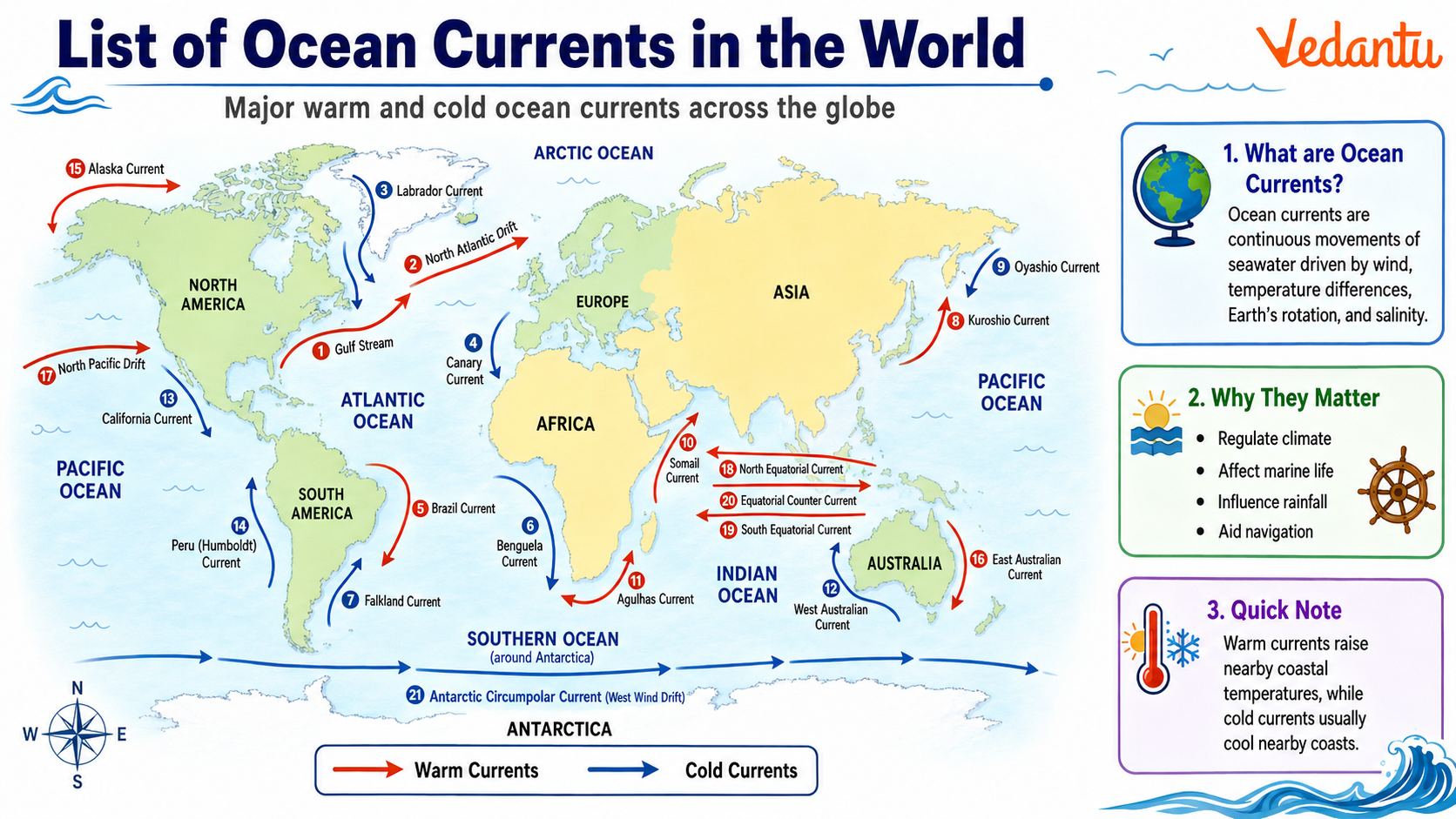
What Are Ocean Currents?
Ocean currents are large streams of seawater that move in definite directions. These currents are generated by factors such as prevailing winds, differences in water density, temperature variations, salinity, and the rotation of the Earth. The Coriolis effect, caused by Earth’s rotation, deflects currents to the right in the Northern Hemisphere and to the left in the Southern Hemisphere.
Main Causes of Ocean Currents
- Prevailing winds such as trade winds and westerlies
- Difference in water density due to temperature and salinity
- Earth’s rotation and Coriolis effect
- Shape of coastlines and ocean basins
Classification of Ocean Currents
1. Warm Ocean Currents
Warm currents originate near the equator and move towards the poles. They raise the temperature of the coastal regions they flow past and often increase rainfall.
2. Cold Ocean Currents
Cold currents originate in the polar or temperate regions and move towards the equator. They lower the temperature of nearby coastal areas and are often associated with dry climates and deserts.
Major Ocean Currents of the World
| Ocean | Warm Currents | Cold Currents |
|---|---|---|
| Atlantic Ocean | Gulf Stream, North Atlantic Drift, Brazil Current | Labrador Current, Canary Current, Benguela Current |
| Pacific Ocean | Kuroshio Current, East Australian Current, North Pacific Drift | California Current, Peru Current, Oyashio Current |
| Indian Ocean | Agulhas Current, Mozambique Current | West Australian Current |
The above table highlights the most important ocean currents frequently asked in competitive examinations. Students should also remember that the Antarctic Circumpolar Current, also known as the West Wind Drift, flows around Antarctica and connects the Atlantic, Pacific, and Indian Oceans.
Important Ocean Currents and Their Features
Gulf Stream
The Gulf Stream is a powerful warm current in the North Atlantic Ocean. It originates in the Gulf of Mexico and flows towards Western Europe. It keeps the climate of Western Europe warmer than other regions at similar latitudes.
Labrador Current
The Labrador Current is a cold current that flows southward from the Arctic Ocean along the coast of Canada. When it meets the Gulf Stream, it creates dense fog and rich fishing grounds near Newfoundland.
Kuroshio Current
The Kuroshio Current, also known as the Japan Current, is a warm current in the North Pacific Ocean. It influences the climate of Japan and contributes to heavy rainfall in the region.
Peru Current
The Peru Current, also called the Humboldt Current, is a cold current flowing along the western coast of South America. It supports one of the richest fishing industries in the world due to nutrient upwelling.
Significance of Ocean Currents
- Regulate global climate by transferring heat
- Influence rainfall and desert formation
- Support marine biodiversity and fishing industries
- Affect navigation and trade routes
- Play a role in the formation of cyclones and storms
Exam Preparation Tips for Students
- Memorize the location of major warm and cold currents ocean-wise
- Understand the climatic impact of important currents like Gulf Stream and Peru Current
- Practice map-based questions for better retention
- Revise the difference between warm and cold currents regularly
Conclusion
The list of ocean currents of the world is a fundamental topic in physical geography. These currents not only shape the climate and ecosystems of coastal regions but also influence global weather systems and human activities. A clear understanding of major warm and cold currents, their locations, and their effects is essential for academic success and competitive examinations. Systematic revision and map practice can help students master this important topic effectively.
FAQs on List of Major Ocean Currents in the World Explained for Students
1. What are ocean currents?
Ocean currents are continuous, directed movements of seawater that flow through the world’s oceans.
• They are driven by winds, Earth’s rotation (Coriolis effect), temperature differences, and salinity variations.
• Ocean currents are classified into warm currents and cold currents.
• They influence climate, weather patterns, marine life, and global navigation.
• Also known as marine currents or global ocean circulation, they are important for geography and competitive exams.
2. What are the major ocean currents of the world?
The major ocean currents of the world are large-scale water movements found in the Atlantic, Pacific, and Indian Oceans.
• Gulf Stream (North Atlantic)
• Labrador Current (North Atlantic)
• Kuroshio Current (North Pacific)
• California Current (North Pacific)
• Canary Current (Atlantic Ocean)
• Benguela Current (South Atlantic)
• Peru or Humboldt Current (South Pacific)
• Agulhas Current (Indian Ocean)
These currents form part of the global ocean conveyor belt and regulate Earth’s climate system.
3. What is the difference between warm and cold ocean currents?
The main difference between warm and cold ocean currents lies in their temperature and climatic impact.
• Warm currents originate near the equator and move toward the poles (e.g., Gulf Stream, Kuroshio Current).
• They raise the temperature of nearby coastal regions.
• Cold currents flow from polar or temperate regions toward the equator (e.g., Labrador Current, Peru Current).
• They lower coastal temperatures and often cause fog and dry climates.
This classification is important in physical geography and climatology.
4. How do ocean currents affect climate?
Ocean currents significantly influence global and regional climate by transferring heat across the Earth.
• Warm currents make coastal areas warmer and wetter (e.g., Western Europe due to the Gulf Stream).
• Cold currents create cooler and drier climates (e.g., Atacama Desert near the Peru Current).
• They affect monsoons, cyclones, and rainfall patterns.
• Ocean circulation helps regulate the global temperature balance.
Thus, currents play a key role in weather systems and climate change studies.
5. What is the Gulf Stream?
The Gulf Stream is a powerful warm ocean current in the North Atlantic Ocean.
• It originates in the Gulf of Mexico.
• Flows along the eastern coast of the United States toward Western Europe.
• It keeps countries like the UK and Norway warmer than other regions at similar latitudes.
• It is part of the North Atlantic Drift and the global thermohaline circulation.
The Gulf Stream is one of the most important ocean currents in the world.
6. What is the Humboldt Current?
The Humboldt Current, also known as the Peru Current, is a cold ocean current in the South Pacific Ocean.
• It flows northward along the west coast of South America.
• It causes the formation of the Atacama Desert due to dry conditions.
• It supports rich marine fisheries because of nutrient upwelling.
• It is closely linked to the El Niño phenomenon.
This current is important for understanding climate anomalies and marine ecosystems.
7. What causes ocean currents to move?
Ocean currents move due to a combination of physical and environmental factors.
• Planetary winds push surface waters.
• The Coriolis effect deflects currents due to Earth’s rotation.
• Differences in temperature and salinity create density-driven circulation (thermohaline circulation).
• The shape of continents and ocean basins directs flow.
These factors together create the global system of ocean circulation.
8. What is thermohaline circulation?
Thermohaline circulation is the deep-ocean movement driven by temperature and salinity differences.
• ‘Thermo’ means temperature and ‘haline’ means salinity.
• Cold, salty water sinks in polar regions.
• Warm surface water moves to replace it, forming the global ocean conveyor belt.
• It regulates long-term climate patterns worldwide.
This system connects all major oceans and is vital for Earth’s heat balance.
9. Why are ocean currents important for marine life?
Ocean currents are crucial for marine ecosystems because they distribute nutrients and oxygen.
• Cold currents bring nutrient-rich water through upwelling.
• They support major fishing grounds like those near Peru and California.
• Currents help in the migration of marine species.
• They maintain biodiversity in oceans and seas.
Thus, marine biology and fisheries depend heavily on ocean circulation.
10. Which ocean has the strongest currents in the world?
The Southern Ocean has the strongest ocean current known as the Antarctic Circumpolar Current (ACC).
• The Antarctic Circumpolar Current flows clockwise around Antarctica.
• It connects the Atlantic, Pacific, and Indian Oceans.
• It is the largest and most powerful current on Earth.
• It plays a major role in global ocean circulation and climate regulation.
This current is often highlighted in geography GK and competitive exams.
