






Key Contributors from the List of Fathers Across Major Biology Disciplines
Biology is a vast branch of science that deals with the study of living organisms. Over time, it has been divided into several specialized branches to understand life in a detailed and systematic manner. Many great scientists have contributed significantly to these branches and are known as the "Father" of their respective fields. The topic "List Of Fathers Of Different Branches Of Biology" is very important for school exams, competitive exams like NEET, and general knowledge preparation. In this article, you will find a well-structured list along with brief explanations to help you remember them easily.
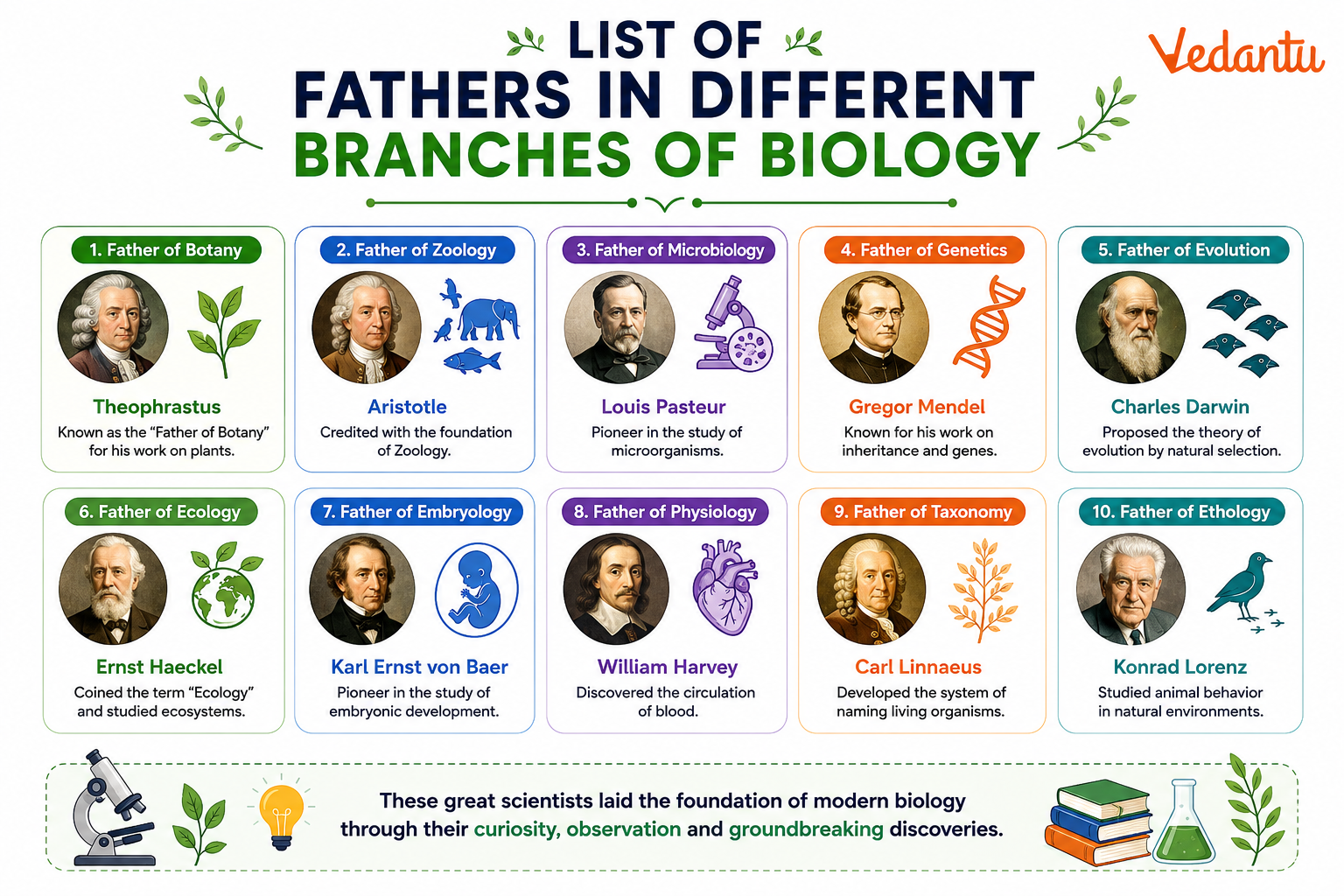
What Are Branches Of Biology?
Branches of biology are specialized fields that focus on specific aspects of living organisms. Each branch studies a particular area such as plants, animals, cells, genetics, evolution, or the environment. The scientists who laid the foundation of these branches through their discoveries and theories are often called the fathers of those branches.
List Of Fathers Of Different Branches Of Biology
| Branch Of Biology | Father Of The Branch | Key Contribution |
|---|---|---|
| Botany | Theophrastus | Systematic study of plants |
| Zoology | Aristotle | Classification and study of animals |
| Genetics | Gregor Mendel | Laws of inheritance |
| Microbiology | Antonie van Leeuwenhoek | Discovery of microorganisms |
| Taxonomy | Carolus Linnaeus | Binomial nomenclature |
| Evolution | Charles Darwin | Theory of natural selection |
| Cell Biology | Robert Hooke | Discovery of cells |
| Modern Genetics | Thomas Hunt Morgan | Chromosomal theory of inheritance |
| Ecology | Ernst Haeckel | Coined the term ecology |
| Anatomy | Andreas Vesalius | Foundations of human anatomy |
The above table lists the most commonly asked fathers of different branches of biology in competitive exams. Their discoveries formed the foundation of modern biological sciences and are frequently included in General Knowledge sections.
Brief Explanation Of Important Fathers
1. Theophrastus - Father Of Botany
Theophrastus was a Greek philosopher and a student of Aristotle. He systematically studied plants and wrote books describing plant structure and classification. Because of his detailed work, he is known as the Father of Botany.
2. Aristotle - Father Of Zoology
Aristotle classified animals based on their characteristics and habitat. His observations and writings laid the foundation for the scientific study of animals, earning him the title Father of Zoology.
3. Gregor Mendel - Father Of Genetics
Gregor Mendel conducted experiments on pea plants and discovered the basic laws of inheritance. His principles such as the Law of Segregation and Law of Independent Assortment are fundamental to genetics.
4. Charles Darwin - Father Of Evolution
Charles Darwin proposed the theory of evolution by natural selection. His book "On the Origin of Species" explained how species evolve over time, changing the understanding of life on Earth.
5. Carolus Linnaeus - Father Of Taxonomy
Carolus Linnaeus introduced the binomial nomenclature system for naming organisms. This system is still used today for scientific classification.
Why This Topic Is Important For Exams
- Frequently asked in school exams and competitive exams like NEET.
- Important for General Knowledge and Biology static GK preparation.
- Helps in understanding the historical development of biological sciences.
- Forms the conceptual base for advanced biological studies.
Tips To Remember Fathers Of Biology Branches
- Group similar branches together such as Botany and Zoology.
- Associate each scientist with their key discovery.
- Revise using short notes and flashcards.
- Practice multiple choice questions regularly.
Conclusion
The List Of Fathers Of Different Branches Of Biology is an essential topic for students preparing for NEET and other competitive exams. These scientists shaped the foundation of modern biology through their groundbreaking discoveries and theories. Learning their names along with their contributions not only improves your General Knowledge but also strengthens your understanding of biological concepts. Regular revision and structured study can help you remember these important facts effectively.
FAQs on List of Fathers in Different Branches of Biology with Key Contributions
1. Who is known as the Father of Biology?
The Father of Biology is Aristotle, who laid the foundation of biological classification and scientific study of living organisms.
• Aristotle (384–322 BC) classified plants and animals based on characteristics.
• He introduced early concepts of zoology and animal behavior.
• Often asked in GK and competitive exams under “Father of Biology” and “Founder of Zoology.”
2. Who is called the Father of Modern Biology?
The Father of Modern Biology is Charles Darwin due to his theory of evolution by natural selection.
• Proposed the Theory of Evolution in 1859.
• Wrote “On the Origin of Species”.
• Key concepts: natural selection, survival of the fittest, adaptation.
3. Who is known as the Father of Botany?
The Father of Botany is Theophrastus, who systematically studied and classified plants.
• Student of Aristotle.
• Wrote “Historia Plantarum”.
• Also called the “Founder of Plant Science” in general knowledge topics.
4. Who is regarded as the Father of Zoology?
The Father of Zoology is Aristotle for his early studies on animal classification and anatomy.
• Classified animals based on habitat and structure.
• Studied marine biology and embryology.
• Frequently asked in GK under “Founder of Zoology.”
5. Who is called the Father of Genetics?
The Father of Genetics is Gregor Johann Mendel for discovering the basic laws of inheritance.
• Conducted experiments on pea plants.
• Proposed Law of Dominance, Law of Segregation, and Law of Independent Assortment.
• Important for exams covering heredity and inheritance.
6. Who is known as the Father of Microbiology?
The Father of Microbiology is Antonie van Leeuwenhoek for discovering microorganisms.
• First to observe bacteria and protozoa using a microscope.
• Also called the “Father of Bacteriology” in some contexts.
• Key topic in microbiology and medical GK.
7. Who is considered the Father of Anatomy?
The Father of Anatomy is Andreas Vesalius for his detailed studies of human body structure.
• Published “De Humani Corporis Fabrica” in 1543.
• Corrected many errors of earlier scientists.
• Known as the founder of modern human anatomy.
8. Who is known as the Father of Ecology?
The Father of Ecology is Ernst Haeckel, who coined the term ecology in 1866.
• Defined ecology as the study of organisms and their environment.
• Contributed to evolutionary biology.
• Frequently asked in environmental science GK questions.
9. Who is regarded as the Father of Immunology?
The Father of Immunology is Edward Jenner for developing the first successful vaccine.
• Introduced the smallpox vaccine in 1796.
• Laid the foundation of vaccination and immune science.
• Key term: vaccination, immunity, infectious diseases.
10. Who is known as the Father of Biotechnology?
The Father of Biotechnology is Karl Ereky, who coined the term biotechnology in 1919.
• Defined biotechnology as using living organisms for industrial production.
• Important in topics like genetic engineering, molecular biology, and applied biology.
• Commonly asked in biology GK and competitive exams.
