






In English Studies: Major Terms and Impact of the Subsidiary Alliance
The Subsidiary Alliance was a strategic political system introduced by Lord Wellesley in India during the late 18th century. It played a major role in expanding British control over Indian princely states without direct warfare in many cases. Under this system, Indian rulers accepted British protection and, in return, surrendered significant aspects of their sovereignty. The policy marked a turning point in the consolidation of British power in India and significantly altered the political landscape of the subcontinent.
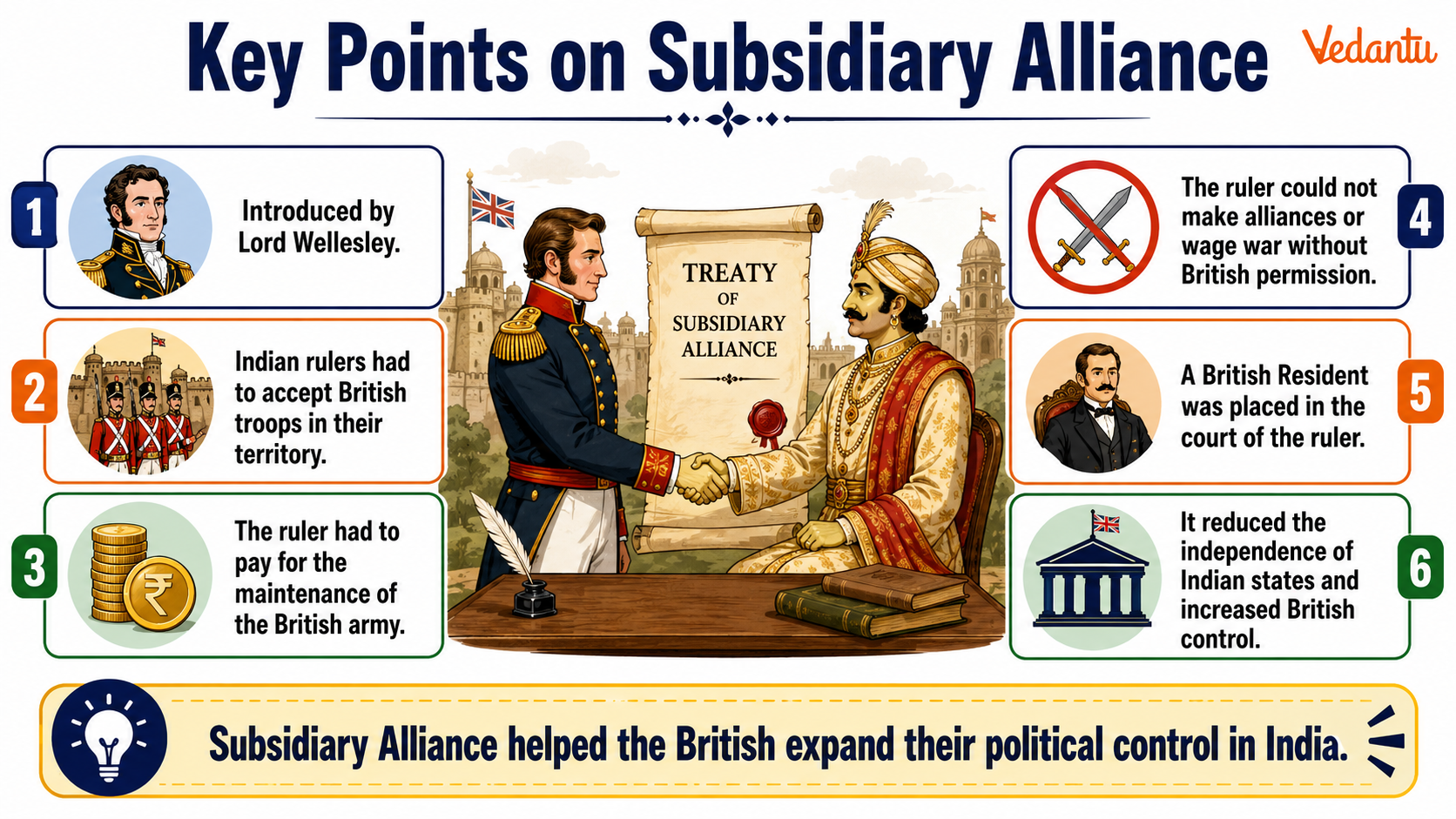
Introduction to Subsidiary Alliance
The Subsidiary Alliance system was introduced by Lord Wellesley, who served as the Governor General of India from 1798 to 1805. The main objective of this policy was to eliminate French influence in India and establish British political supremacy. Through diplomatic pressure and military threat, Indian rulers were persuaded to accept British troops within their territories and follow British advice in external affairs.
Key Features of Subsidiary Alliance
- Indian rulers had to accept British troops stationed within their territory.
- The ruler was required to pay for the maintenance of the British army, either in cash or by ceding territory.
- The ruler could not form alliances with any other foreign power without British permission.
- The ruler had to dismiss any European officers other than the British from their service.
- A British Resident was appointed at the court of the allied state to supervise matters.
- In return, the British promised protection against external threats and internal rebellions.
Objectives of the Subsidiary Alliance
The British East India Company introduced this policy with clear political and military goals. It was not merely a defensive arrangement but a calculated step towards imperial expansion.
- To expand British political influence in India.
- To reduce the risk of French interference in Indian affairs.
- To strengthen the military position of the British without direct annexation.
- To weaken Indian rulers by limiting their independence.
Major States That Accepted Subsidiary Alliance
| State | Year | Ruler |
|---|---|---|
| Hyderabad | 1798 | Nizam of Hyderabad |
| Mysore | 1799 | After defeat of Tipu Sultan |
| Awadh | 1801 | Nawab of Awadh |
Other states such as the Marathas, Tanjore, and Travancore also entered into subsidiary alliances over time. Hyderabad was the first state to accept this system, setting an example for others.
Advantages for the British
- Expansion of territory without direct warfare in many cases.
- Increased military strength funded by Indian rulers.
- Control over the foreign policies of Indian states.
- Strategic positioning of troops across India.
Disadvantages for Indian Rulers
- Loss of sovereignty and independence in foreign affairs.
- Heavy financial burden due to maintenance of British troops.
- Interference of the British Resident in internal matters.
- Weakening of native armies and administrative control.
Impact of Subsidiary Alliance on Indian Politics
The Subsidiary Alliance significantly reduced the political independence of Indian princely states. Although rulers remained nominal heads of their kingdoms, real power gradually shifted to the British. This system laid the foundation for indirect British rule and prepared the ground for future annexations. By the early 19th century, a large part of India had come under British influence either directly or indirectly through this policy.
Difference Between Subsidiary Alliance and Direct Annexation
| Aspect | Subsidiary Alliance | Direct Annexation |
|---|---|---|
| Control | Indirect control through British Resident | Complete British administration |
| Ruler | Local ruler remained in position | Ruler removed from power |
While Subsidiary Alliance allowed rulers to retain their throne under British supervision, direct annexation resulted in full integration of the state into British territory. Both methods were used to expand British authority in India.
Conclusion
The Subsidiary Alliance was one of the most powerful diplomatic tools used by the British East India Company to expand its empire in India. Introduced by Lord Wellesley, it helped the British gain political supremacy without extensive warfare. Although it promised protection to Indian rulers, it gradually eroded their independence and strengthened British dominance. Understanding the Subsidiary Alliance is essential for grasping how British rule expanded in India during the late 18th and early 19th centuries.
FAQs on English – Main Features of the Subsidiary Alliance System
1. What was the Subsidiary Alliance in Indian history?
The Subsidiary Alliance was a political system introduced by Lord Wellesley in 1798 to expand British control in India.
• Under this system, Indian rulers had to accept a British army contingent within their territory.
• They were required to pay for the maintenance of the British troops.
• They could not form alliances or wage wars without British permission.
• A British Resident was appointed in their court.
This policy strengthened the British East India Company and reduced the sovereignty of Indian states. (People also ask: What is Subsidiary Alliance policy? Who introduced Subsidiary Alliance?)
2. Who introduced the Subsidiary Alliance and why?
The Subsidiary Alliance was introduced by Lord Wellesley, the Governor-General of India (1798–1805), to expand British political dominance.
• To control Indian princely states indirectly.
• To prevent French influence in India.
• To strengthen the British military presence.
• To make Indian rulers dependent on the British.
This strategy helped establish British paramountcy in India without direct annexation. (People also search: Lord Wellesley reforms, British expansion policy)
3. What were the main features of the Subsidiary Alliance?
The main features of Subsidiary Alliance clearly defined British supremacy over Indian states.
• Acceptance of a permanent British force in the state.
• Payment for the army through cash or territory.
• No independent foreign policy by the ruler.
• Appointment of a British Resident.
• Protection by the British against external threats.
These conditions limited the independence of Indian rulers and expanded the East India Company’s authority. (PAA: What were the conditions of Subsidiary Alliance?)
4. Which Indian states accepted the Subsidiary Alliance?
Several Indian states accepted the Subsidiary Alliance to secure protection or avoid conflict.
• Hyderabad (first to accept in 1798)
• Mysore
• Awadh
• Maratha states (like Peshwa Baji Rao II)
• Tanjore and others
These alliances gradually brought large parts of India under British control. (People also ask: Which state first accepted Subsidiary Alliance?)
5. What were the advantages of the Subsidiary Alliance for the British?
The Subsidiary Alliance system provided major benefits to the British East India Company.
• Expansion of political influence without direct wars.
• Increase in revenue through subsidies or territory.
• Control over Indian rulers’ foreign relations.
• Establishment of military dominance in India.
This policy made the British the supreme power in India during the early 19th century. (People also search: British expansion in India, colonial administration policies)
6. What were the disadvantages of the Subsidiary Alliance for Indian rulers?
The Subsidiary Alliance severely weakened Indian princely states.
• Loss of political independence.
• Heavy financial burden due to army maintenance.
• Interference by the British Resident in internal matters.
• Gradual annexation if payments failed.
This system ultimately reduced rulers to puppet leaders under British control. (PAA: Why was Subsidiary Alliance harmful to Indian states?)
7. How did the Subsidiary Alliance lead to British expansion in India?
The Subsidiary Alliance policy enabled indirect British rule and territorial expansion.
• States that failed to pay subsidies lost territory.
• British troops gained strategic control over key regions.
• Internal disputes allowed British intervention.
• Reduced chances of united resistance against the British.
Thus, it paved the way for complete British dominance in India. (People also ask: How did British expand their empire in India?)
8. What is the difference between Subsidiary Alliance and Doctrine of Lapse?
The Subsidiary Alliance and Doctrine of Lapse were two different expansion policies of the British.
• Subsidiary Alliance (by Lord Wellesley) focused on indirect control through military agreements.
• Doctrine of Lapse (by Lord Dalhousie) allowed annexation if a ruler had no natural heir.
• The former limited sovereignty; the latter directly annexed territories.
Both policies contributed to the growth of the British Empire in India. (People also search: Difference between Wellesley and Dalhousie policies)
9. When was the Subsidiary Alliance introduced?
The Subsidiary Alliance was introduced in 1798 by Lord Wellesley.
• First implemented with Hyderabad.
• Expanded rapidly between 1798 and 1805.
• Became a key feature of British expansion in the early 19th century.
This period marked the beginning of systematic British political control over Indian princely states. (PAA: What happened in 1798 in Indian history?)
10. Why is the Subsidiary Alliance important in Indian history?
The Subsidiary Alliance is important because it laid the foundation for British supremacy in India.
• It weakened powerful Indian kingdoms.
• It established indirect British rule.
• It increased British military and political influence.
• It prepared the ground for later annexations.
This policy played a major role in shaping colonial India and is a key topic for GK, UPSC, SSC, and school exams. (People also ask: Why is Subsidiary Alliance significant?)
